You passed the state exam. The city just rejected your permit anyway.
You studied for the state LLE, paid the exam fee, passed it, submitted your application, and got your permit from the Board for Licensing Contractors. You assumed that covered electrical work under $25,000 anywhere in Tennessee. Then Nashville's codes department told you no — they don't accept the state LLE. Neither does Memphis, Knoxville, Chattanooga, or Murfreesboro. Each one runs its own licensing program, issues its own journeyman and master credentials, and requires its own exam. The state permit you just earned is valid only in areas that rely on the state Division of Fire Prevention for inspections — mostly rural and suburban jurisdictions.
This is the collision at the center of Tennessee's electrical licensing system: the state and its major cities operate two completely independent regulatory tracks with no formal coordination between them. A single mistake in understanding which credential you need — and where — can cost you a non-refundable application fee, months of delay, and civil penalties that reach 20% of a project's total contract value.
The Dual-Track Navigation System
The Tennessee Electrician License Guide maps both layers of the licensing system — the state Board for Licensing Contractors and the four major metro codes boards — into one sequential roadmap. It doesn't teach you the National Electrical Code or prepare you for trade exams. It teaches you how to figure out which credential you actually need for your work area, document your experience so boards accept it on the first submission, register for the correct exam through ProV, and assemble the right application package whether you're pursuing a state LLE, a local journeyman card, or the full CE contractor classification.
Every chapter targets the specific administrative failure that catches people at that career stage. The apprenticeship chapter prevents undocumented hours from disappearing when you change employers. The LLE chapter explains exactly where the state permit works and where it doesn't. The municipal chapters walk through Nashville, Memphis, Knoxville, and Chattanooga individually so you don't waste time preparing for the wrong city's process. The CE contractor chapter sequences the financial documentation, insurance, and exam steps in the order the Board actually reviews them.
What You Get
- State vs. Local Jurisdiction Map — which credential authorizes work in which areas, why the state LLE is rejected by major metro codes departments, and how to determine whether your target work area falls under state or local jurisdiction before you spend money on the wrong exam
- LLE Permit Walkthrough — the $25,000 project cap (labor, materials, and equipment combined), the CORE application portal, ProV exam registration, the 40-question trade exam structure, and the legal boundary between holding an LLE and advertising yourself as a contractor
- City-by-City Metro Licensing Breakdown — apprenticeship registration, experience hour thresholds, exam logistics, and fee structures for Nashville (8,000 hours, ProV metro exam, $80), Memphis (age and experience tiers through the Shelby County board), Knoxville (Class 1 through Class 4 trade licenses), and Chattanooga (OpenGov registration, journeyman and Class I contractor tracks)
- Experience Documentation Strategy — how to track hours across multiple employers, the Board-approved Experience Sheet and Reference Sheet, handling uncooperative former employers who won't sign verification forms, and why independently maintained records are your most valuable asset when employer records disappear
- CE Contractor Classification Pathway — the statewide license for projects at $25,000 and above, the qualifying agent role, the Business & Law and CE Trade exams through ProV, financial statement or 50% surety bond requirements, insurance thresholds, Secretary of State registration, and the full CORE application package
- ProV Exam Registration Guide — the transition from PSI to ProV, scheduling through provexam.com, the 2023 NEC codebook requirement, allowed reference materials, calculator rules, tab restrictions, and exam-day logistics for both state and metro exams
- Out-of-State Transfer Framework — why Tennessee offers zero statewide journeyman reciprocity, how contractor-level trade exam waivers work for workers from Alabama, Georgia, Mississippi, and North Carolina, and how to avoid restarting your career from scratch
- Renewal and Continuing Education — the LLE biennial renewal (no CE requirement), CE contractor renewal with 8 hours including 3 NEC update hours, local municipal renewal cycles, late fees, reinstatement rules, and what happens if you miss a deadline
- Common Misconceptions — the most expensive mistakes Tennessee electricians make, from assuming the LLE works statewide to confusing state contractor licensing with local journeyman credentials to sitting for exams before verifying which credential they need
Who It's For
- Apprentices approaching the hours threshold for an LLE or local journeyman exam who need to know which credential to pursue based on where they plan to work
- Experienced electricians working under someone else's license who want their own credential but have never navigated the administrative side — especially with experience spread across multiple employers
- Out-of-state electricians relocating to Tennessee who assumed their existing license would transfer and discovered that Tennessee has no statewide journeyman reciprocity
- LLE holders who tried to pull a permit in a major metro area and were told the state credential isn't accepted there
- Electricians ready to step up to a contracting business through the CE classification and need to sequence the financial, insurance, and exam requirements correctly
Why This Guide Instead of Free Resources
Everything in this guide is technically available across the TDCI Board for Licensing Contractors website, municipal codes department portals, the Tennessee Code Annotated, and scattered Reddit threads. But the state website doesn't explain the local licensing process — that's municipal jurisdiction. City codes department websites don't explain how their local credentials interact with state permits — that's TDCI jurisdiction. Neither side warns you that the state LLE is rejected in their city, or walks you through the sequence that prevents application rejections, until you've already paid fees and waited weeks for a decision.
Exam-prep packages from RocketCert, JCR Productions, and national providers run $299 to $649 and focus on NEC code calculations — nothing about hour documentation, the state-local jurisdictional split, municipal licensing differences, or business formation for the CE path. Licensing consultants charge $500 or more per application filing.
This guide costs less than a single state application fee and covers the entire dual-track pathway from apprenticeship registration through statewide contractor operations.
Satisfaction Guarantee
If the guide doesn't give you a clear roadmap for your specific licensing stage, reply to the confirmation email and we'll refund the purchase.
Get the Tennessee Electrician License Guide →
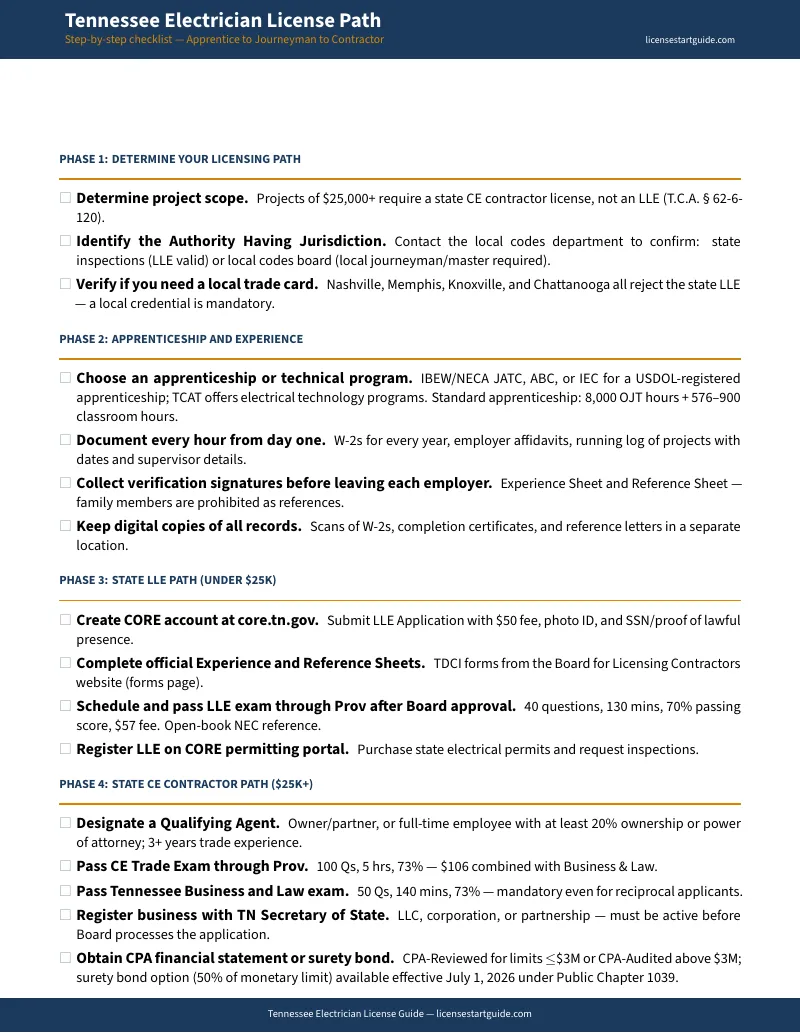
Download includes the complete 15-chapter dual-track roadmap guide (47 pages), a 25-item licensing checklist organized across 6 career phases, and 5 standalone planning worksheets: Experience Tracking Log, Application Cost Calculator, Jurisdictional Requirements Checklist, License Renewal Tracker, and Agency Communication Log. Free tier available — download the checklist alone to see the scope before deciding.