You're About to Spend $15,000 on Trade School — or Wait 2 Years for an Apprenticeship. Which One Actually Gets You Licensed?
You've been researching for weeks. Every trade school website says you'll be "job-ready in 9 months." Every union hall says their apprenticeship is the gold standard. And every Reddit thread gives you a different answer.
Meanwhile, the clock is ticking. Every month you spend deciding is a month you're not earning trade wages, not logging hours, not moving toward your license.
The problem isn't a lack of information. It's that the information you're getting comes from people who want your tuition check or your union dues. Nobody's showing you the actual math — how much you'll earn, how much you'll owe, and how many hours your state licensing board actually requires before you can sit for the exam.
The Licensing Path Comparison System
This guide doesn't tell you which pathway to choose. It gives you the exact data, tools, and state-specific rules you need to figure it out yourself — and avoid the mistakes that cost people years of lost hours and thousands in unnecessary tuition.
Most "trade school vs apprenticeship" content online is either written by schools trying to recruit you or unions promoting their programs. This guide has no enrollment link and no sponsor affiliation. It's a neutral comparison framework built on state licensing board rules, DOL apprenticeship data, and real wage progression schedules.
What's Inside
- The Opportunity Cost Calculator — because "free apprenticeship" vs. "$15,000 tuition" is only half the picture. The real gap is the four-year net-worth difference when you factor in wages earned during training, debt service, and the time-value of starting your earning clock a year earlier. This calculator lets you plug in your actual tuition quotes, local apprentice wages, and commute costs to see the full picture.
- State-by-State Licensing Credit Breakdown — covering California, Texas, Florida, Colorado, Illinois, and New York City. For each state: exactly how many classroom hours trade school satisfies, how many field hours you still need, what exam fees cost, and whether your state even accepts trade school credit toward the experience requirement. No more guessing whether a $12,000 diploma actually shortens your timeline.
- The Hour-Audit Worksheet — the single most expensive mistake in the trades is working as an unregistered helper while assuming your hours count. In Texas, plumbing hours logged before registering with the TSBPE are legally void. In California, electrical work without an active Trainee card doesn't count. This worksheet walks you through verifying your registration status before you lose years of credit to a paperwork gap.
- The Parallel-Track Waitlist Strategy — union JATC waitlists run 12 to 36 months in major metros. Instead of waiting frozen, this section shows you how to register as a non-union apprentice or trainee and start logging certified hours with an open-shop contractor. Those hours typically transfer when your union slot opens — so you arrive with a head start instead of starting from zero.
- The Program Verification Checklist — a step-by-step audit for confirming that a trade school's curriculum is actually approved by your state licensing board before you pay tuition. Includes the specific databases to check, the questions to ask admissions, and the red flags that signal a program won't help you toward licensure.
- Hour Documentation Log — a weekly tracking sheet for logging daily hours, task domains, job sites, and supervisor verification, formatted to match what state licensing boards actually require. Because the board doesn't care how many hours you worked — they care how many hours you can prove you worked, with proper signatures and running totals.
- The Decision Worksheet — after reading the state-specific data and running the financial calculator, this worksheet consolidates everything into a structured side-by-side comparison tailored to your specific trade, state, financial situation, and timeline. It's the final tool that turns research into a decision.
Who This Is For
- High school graduates weighing a recruiter's trade school pitch against the apprenticeship route — and wanting honest numbers before signing an enrollment agreement
- Career changers leaving retail, food service, or logistics who need to know which pathway starts paying fastest and leads to licensure without hidden years of unpaid waiting
- Veterans with GI Bill benefits who need to verify which programs qualify for VA funding and which state boards accept military OJT hours as licensing credit
- Trade helpers already on job sites who need to audit whether their employer actually registered them — before discovering their hours don't count when they apply for the exam
- Parents trying to verify a vocational school's job-placement claims against what state licensing boards actually require for licensure
Why Free Guides Don't Solve This
The free information you find online falls into three categories, and all three have the same structural problem.
Trade school blogs (UTI, InterCoast, NCS Trades) emphasize financial aid availability and short program lengths. What they don't explain is that completing their program doesn't replace the multi-year field-hour requirements your state board enforces. You can graduate in 9 months and still need 8,000 more hours before you can sit for the exam.
Software company blogs (ServiceTitan, Housecall Pro) provide accurate state licensing overviews — but their goal is selling you $200/month field service software, not helping you decide between training pathways. They don't include financial modeling tools or hour-audit worksheets because that's not their business.
Reddit threads and forums give you anecdotal advice from people in one specific trade, in one specific state, in one specific year. Useful for vibes. Dangerous for decisions that involve $15,000 in tuition or four years of your career.
This guide doesn't exist to replace any of those resources. It exists because none of them give you the tools to compare your specific options using your state's actual licensing rules, your real financial numbers, and your documented field hours.
100% Satisfaction Guarantee
If the guide doesn't give you a clearer picture of which pathway fits your situation, email [email protected] for a full refund. No time limit, no questions.
Two Ways to Start
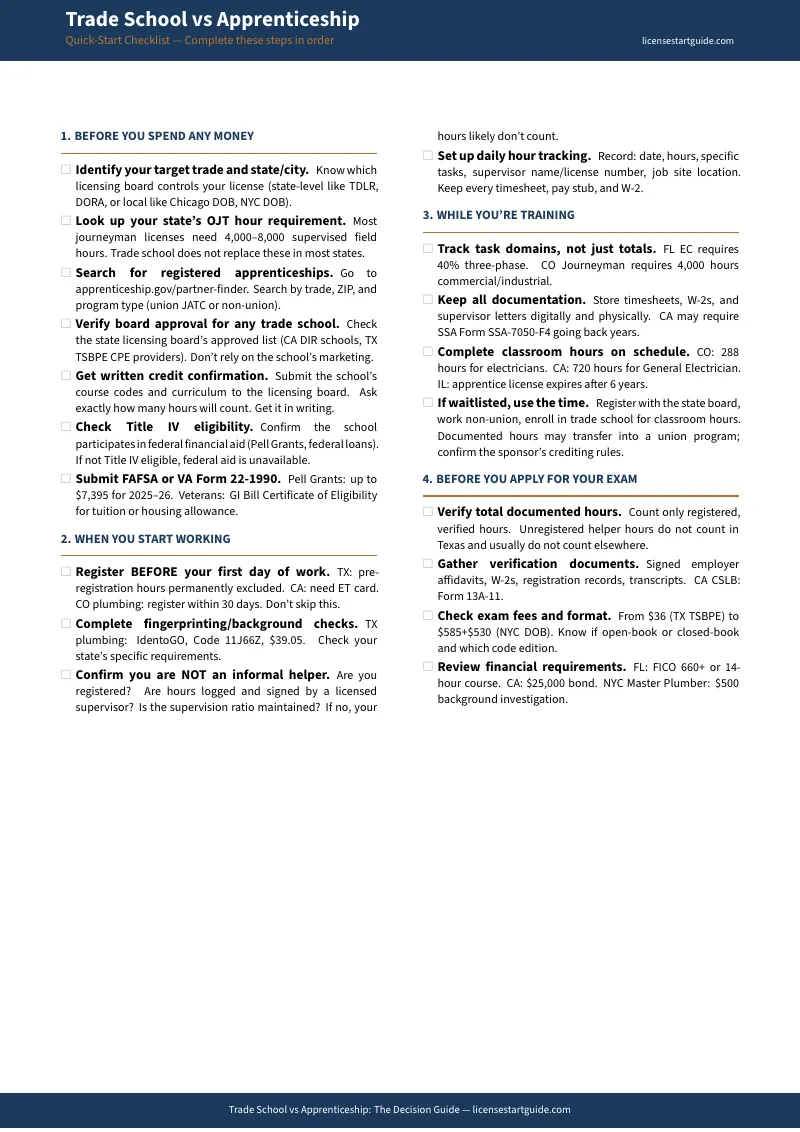
The free quick-start checklist gives you a one-page diagnostic to verify whether your current field hours are being properly documented — the single highest-stakes question for anyone already working in a trade.
The full Decision Guide gives you everything above: the financial calculator, state-by-state licensing breakdowns, hour-audit worksheets, waitlist strategies, program verification tools, and the decision worksheet that pulls it all together. One purchase, lifetime access, no subscription.