Six Agencies. One Missed Board Meeting Burns Two Months.
You've got the field skills. You can size ductwork, run refrigerant lines, and troubleshoot a failed compressor without breaking a sweat. But none of that matters to the Board of Plumbing and HVACR Examiners until you've threaded your paperwork through six separate regulatory bodies — the EPA, the Division of Professional Regulation, the Division of Revenue, the Department of Labor, and whichever county and municipal offices cover the areas where you want to work.
Get the order wrong and the consequences are expensive. Start your DELPROS portal application before gathering all your third-party employment verifications, and the system auto-deletes your file after six months — along with the non-refundable $173 fee. Register your business and bind a liability policy before the Board approves you to sit for the ProV exam, and you spend months paying premiums on an entity that cannot legally contract for a single job. The Board meets once a month, on the second Tuesday. A missing supervisor signature on your Verification of Employment form defers your application to the next cycle — four to eight weeks of dead time while you wait.
Free checklists from software companies and test-prep providers cover pieces of this — but none of them map the full sequence across all six agencies, and most stop at the trade license without touching business registration, contractor registration, or county permitting.
The Six-Layer Compliance Map
This guide maps every step of Delaware's HVAC licensing process in the order you should actually execute them — experience verification first, EPA card second, DELPROS application third, exams fourth, business formation fifth, county permits last. Each chapter tells you what to file, where to file it, what it costs, and what must be complete before you move on.
The result: you never pay a non-refundable fee before the gate that precedes it is locked in, and you never show up at a Board meeting without the documents they actually need.
What's Inside
- Regulatory architecture map — how the Division of Professional Regulation, the Board of Plumbing and HVACR Examiners, the Division of Revenue, the Department of Labor, and county permitting offices divide jurisdiction over a single HVAC business, and why confusing them delays your launch
- Two qualification pathways decoded — the apprenticeship-completer route (four-year program plus two years under a Master) vs. the experience-only bypass route (seven years under a Master), with the specific documentation each requires and what to do when a former supervisor has retired or refuses to sign
- The DELPROS six-month timeout explained — how the countdown works, which third-party documents most frequently cause delays, how to prepare everything before starting your application, and how to track progress on the e-License dashboard so the portal never deletes your work
- Board review cycle and meeting schedule — applications are reviewed on the second Tuesday of each month; one deficiency defers you to the next meeting. This chapter shows how to avoid the common errors that trigger deferrals
- Bypass exam logistics — Associated Builders and Contractors (ABC) Delaware administers the exams at New Castle County VoTech, PolyTech High School, and Sussex Tech; the March 2025 regulatory update means restricted-license candidates only take the section for their specialty
- ProV Master HVACR exam walkthrough — registration, the open-book four-hour format, 100-question structure, passing threshold, and the three-attempt rule that triggers a mandatory one-year lockout
- Unrestricted vs. restricted license categories — scope differences across all six restricted specialties, when upgrading from restricted to unrestricted makes business sense, and the legal consequences of working outside your license scope
- Reciprocity tiers — Connecticut and Maryland get streamlined processing; all other states require seven years of documented master-level practice, and states without centralized licensing make that documentation especially difficult
- Division of Revenue business registration — the $75 annual business license, gross receipts tax obligations, and the Delaware One Stop portal
- Department of Labor contractor registration — the Contractor Registration Act (19 Del. C. Chapter 36), OSHA safety plan requirements, workers' comp and unemployment insurance, fee tiers ($200–$500), and civil penalties up to $85,000
- County and municipal permits — New Castle County's Permit Endorsed License ($410 plus a $25,000 Statutory Compliance Bond), Wilmington's flat mechanical permits, Newark's valuation-based fees, and how to figure out which layers apply to a given job site
- Continuing education and renewal — the new 5-hour biennial CE requirement, the DELPROS CE Tracker, the 5% random audit for timely renewals vs. 100% for late renewals, and reinstatement
- Complete cost reference table — every fee in one place, sequenced by the order you actually pay it
- Official contacts directory — direct links, phone numbers, and mailing addresses for every agency you'll interact with
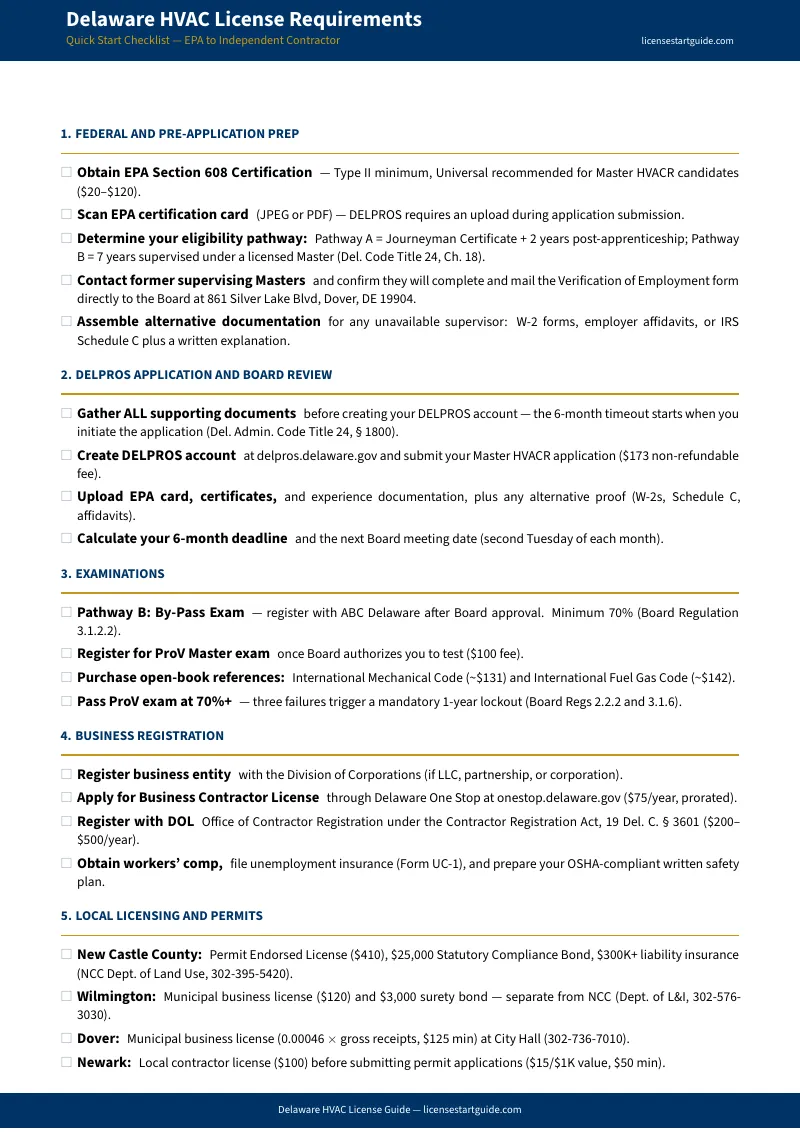
- 25-item quick-start checklist — printable action list covering every step from EPA certification through your first permitted job
- Application document tracker — fillable worksheet listing every document the Board requires, organized by pathway, with spaces for dates and status so you know you're ready before starting the DELPROS clock
- DELPROS timeline planner — map your milestones against the six-month deletion deadline and the next Board meeting dates
- Licensing cost calculator — every fee across all six agencies in one worksheet, with space to total your first-year startup costs by service area
- County and municipal compliance checklist — track your local registrations across New Castle County, Wilmington, Newark, Dover, Kent, and Sussex
- CE and renewal tracker — log your 5-hour continuing education requirement by category and track all annual renewal deadlines
Who This Is For
- Post-apprenticeship journeypersons going independent — you've completed a four-year apprenticeship and logged two years under a licensed Master. The guide sequences the DELPROS application, Board review, ProV exam, business registration, and county permitting so you don't waste money on steps you're not ready for.
- Bypass-route candidates — you have seven or more years of supervised experience but no formal apprenticeship certificate. Your pathway runs through the Board, ABC Delaware, ProV, and then business setup — the guide maps the handoff between each authority so nothing falls through the cracks.
- Out-of-state contractors expanding into Delaware — you hold an active HVAC credential from another state and assume it transfers. Unless you're coming from Connecticut or Maryland, it doesn't. The guide explains the reciprocity tiers and how to assemble your documentation when your home state doesn't centralize licensing records.
- Licensed technicians launching a contracting business — you already hold the Master HVACR license and now need to set up the business side. The guide separates the business-formation steps from the licensing steps so you don't confuse one agency's requirements with another's.
Why Free Resources Get the Order Wrong
Test-prep companies like RocketCert and AtHomePrep focus entirely on exam content — they don't cover business registration, DOL contractor filings, or county permitting. AtHomePrep still incorrectly states that Delaware does not require continuing education for HVACR renewals, missing the new 2025–2026 regulations entirely. Enterprise software companies like ServiceTitan and Housecall Pro provide high-level overviews designed to funnel you into their platform, not to walk you through the DELPROS portal or explain the six-month timeout. The state portal itself is purely transactional — it does not provide a sequential roadmap that integrates other required registrations.
None of them map the full sequence across all six layers. None of them explain how the Board's monthly meeting schedule interacts with the portal's countdown timer, or that bypass-route candidates face a multi-step handoff between three separate organizations, or how county bonding requirements vary between New Castle County, Wilmington, and Newark.
This guide covers every agency, in the order that protects your capital.
Satisfaction Guarantee
If the guide doesn't give you a clear, step-by-step path through Delaware's licensing process, email us and we'll make it right. No hoops, no time limit.
Get Started
Download the free checklist to see the 25 steps at a glance — then grab the full guide for the chapter-by-chapter walkthrough, cost tables, and the compliance map that keeps you from paying for steps you're not ready for.