
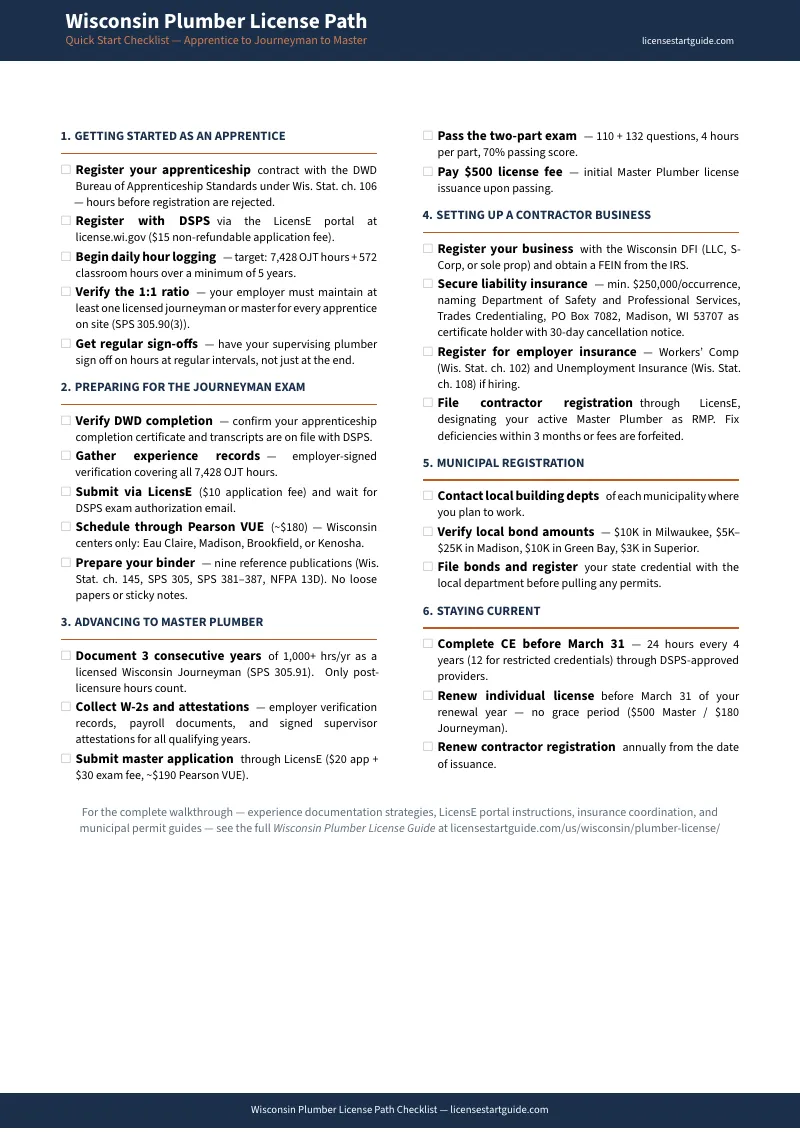
The whole licensing path is documented. It's just scattered across four agencies.
Wisconsin's plumbing career ladder looks simple: apprentice, journeyman, master. But the administrative machinery behind each step is buried across DSPS license applications, DWD apprenticeship contracts, Department of Financial Institutions business filings, and municipal building inspection departments that each enforce their own bond and permit rules. Miss one piece — an unsigned employer affidavit, a missing insurance certificate, a municipal bond you didn't know existed — and you forfeit non-refundable fees, sit in a three-month review queue, and lose contracting revenue on projects you can't start.
The Wisconsin Plumber License Guide is a Regulatory Navigation System — a single-document roadmap that sequences every filing, fee, and coordination step from your first day as an apprentice through contractor registration, so you submit each application correctly the first time.
What's inside the guide
Apprenticeship Registration and Hour Documentation
Your DWD apprenticeship contract must be registered before you start logging hours — every hour worked before that registration is rejected by DSPS. The guide walks through the full enrollment sequence, the 8,000-hour OJT requirement, the 576-hour classroom minimum, and a documentation strategy that protects your hours when employers change, close, or refuse to sign affidavits. Covers the W-2 and pay-stub alternatives when a former employer is unavailable.
Journeyman Exam Logistics
The journeyman exam is a two-part, six-hour test through Pearson VUE — 87 questions in part one, 120 in part two, with 70% required on each section independently. The guide details the application fee structure, retake waiting periods, and the three-month deadline after passing within which you must apply for your license or lose your exam results entirely.
Master Plumber Qualification
Three consecutive years of at least 1,000 documented hours as a licensed journeyman, then an eight-hour master exam with 242 questions across two four-hour sections. The guide covers both the standard experience pathway and the engineering-degree alternative under SPS 305.91(3)(b), with the documentation strategy that prevents the rejection that sends you back to the end of the review queue.
The Permit Gap — Why Your Journeyman License Isn't Enough
A journeyman plumber in Wisconsin cannot contract for work, bid on projects, or pull permits. Doing any of those carries administrative forfeitures up to $2,000 per incident. The guide explains exactly what you can and cannot do at each license level, the legal boundary between individual credentials and business authority, and the precise steps required to bridge that gap.
Contractor Registration and the RMP Designation
Launching a plumbing business requires a Plumbing Contractor Registration linked to a designated Responsible Master Plumber. The guide maps the complete sequence: entity formation with DFI, the RMP designation requirements, proof of financial responsibility, the insurance-coordination timing trap that costs contractors months of premium payments while their application sits in queue, and the vulnerability that suspends your contracting authority if your RMP leaves the company.
Municipal Permits and Bonds — City by City
State licensing proves competency. Municipal registration proves you can work in a specific city. Milwaukee requires a $10,000 performance bond and charges triple fees for unpermitted work. Madison routes permits through the ELAM/Accela portal and requires staff verification of your DSPS license before your account activates. Green Bay doubles the permit fee if work starts before the permit is issued. Appleton charges a $35 callback fee for failed inspections. The guide covers each city's requirements and a framework for handling the smaller villages that maintain their own annual registration cycles.
Restricted and Specialized Credentials
Wisconsin issues restricted-scope licenses for septic, POWTS, water softeners, water heaters, cross-connection testing, and utility pipelaying. Each has its own experience thresholds, educational requirements, and exam format. The guide covers the full restricted credential matrix, including the 100-hour coursework requirement for restricted service applicants and the one-to-one learner-to-licensed-plumber supervision ratio.
Renewal and Continuing Education
All credentials renew quadrennially on March 31 — miss it and you face escalating late penalties on top of the base fee. The guide covers the 24-hour CE requirement, the reduced 12-hour requirement for restricted credentials, approved provider guidance, and the reinstatement process for lapsed licenses.
Worksheets and Planning Tools
Pre-formatted trackers for experience hours, application filing timelines, insurance policy coordination, and municipal registration checklists. Fill them out as you progress through each stage — they're designed to be the documentation package DSPS and your municipality need, organized the way they need it.
Who this guide is for
- Apprentices starting their DWD-indentured program and structuring hour logs from day one
- Journeymen preparing for the exam or documenting experience from multiple employers
- Out-of-state plumbers transferring credentials into Wisconsin's DSPS system
- New master plumbers navigating contractor registration, the RMP designation, and municipal bonds
- Restricted-credential holders advancing through the restricted service or restricted appliance pathway
Why not just use the government websites?
The DSPS LicensE portal publishes applications and fee schedules. The DWD Bureau of Apprenticeship Standards handles indenture contracts. The Department of Financial Institutions handles business entity formation. Each city's building inspection department handles its own permits and bonds. None of these systems explains how the others work, warns about common filing errors, or provides a start-to-finish sequence for getting from apprentice to operating contractor.
Exam-prep companies like RocketCert and Plumbers Training Institute sell code study courses from $45 to $300 — but they cover test preparation only, not the administrative pathway that causes the most expensive delays.
Private licensing consultants charge $500 to $1,500 per filing.
This guide compiles instructions from all relevant state and municipal agencies into a single roadmap for a fraction of one filing fee. One rejected application costs more in forfeited fees and lost contracting revenue than this guide costs once.
Satisfaction guarantee
If the guide doesn't give you a clearer path to your next credential, email [email protected] and we'll make it right.
Get started now
Download the Wisconsin Plumber License Guide — — and stop forfeiting fees to incomplete applications.
Already have the free checklist? Get the full guide for the complete roadmap with worksheets, municipal bond details, and step-by-step filing instructions.