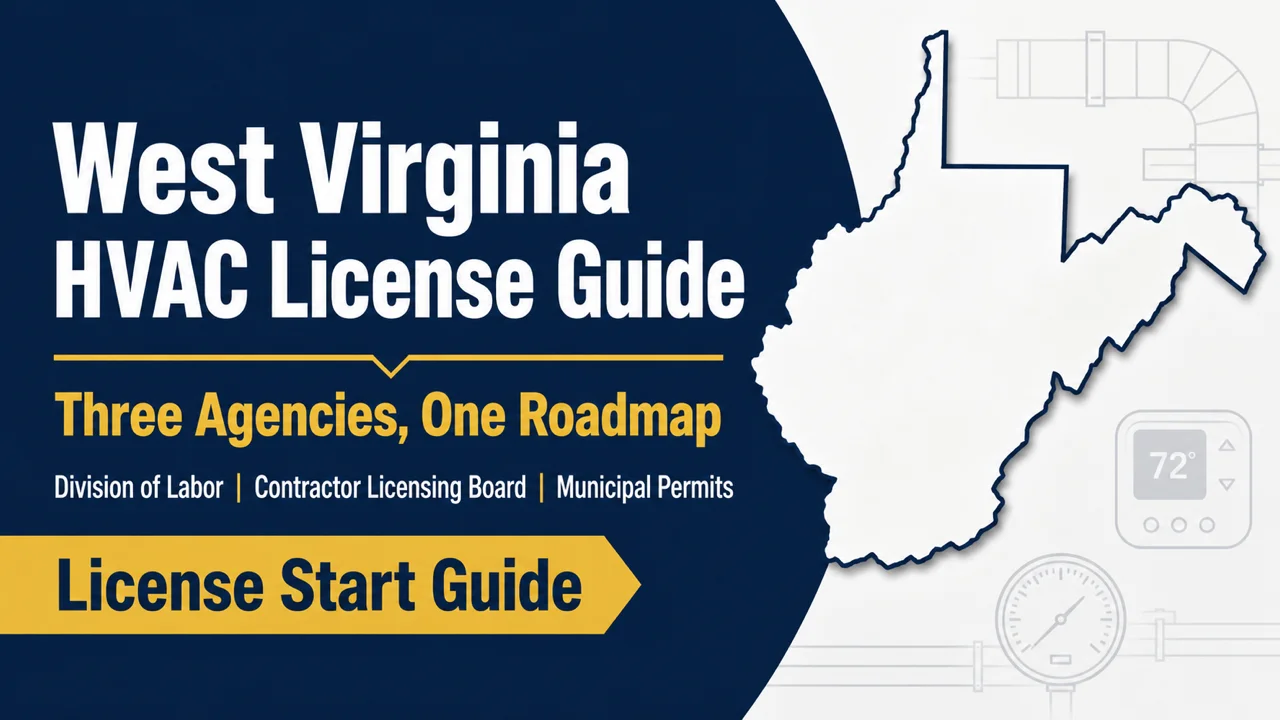
Three Agencies. Zero Coordination. Every Credential on Your Shoulders.
You know how to size ductwork, charge a system, and troubleshoot a compressor. But the day you try to work independently in West Virginia, you discover that your technical skills are governed by three separate agencies — the Division of Labor, the Contractor Licensing Board, and whichever municipal building department controls the zip code where the job is — and none of them will tell you how the other two work.
The Division of Labor issues your individual technician certification. The Contractor Licensing Board issues your business license. The city issues your mechanical permit. Each one has its own application portal, fee schedule, and approval timeline. Miss any single layer, and you're exposed: fines starting at $200, escalating to misdemeanor charges with jail time by the third offense, and federal EPA penalties up to $44,539 per day on top of it all.
The worst part is that most technicians don't find out about these gaps at a desk — they find out at a job site, when a municipal inspector shuts them down or a distributor refuses a wholesale equipment sale because the right combination of credentials isn't in place.
The Three-Agency Licensing Map
The West Virginia HVAC License Guide is a plain-English process manual that translates three separate regulatory systems into a single chronological sequence you can follow from apprentice registration through your first permitted job. It covers every credential tier, every exam, every fee, and every municipal boundary — with the sequencing logic that no single state website, exam prep vendor, or bond broker provides.
This is not exam prep. There are no test questions, no practice exams, no study drills. This is the logistical layer — the part that tells you which steps cost nothing, which steps require other steps to be complete first, and which steps will waste your money if you do them out of order.
What You Get
- Complete 13-Chapter Licensing Guide — Covers West Virginia's three-agency regulatory framework, all three technician certification tiers (HVAC Technician, Residential Technician, Technician-in-Training), the ProV examination system that replaced PSI in September 2024, EPA Section 608 certification, contractor business licensing with monetary thresholds, business formation steps, insurance and wage bonding requirements, municipal permitting in Charleston, Huntington, Morgantown, and Parkersburg, out-of-state universal recognition under the 2025 RECAP Act, cross-trade boundaries, renewal procedures, and a complete contacts directory.
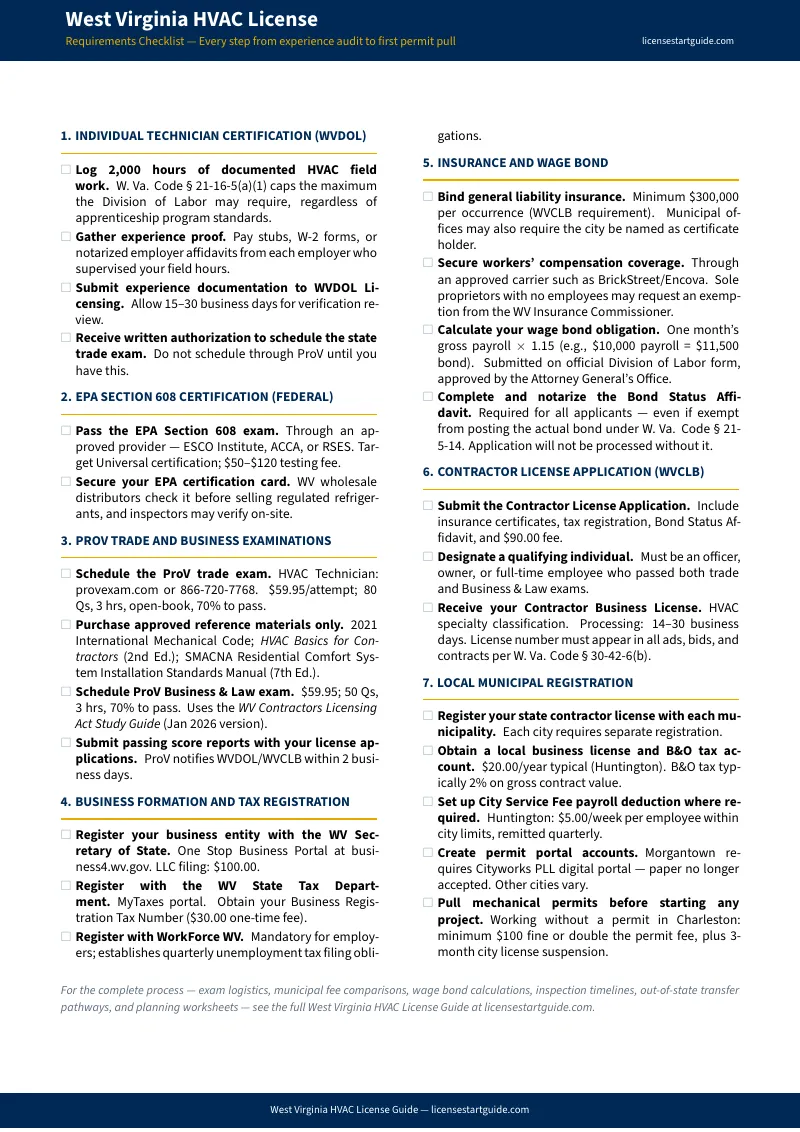
- Quick-Start Verification Checklist — 25 actionable items across 7 sections that track your progress from initial credential assessment through your first permitted project. Check each item as you complete it to ensure nothing slips through the cracks between agencies.
- Planning Worksheets — The Licensing Milestone Tracker, Exam Preparation Planner, Insurance and Bonding Checklist, Municipal Registration Log, and Agency Communication Log — ready to fill in so you have a documented paper trail for every step.
Who This Guide Is Built For
- Technicians going independent — You have the field hours and the EPA card. You need to understand the contractor licensing threshold ($5,000 residential, $25,000 commercial), the insurance minimums, the wage bond calculation, and the business formation sequence that gets your entity registered without paying fees before your paperwork is ready.
- Permit-blocked technicians — The municipal building department just told you that your state technician certification isn't enough to pull a local mechanical permit. You need the local business license, the B&O tax account, and the city registration — and you need to know exactly which ones apply in your city before the project deadline hits.
- EPA card holders who assumed they were covered — The EPA Section 608 certification governs refrigerant handling. It does not authorize physical HVAC installations, replacements, or alterations in West Virginia. Under state law, that requires a separate technician certification from the Division of Labor — and the guide explains how to get it without wasting time on steps that don't apply to your situation.
- Out-of-state contractors relocating from neighboring states — The 2025 RECAP Act can waive your trade exam, but it doesn't waive business registration, workers' compensation enrollment, insurance requirements, or local tax setups. The guide maps every administrative step that universal recognition does not cover.
- Apprentices and trade school graduates — You need to understand the Technician-in-Training pathway, the supervision ratios (4:1 residential, 2:1 commercial), and the documentation requirements for advancing to higher tiers — before a state inspector shows up on your job site.
Why Not Just Use the Free State Websites?
The Division of Labor website publishes technician certification rules. The Contractor Licensing Board website publishes contractor licensing rules. Each municipal building department publishes its own permit procedures. All of them are authoritative — and all of them are siloed.
The Division of Labor does not explain how its technician certifications relate to the Contractor Licensing Board's business licenses. The Contractor Licensing Board does not explain how its licenses relate to municipal permits. No single state resource connects the three regulatory layers into a sequence, shows which steps must be completed before others, or warns you about the process traps that cost applicants forfeited fees and weeks of delays.
The guide fills that gap. It takes what's scattered across three agencies and dozens of municipal offices and assembles it into one chronological roadmap — with the sequencing corrections and documentation protocols that no individual agency provides.
Why Not Rely on Exam Prep Companies?
AtHomePrep charges $297 for exam preparation materials. RocketCert charges $299 to $589 for study bundles with reference books. Both are legitimate exam prep tools — but neither addresses what happens after you pass: business registration with the Secretary of State, State Tax Department registration, workers' compensation enrollment, the wage bond requirement, general liability insurance minimums, or the city-by-city municipal permitting process.
An exam prep course teaches you how to answer test questions. This guide teaches you how to navigate the administrative system that surrounds the exam — so you don't spend hundreds of dollars on study materials before you've even confirmed that your work experience qualifies you to sit for the test.
Satisfaction Guarantee
Review the licensing sequence and the municipal permitting roadmaps. If the plain-English instructions don't clarify the exact steps needed to navigate West Virginia's HVAC credentialing process — or if you decide to hire a licensing consultant for personalized guidance instead — email us at any time for an immediate, full refund.
The free checklist is yours to keep either way. It gives you every credential step on a single page — download it now to start your self-audit, then decide whether the full guide is worth the investment.
Get the Toolkit and start working through the three-agency sequence tonight — or download the free checklist to see the full credential map before you decide.
Important notice: License Start Guide is a publisher of educational resources. This guide assists individuals in understanding West Virginia's HVAC licensing procedures and navigating the application process. It does not provide personalized legal, business, or licensure advice, does not act as an exam preparation program, and does not establish any professional advisory relationship. For complex credential denials or board hearing situations, consultation with a licensed attorney is recommended.