
You passed the test. DOPL rejected your application anyway.
You logged your hours, completed your program, and passed both the written and practical exams. Then your application came back — pending, not approved. Your school hadn't transmitted preapproval to Prov before you registered. Or your experience verification form went to DOPL instead of being uploaded to Prov during exam registration. Or your employer signed the hours sheet but used an expired license number. Each mistake costs you weeks, sometimes months, while your wages stay locked at the apprentice rate.
Utah's licensing system runs through four separate regulatory layers — state statute, DOPL administrative rules, agency portal procedures, and Prov's testing requirements — and the rules changed twice in early 2026 alone. Most online guides still describe the old process. The state's own website provides the regulations, but it does not provide a roadmap.
The Administrative Roadmap System
The Utah Electrician License Guide translates dense state statutes, administrative rules, and vendor procedures into one sequential walkthrough — from initial apprentice registration through contractor business launch. It doesn't teach the National Electrical Code. It doesn't prepare you for trade exams. It maps every administrative step in the order DOPL, Prov, and local building departments actually process them, so your documentation is right the first time and your application doesn't come back.
Each chapter targets the specific administrative failure point that catches people at that career stage. The apprentice chapter prevents undocumented supervision ratios. The hour-logging chapter explains the 3,000-hour annual cap before you discover it on a rejected form. The exam chapter walks through the 2026 school preapproval and experience upload requirements. The contractor chapter separates personal Master credentials from E200/E201 business licenses before you take side jobs that violate the Construction Trades Licensing Act.
What You Get
- Five-Tier License Map — how Apprentice, Residential Journeyman, Journeyman, Residential Master, and Master credentials build on each other, and the critical boundary between individual trade licenses and E200/E201 contractor licenses that catches Master Electricians who start contracting without the right credential
- Apprentice Registration and Tracking Fee Breakdown — the MyLicenseOne application, the Verification of Supervision form, approved Wasatch Front programs, the $0.24/hour AT-01 tracking fee that accumulates to $1,920 over 8,000 hours, and how union vs. merit-shop programs handle employment and fee structures differently
- Supervision Ratio Compliance — the 1:2 nonresidential and 1:3 residential ratios, the fourth-year independent work exemption, and exactly what happens to your logged hours when a jobsite audit finds a ratio violation
- Annual Hour Cap Strategy — the 3,000-hour annual credit ceiling under R156-55b-302a(8), worked timeline calculations from Apprentice to Journeyman, and why the minimum calendar path is longer than most candidates expect
- 2026 Exam Registration Walkthrough — the school preapproval requirement (January 1, 2026), the experience verification upload to Prov (January 19, 2026), written and practical exam formats, allowed references, testing center locations, and online proctoring through Examroom
- Master Advancement Pathways — three education routes (experience at 8,000 Journeyman hours, AAS at 4,000 hours, ABET EE degree at 2,000 hours), the new Master Law and Rules exam format (August 1, 2025), and the practical module waiver for candidates who passed at the Journeyman level
- Out-of-State Endorsement Protocol — why "reciprocity" is a misleading label, the actual Licensure by Endorsement process under R156-55b-305, the one-year active license requirement, and the mandatory Master Law and Rules exam that endorsement candidates cannot skip
- E200/E201 Contractor Launch Sequence — business entity registration, the 25-hour pre-license course, the Business and Law exam, the $226 application fee breakdown, $1M/$2M general liability insurance naming requirements, workers' comp, and the Division of Corporations filing order
- Five fillable planning tools — Apprenticeship Hour Tracker, Employer Verification Signature Log, Exam Registration Checklist, Contractor Launch Checklist, and License Renewal Timeline Planner, each designed to print and write on
- Local Permitting and Business Licensing — why a state contractor license alone does not authorize permit-pulling, municipal registration requirements, home-office zoning compliance, and the limited minor-work exception for mechanical installations
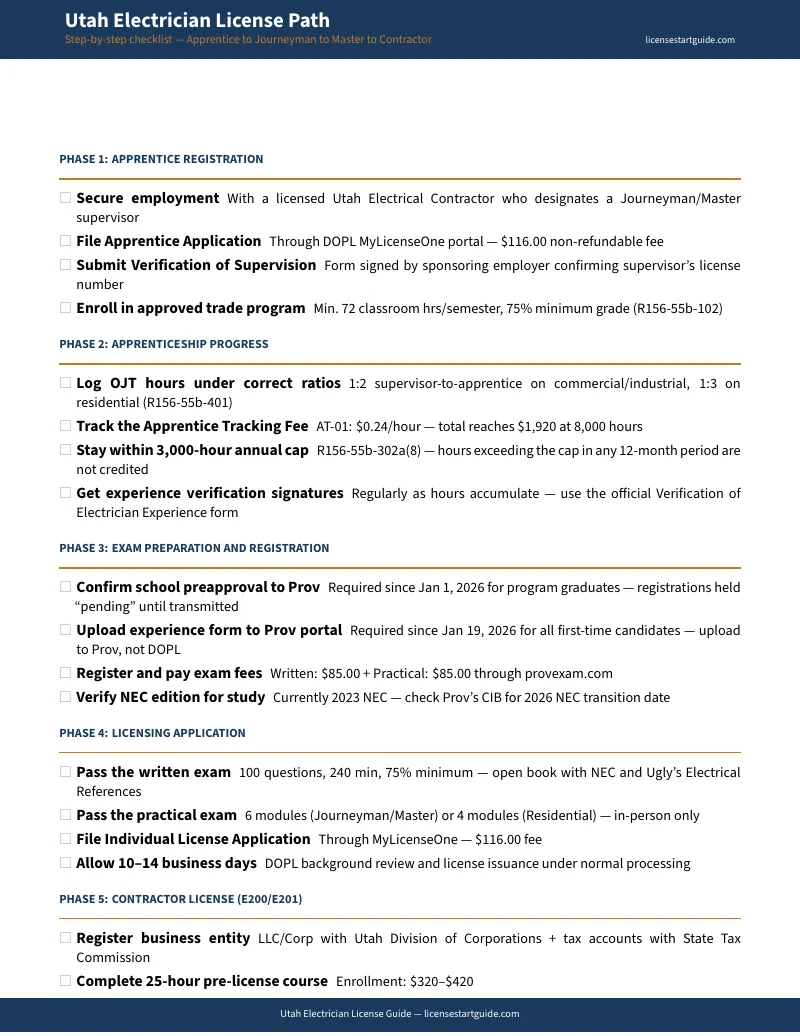
- 25-Item Licensing Checklist — a printable action plan organized across 6 career phases from apprentice registration through biennial renewal, with every milestone, fee, and deadline in sequence
Who It's For
- Apprentices starting their career who need to register correctly with DOPL and understand supervision ratios before their first day on a jobsite
- Apprentices nearing exam eligibility who need to navigate the school preapproval and Prov registration process under the current 2026 rules
- Journeyman electricians advancing to Master who need to understand the three education pathways and the new exam format
- Out-of-state electricians relocating to Utah who have discovered that "reciprocity" does not mean automatic license transfer
- Master Electricians transitioning to independent contracting through the E200/E201 pathway
- Licensed electricians approaching their biennial renewal who need to verify CE compliance and avoid late fees
Why This Guide Instead of Free Resources
Everything in this guide is technically available across the DOPL website, Prov's Candidate Information Bulletins, the Utah Administrative Code, and local building department portals. But DOPL's site doesn't explain how Prov's exam registration process works. Prov's bulletins don't cover state license applications or contractor setup. Neither one warns you about the school preapproval requirement, the annual hour cap, or the supervision ratio audit risk until your application is already delayed.
Exam prep providers like RocketCert and GetLicenseReady focus on NEC code study — nothing about hour documentation, the 2026 procedural changes, contractor insurance requirements, or the endorsement pathway. Field service platforms like ServiceTitan and Housecall Pro publish generic programmatic articles that frequently miss Utah-specific rules.
This guide costs less than a single DOPL application fee and covers the entire pathway from apprentice registration through statewide contractor operations.
Satisfaction Guarantee
If the guide doesn't give you a clear roadmap for your specific licensing stage, reply to the confirmation email and we'll refund the purchase.
Get the Utah Electrician License Guide →
Download includes 7 printable PDFs: the 12-chapter administrative roadmap guide, a 25-item licensing checklist organized across 6 career phases, and five fillable tools (Apprenticeship Hour Tracker, Employer Verification Signature Log, Exam Registration Checklist, Contractor Launch Checklist, License Renewal Timeline Planner). Free tier available — download the checklist alone to see the scope before deciding.