
You logged the hours. One unsigned affidavit could wipe them all out.
You spent two years running pipe under a licensed Master, keeping your head down, learning the trade. But the Plumbers' Examining Board doesn't care how many hours you worked — it cares how many hours you can prove. And in Maine, proof means a notarized Supervisor's Affidavit signed by every Master who supervised you.
If your former employer closed their business, retired to Florida, or just won't return your calls, those hours are in legal limbo. The Board will return your application unprocessed, and you're back to square one while the clock keeps ticking.
That's one of four documentation traps built into Maine's plumbing licensing system — a system split across three regulatory layers that don't talk to each other, where clearing one layer doesn't automatically satisfy the others.
The Three-Layer Navigation System
The Maine Plumber License Guide maps all three layers — state trade credentials, business formation, and municipal permitting — into one sequential roadmap. It doesn't teach you the plumbing code. It teaches you how to document experience so the Board accepts it, file applications in the correct order, and coordinate state-level credentials with the local code enforcement offices that actually control whether you can start work at a specific address.
Every chapter targets the specific administrative failure that catches people at that stage. The experience chapter prevents the unsigned-affidavit trap. The exam chapter prevents the premature-Prov-scheduling mistake. The reciprocity chapter prevents the wasted application that gets returned because your home state doesn't meet Maine's equivalency standard. The business chapter prevents the gap between "I passed the Master exam" and "I can legally pull permits and get paid."
What You Get
- Five License Tiers Decoded — the complete Trainee → Student Trainee → JIT → Journeyman → Master progression, with costs, supervision ratios, and the exact scope boundaries that determine what each license lets you do (and what gets you into trouble)
- Experience Documentation Strategy — how to format the Supervisor's Affidavit correctly, the interval strategy for collecting signatures before employers disappear, and backup documentation options when a former supervisor is unreachable
- Exam Scheduling Sequence — the Board-authorization-first rule, Prov testing centers (Auburn, Bangor, Calais, Portland, Presque Isle), remote proctoring, passing scores (70% Journeyman, 75% Master), and the retake process
- Out-of-State Reciprocity Framework — Maine's case-by-case evaluation under Section 3504-A, the "substantial equivalency" standard, how to determine whether your home state qualifies, and how to package your application to avoid the rejection that costs months
- Business Formation Walkthrough — Secretary of State registration, EIN, Maine Revenue Services tax accounts, Workers' Compensation (mandatory with one employee), general liability insurance ranges, and the Title 10 written-contract requirements for residential projects over $3,000
- Municipal Permitting Case Studies — Portland's CSS portal and Tyler ID requirement, Bangor's inspector-driven scheduling, Lewiston and Auburn's double-fee penalty for unpermitted work, and rural towns like Etna where the plumbing inspector is available four hours per month
- Renewal and Reinstatement — the biennial cycle, the fact that plumbers currently have no CE requirement (unlike electricians), late-renewal penalties ($50 within 90 days, $100 up to 2 years), and the re-exam requirement for lapses over 2 years
Who It's For
- Apprentices and trainees registering their first hours and trying to protect them from documentation failures
- Journeymen calculating their Master exam eligibility and preparing the application package
- Out-of-state licensed plumbers relocating to Maine who need to know whether their credentials transfer
- Newly licensed Master Plumbers ready to start a contracting business and pull their first municipal permits
- Rural contractors navigating towns where the plumbing inspector keeps extremely limited office hours
Why This Guide Instead of Free Resources
Every fact in this guide is technically available across the Plumbers' Examining Board website, the Secretary of State filing portal, Prov's exam scheduling system, and dozens of municipal code enforcement pages. But the Board's website doesn't explain business registration. The Secretary of State doesn't mention trade supervision ratios. Neither tells you about the municipal permitting systems that vary town by town — Portland's mandatory online portal, Auburn's automatic fee-doubling for unpermitted work, Etna's four-hour monthly inspection window.
Exam-prep courses from national providers run $179 to $350 and cover code study only — nothing about experience documentation, reciprocity pathways, business formation, or local permits. Private licensing consultants charge $500 to $2,000 per engagement.
This guide costs less than a single state application fee and covers the entire pathway from first day as a trainee through operating as a licensed, permitted, insured plumbing contractor.
Satisfaction Guarantee
If the guide doesn't give you a clear roadmap for your specific licensing stage, reply to the confirmation email and we'll refund the purchase.
Get the Maine Plumber License Guide →
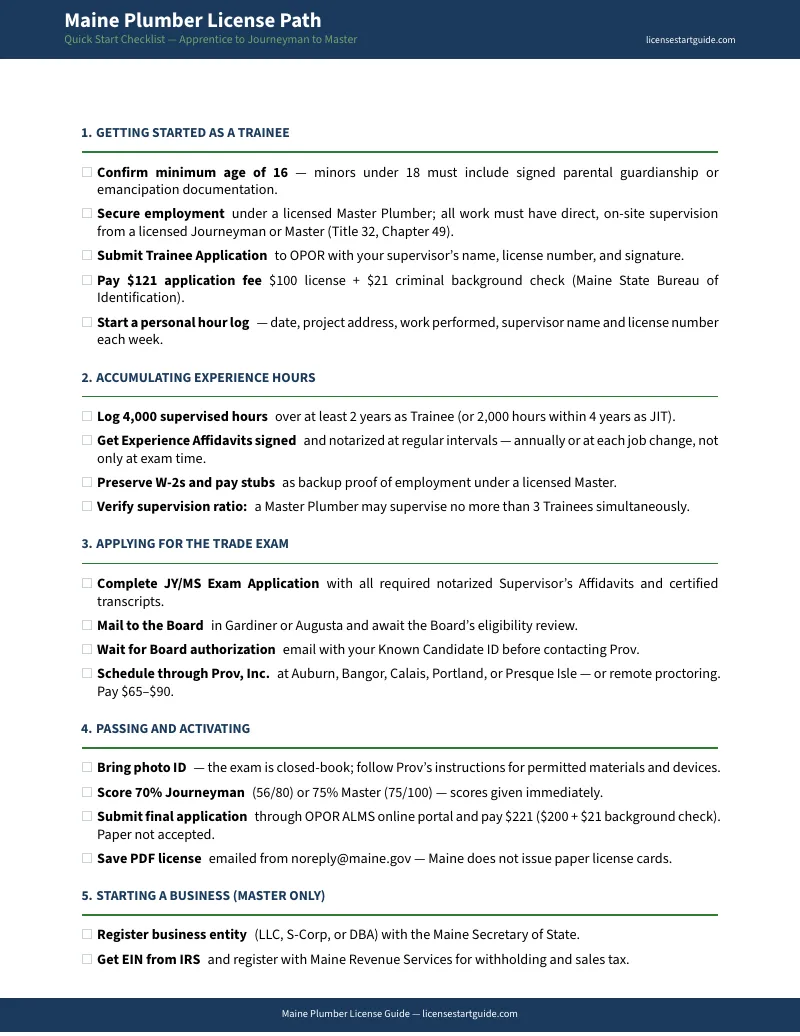
Download includes the complete 14-chapter guide PDF, a printable 25-item career-phase checklist, and six standalone worksheets — an experience hour tracking log, application submission checklist, exam preparation timeline, business formation checklist, municipal permit preparation sheet, and agency communication log. Free tier available — download the checklist alone to see the scope before deciding.