You Know the Trade — But Louisiana's Two-Layer Licensing System Wasn't Built to Be Self-Taught
You've spent years running crews, pulling wire, framing houses, or managing jobsites under someone else's license. You're ready to take projects in your own name. So you search "how to get a Louisiana contractor license" and find the LSLBC portal — a collection of PDF forms, statutory links, and application questions that assumes you already understand the process well enough to navigate it.
Here's what the portal doesn't tell you: the state license is only half of the compliance picture. Louisiana runs a dual-layer system. The LSLBC licenses your trade competency statewide. But every parish and municipality controls its own building permits, zoning clearances, occupational license taxes, and local surety bonds that the state board never mentions. A contractor who walks out of the LSLBC with a fresh license and drives to a New Orleans jobsite will be stopped at the One Stop App portal. A contractor heading to Baton Rouge needs a separate $10,000 local bond and an occupational license tax registration the state never required.
And the information online is dangerously outdated. National surety broker sites still claim Louisiana requires a statewide licensing bond — it doesn't; the statute allows an Irrevocable Letter of Credit instead. Popular licensing guides reference a $75,000 residential threshold that hasn't existed in years. The current statute sets it at $50,000, and the net worth requirement is $50,000 — not the $10,000 figure that older LSLBC PDFs and commercial exam-prep sites still publish. Applying with a financial statement prepared to the wrong number means an automatic rejection and wasted CPA fees.
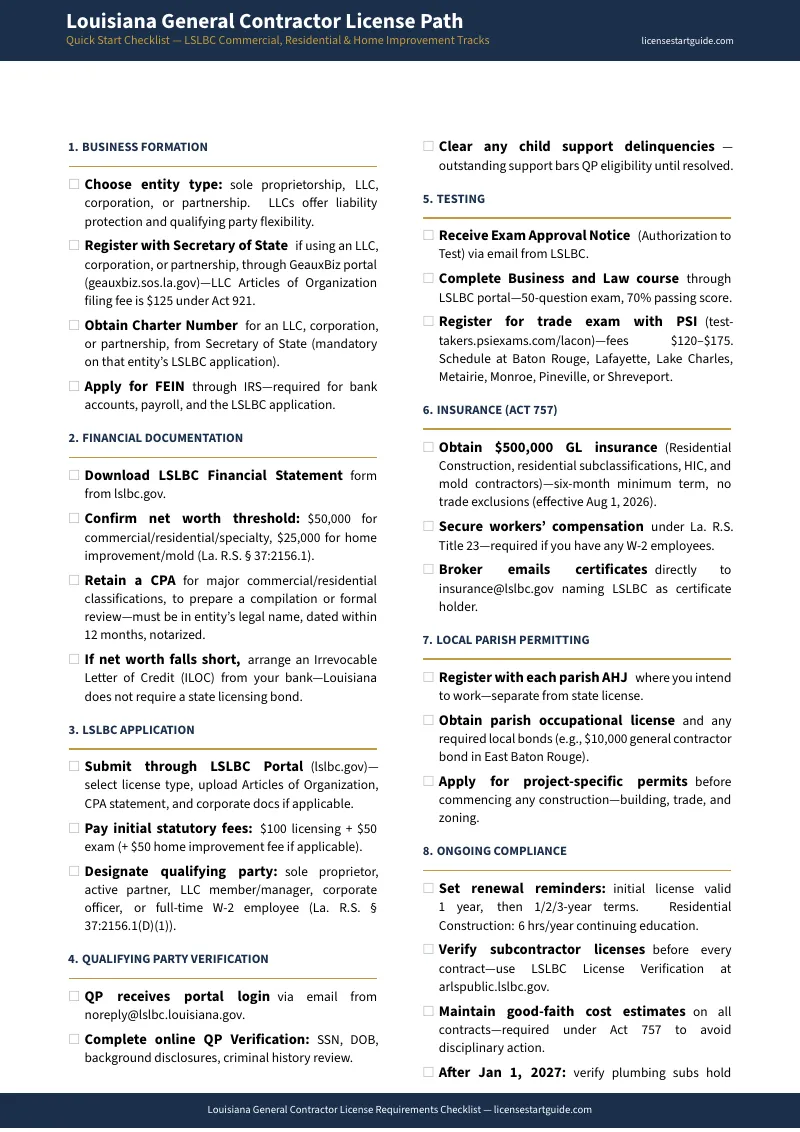
The Louisiana Licensing Sequence Map
This guide connects every agency touchpoint — state and local — into one chronological sequence, so you handle business entity formation, LSLBC application, trade exams, insurance filings, and parish-level permits in the right order without backtracking.
Most contractors piece together compliance information from the LSLBC portal (which doesn't mention parish-level requirements), surety broker sites (which sell bonds the state doesn't require), and exam-prep companies (which charge $299–$875 for test materials without explaining the business setup steps that must come before testing). The Louisiana Licensing Sequence Map gives you a single document that maps the process from geauxBIZ entity registration through your first parish building permit — including the steps that look optional but are actually blocking, like the CPA-prepared balance sheet that must use the current $50,000 net worth figure and the qualifying party affidavit that must be notarized before the board will process your application.
What's Inside
- Entity Formation on geauxBIZ — LLC Articles of Organization ($125 under Act 921), sole proprietor registration, federal EIN, and the Secretary of State charter number that the LSLBC requires before it will accept your application
- The Financial Statement Prep Guide — exactly how the LSLBC calculates net worth on a CPA-prepared balance sheet under R.S. 37:2156.1, the 12-month freshness rule, what counts as an asset, and how to use an Irrevocable Letter of Credit to cover a net worth shortfall so you don't get rejected for a problem that has a statutory solution
- LSLBC Classification Decoder — Major Classifications (Building Construction, Highway/Heavy/Utility), Specialty Classifications (Electrical, Mechanical, Plumbing under Acts 908 and 757), Subclassifications (including the new Residential Roofing tier under Act 422), and Credentials — mapped to the project types and dollar thresholds that trigger each one
- Qualifying Party Blueprint — who qualifies as the QP (sole proprietor, officer, member, manager, or full-time W-2 employee), experience documentation standards, the notarized QP affidavit, and the statutory 60-day replacement timeline that suspends your license if your qualifier leaves and you don't act
- Trade Exam and Business & Law Course Walkthrough — the mandatory online Business & Law course in the LSLBC portal (must be completed before you can schedule the trade exam), PSI Services scheduling, the $75 out-of-Baton-Rouge convenience fee, and what reference materials PSI allows in the testing room
- Act 422 Roofing Compliance Pathway — the $7,500 residential threshold, criminal misdemeanor penalties for unlicensed roofing (imprisonment and daily fines), the Residential Roofing trade exam, and how Act 422 interacts with local parish re-roofing permit rules
- Insurance and Bonding Clarity — the new $500,000 general liability minimum under Act 757 (effective August 1, 2026) plus workers' comp filing requirements for residential, HIC, and mold licenses; the fact that the LSLBC does not require a state-level licensing bond despite what national surety sites sell; and the parish-level bonds that local jurisdictions do require
- New Orleans Parish Playbook — One Stop App registration, municipal trade classifications (Class A Mechanical/Electrical), the $50 temporary occupational license plus $190 home-based Certificate of Occupancy, zoning clearance requirements, and the local re-roofing permit trigger (50% or more of the roof covering replaced)
- Baton Rouge Parish Playbook — occupational license tax start-up fees ($50 Jan–Jun, $25 Jul–Dec), the $10,000 local general contractor bond, DPW Inspection Division plan review fees (65% of the base permit fee), and zoning clearance through the Finance Department Revenue Division
- Reciprocity Directory — which states have agreements (Alabama, Arkansas, Georgia, Mississippi, North Carolina, South Carolina, Tennessee, and Texas), what reciprocity actually waives (trade exam only), and every requirement that still applies (Business & Law course, financial statement, insurance, application fees)
- Six Printable Planning Tools — the Application Document Assembly Worksheet for inventorying every required document before you file, the Financial Statement Preparation Worksheet for organizing assets and liabilities before your CPA appointment, the Exam Preparation Tracker from ATT through exam day, the Agency Communication Log for tracking every call and submission across state and parish offices, the Subcontractor Verification Checklist for confirming each sub's license and insurance, and the Parish Permit Tracker for local registration and bonding status in every parish you work
Who This Is For
- Experienced subcontractors going independent — framers, lead carpenters, masonry crews, and project managers who know construction but have never navigated the LSLBC application, CPA financial statement, or qualifying party requirements on their own
- Roofing operators under Act 422 pressure — residential roofers who operated without a state license or under a Home Improvement registration before January 2026 and now face criminal penalties on any job over $7,500
- Out-of-state contractors entering Louisiana — crews from reciprocity states (including Texas) who need to understand what Louisiana requires beyond their home-state license
- Qualifying parties transferring credentials — QPs leaving one firm and registering with a new entity who need to navigate the 60-day replacement window and re-file the affidavit
Why Not Free Online Resources?
The LSLBC portal provides the blank application forms and statutory references — but it does not explain how to structure your business, prepare your financial statement, or sequence the process so you're not paying a CPA to prepare a balance sheet against the wrong net worth figure. It does not mention parish-level occupational license taxes, local bonds, or zoning clearances at all.
National surety broker sites target Louisiana search terms to sell bonds — but many of them incorrectly claim the LSLBC requires a statewide licensing bond, when the statute actually mandates an Irrevocable Letter of Credit for net worth shortfalls. Their content is accurate about the product they're selling, not about the licensing process as a whole.
Commercial exam-prep companies charge $299–$875 for test materials and study courses — without explaining the entity formation, financial statement preparation, and qualifying party documentation that must be completed before you're even eligible to schedule an exam. A contractor who buys a $500 exam prep kit before confirming their net worth meets the current $50,000 requirement has spent money in the wrong order.
This guide covers the entire process — entity formation through parish-level permitting — in one document, with every figure verified against the current controlling statutes and municipal ordinances.
Satisfaction Guarantee
If this guide doesn't save you time navigating Louisiana's contractor licensing and permitting system, email us and we'll make it right.
Get Started
Download the free checklist to see the full state-to-parish compliance sequence at a glance. Ready for the complete walkthrough with the CPA financial statement prep guide, parish-by-parish playbooks, qualifying party blueprint, and the document execution tracker? Get the full guide for .