
You've logged the hours. Kentucky's paperwork maze won't let you use them.
You spent two years working under a master plumber, pulling water lines and running drains in Kentucky heat. Now you're ready to sit for the journeyman exam — except the DHBC won't authorize you because your former employer hasn't signed Form PLB-2. Or they signed it incorrectly. Or you changed employers mid-apprenticeship and nobody told you that the state needs attestation from every master plumber who supervised you, covering every period of your documented experience.
The licensing path gets murkier at each stage. You pass the journeyman exam, then discover that your license doesn't let you pull permits or take on side work — those rights belong exclusively to master plumbers, and the penalty for performing unpermitted plumbing work is up to $1,000 per day under KRS Chapter 318. You earn your master license, then find out that the state credential alone doesn't authorize business operations in Louisville or Lexington — each city has its own contractor registration, fee structure, and insurance requirements layered on top of the state system.
The Dual-Tier Compliance Roadmap
The Kentucky Plumber License Guide maps both layers of Kentucky's licensing system — state DHBC trade credentials and municipal contractor registrations — into one sequential roadmap. It doesn't prepare you for the trade exam or teach the Kentucky State Plumbing Code. It teaches you how to document experience so the DHBC accepts it on the first submission, file applications in the correct sequence, navigate the gap between a state trade license and local business authorization, and avoid the compliance traps that catch plumbers at every career transition.
Every chapter targets the specific administrative failure that stalls people at that licensing stage. The apprentice chapter prevents undocumented hours from becoming a career bottleneck. The journeyman chapter explains exactly what Form PLB-2 requires and what to do when an employer won't cooperate. The master chapter separates the trade credential from the business permissions it doesn't automatically grant. The municipal chapter maps the Louisville and Lexington registration processes that the state portal never mentions.
What You Get
- Dual-Tier System Map — how the DHBC Division of Plumbing and local municipal authorities divide regulatory power, why a state trade license and a local contractor registration serve completely different functions, and where the gap between them creates compliance exposure
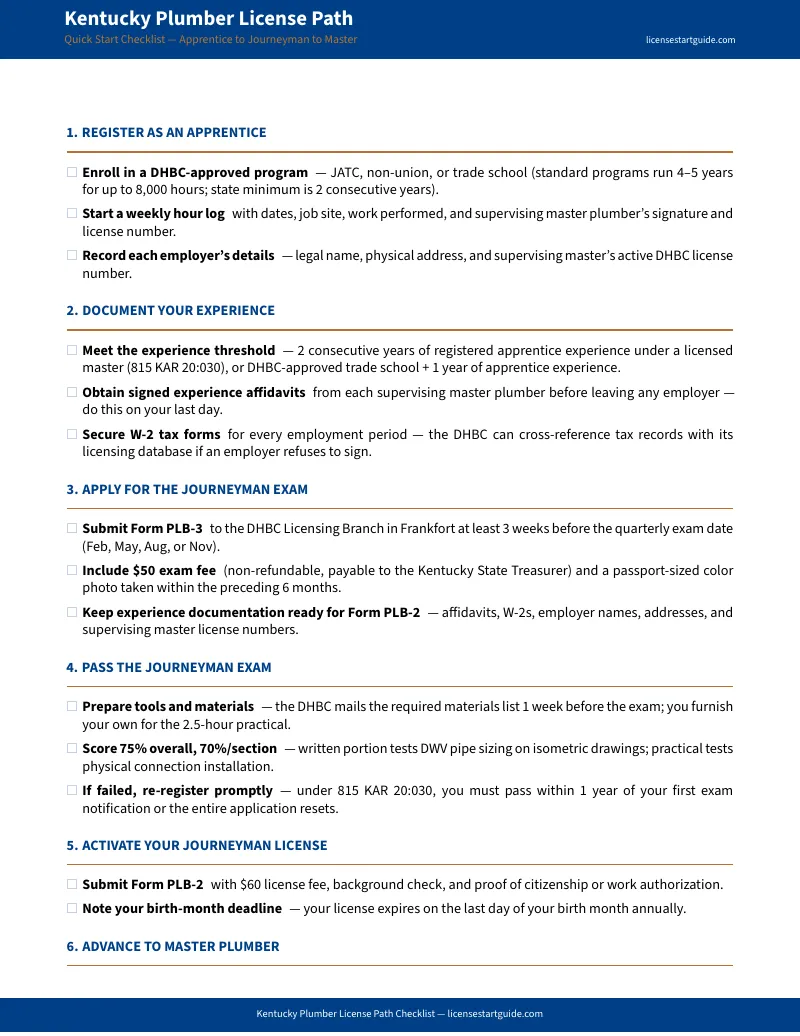
- Experience Documentation Strategy — how to compile Form PLB-2 attestations, handle employer transitions, use W-2 payroll records when a former employer refuses to sign, and prevent the documentation gaps that delay exam authorization by months
- Journeyman Exam Walkthrough — the 5-hour written and practical examination structure, quarterly testing windows, cast-iron and copper connection practical components, the $50 exam fee and $60 license fee, and the recovery path after a failed attempt
- Master Plumber Advancement — the 2-year post-journeyman experience requirement, the written trade and law exam, the $150 exam and $250 license fees, and the legal authority shift that changes your liability exposure and permit-pulling rights
- Permit Authority by License Level — why journeymen cannot pull permits under KRS Chapter 318, the $1,000-per-day penalty for unpermitted work, the master plumber and homeowner exemption, and the inspection sequence for rough-in, underground, and final stages
- Louisville Metro Registration — Class A ($125/year, multiple permits) versus Class B ($50/year, single permit) contractor licensing through the Department of Codes and Regulations, the Jefferson County occupational tax requirement, and the Louisville-DHBC permit portal overlap
- Lexington-Fayette Registration — the $0 registration fee for state-licensed plumbers through LFUCG, the Lexington-Fayette County Health Department plan review process for projects with more than 5 fixtures, and the hand-delivery workflow for state inspector review
- Continuing Education Compliance — the state-mandated 8-hour annual CE requirement under 815 KAR 20:032, the 2-hour job safety minimum for journeymen, the 12-hour carry-forward cap, and how to verify provider approval so you don't complete a 6-hour package that leaves you 2 hours short
- Out-of-State Credential Evaluation — Kentucky's case-by-case review process for plumbers licensed in Ohio, Indiana, Tennessee, and other states, how to bypass the apprentice track and sit directly for the exam, and the documentation the DHBC requires
- Business Formation Sequence — registering with the Kentucky Secretary of State, securing Department of Revenue tax accounts, designating a Responsible Managing Employee, meeting the $250,000 general liability insurance minimum, and coordinating workers' compensation coverage
Who It's For
- Apprentices approaching their two-year experience threshold who need to compile Form PLB-2 documentation from multiple employers without delays
- Journeymen who've been offered side work and need to understand exactly what they can and cannot do legally — and what it takes to advance to master status
- Master plumbers launching an independent business who need the full registration sequence: state entity formation, local contractor licensing in Louisville or Lexington, insurance minimums, and tax accounts
- Out-of-state plumbers relocating to Kentucky who've discovered that neighboring states' licenses don't transfer automatically
- Any Kentucky plumber confused by the 8-hour CE requirement after a commercial provider sold them a 6-hour package
Why This Guide Instead of Free Resources
Everything in this guide is technically available across the DHBC website, Louisville Metro's construction review portal, the Lexington-Fayette County Health Department's plan submission guidelines, and the Kentucky Revised Statutes. But the DHBC site doesn't explain how municipal contractor registration works — that's local jurisdiction. Louisville's portal doesn't explain state trade licensing — that's the DHBC's domain. Neither side warns you about the Form PLB-2 documentation traps, the 8-hour versus 6-hour CE mismatch, or the $1,000-per-day penalty exposure for journeymen doing unpermitted work until you're already in violation.
Exam-prep providers like RocketCert and TradesmanCE charge $59 to $300 for test-passing materials and CE courses — nothing about experience documentation, the state-municipal regulatory split, business formation, or out-of-state credential evaluation. Some of those same providers sell 6-hour CE packages to Kentucky plumbers despite the state requiring 8 hours.
This guide costs less than a single DHBC license application fee and covers the entire dual-tier pathway from apprentice registration through independent business operations.
Satisfaction Guarantee
If the guide doesn't give you a clear roadmap for your specific licensing stage, reply to the confirmation email and we'll refund the purchase.
Get the Kentucky Plumber License Guide →
Download includes 8 printable PDFs: the complete 12-chapter guide covering apprentice-to-master licensing plus Louisville and Lexington municipal registration, a 24-item licensing checklist organized by career stage, an experience documentation tracker, an application filing checklist, a 90-day exam preparation timeline, a business setup checklist, a CE tracking log, and a renewal calendar. Free tier available — download the checklist alone to see the scope before deciding.