
You know how to wire a building. But do you know how to navigate Kentucky's licensing paperwork?
Here's what actually holds electricians back in Kentucky: it's not the NEC exam. It's the stack of documentation the DHBC Electrical Division demands before they'll even let you sit for it.
A signed, notarized employer verification letter on company letterhead — for every job you've ever held. IRS tax transcripts — W-2s, 1099s, or Schedule C — for every single year of claimed experience. One missing document, one gap in your hour records, one employer who won't sign a letter after you've left, and the DHBC rejects your application. Those years of field work vanish from the record.
Exam-prep companies charge $200 to $400 to teach you NEC code calculations. They leave you completely on your own when your application gets rejected because your supervised hours are ruled invalid, or because your employer verification letter used the wrong format, or because you didn't know you needed page two of your Federal 1040.
The Paperwork-to-Permit System
This guide doesn't teach you electrical code. You already know your trade. What it does is map the complete administrative sequence — from your first apprentice registration through pulling your first permit as an independent contractor — in the exact order Kentucky's regulators expect to see it.
That means the documentation standards the DHBC actually enforces on experience verification. The IRS transcript retrieval procedure. The three journeyman pathways and how education credits interact with the updated HB 444 rules. The Master Electrician transition and the business formation steps most contractors discover too late. And the local permitting layer — Louisville Metro, Lexington-Fayette — that sits on top of your state credential and controls whether you can actually start work.
What's Inside the Full Guide
- Hour documentation and employer verification — the exact format for notarized affidavits, the annual threshold that defines a qualifying year (1,600 hours), and the procedure for handling employers who have closed or won't cooperate
- IRS tax transcript retrieval — step-by-step instructions for downloading historical transcripts to satisfy Kentucky's employment verification requirement, which catches applicants who thought W-2 copies would be enough
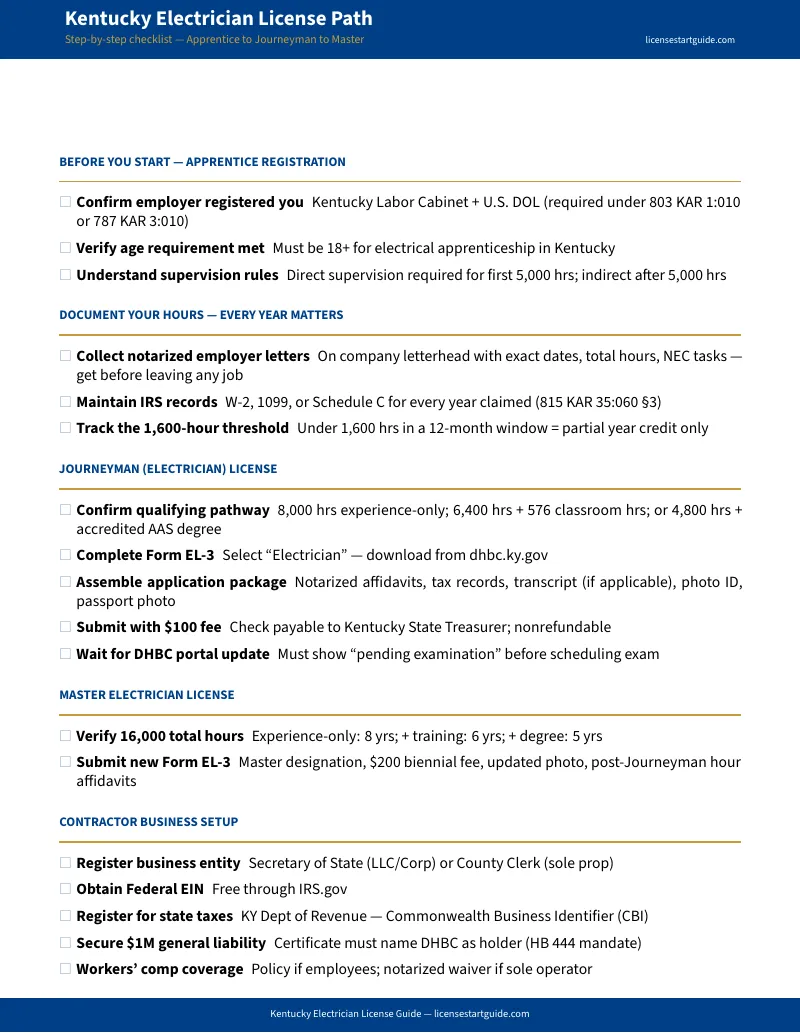
- Three journeyman pathways mapped side by side — experience-only (8,000 hours), classroom (6,400 hours + 576 classroom hours), and degree (4,800 hours + accredited AAS), with the document requirements for each
- Master Electrician transition — the 16,000-hour experience requirement, mandatory two years of active journeyman licensure, three qualifying pathways with education credit, and worked cost calculations so you know the total investment before you begin
- Contractor business formation sequence — entity registration, EIN, state tax registration, the $1,000,000 general liability insurance mandate under HB 444, workers' compensation, the Master Electrician dependency rule, and Form EL-2
- Louisville Metro permitting — Construction Review registration, Type A ($125/year, multiple projects) versus Type B ($50/year, one project) local licenses, residential permit fees, the $1,000 unpermitted-work fine, and homeowner exemptions
- Lexington-Fayette permitting — Accela Citizen Access portal, $10 flat permit fee, General/Residential/Specialty contractor tiers, and the code enforcement monitoring that creates title complications for homeowner-permitted upgrades
- Reciprocity with Ohio, Virginia, West Virginia, and Louisiana — the specific conditions each agreement requires, plus what happens when you're moving from a non-reciprocal border state like Indiana or Tennessee
- Biennial renewal and continuing education — 6 hours per year, the dual-licensing CE rule for Master/Contractor holders, birth-month timing, the $50 late penalty, and lapsed license reinstatement
- Provisional licensing — the one-year nonrenewable bridge credential for experienced workers who haven't yet passed the exam
Who This Guide Is Built For
Apprentices tracking their hours — you're in the field building experience, but you need to make sure every hour counts. The guide covers the registration verification habit, the employer exit affidavit template, and the documentation standards that determine whether your hours survive DHBC review.
Journeyman candidates ready to apply — you've hit the hour threshold and you're ready to submit. The guide maps the entire application sequence: which forms, which supporting documents, in what order, and the specific mistakes that trigger rejection on first review.
Master electricians going independent — the Master credential is a personal qualification. The Contractor credential is a business license. They are not the same thing. The guide walks you through the gap between the two, including the insurance, the qualifying agent rule, and the local registration that sits between your state license and your first permitted job.
Out-of-state electricians moving to Kentucky — reciprocity doesn't mean what most people assume. Ohio candidates need a license obtained via a state-recognized exam. Louisiana candidates need three consecutive years of active licensure. Workers from Indiana, Tennessee, and Missouri face the full Kentucky pathway. The guide maps every scenario.
Why Not Just Use the Free Resources?
The DHBC website hosts the application forms. RocketCert sells exam prep. The IEC Bluegrass Association runs apprentice training programs. None of them provide a unified administrative roadmap from apprentice registration through contractor permitting.
The state provides raw documentation — forms, statutes, administrative regulations — but no instructions for sequencing them. The exam-prep companies teach code calculations but leave you on your own when your application packet is incomplete. The trade associations serve enrolled members but don't offer an independent pathway for non-union or private-track electricians.
This guide fills the gap between "here are the forms" and "here's how to actually get licensed without delays, rejections, or wasted fees."
What You Get
- The full 49-page guide — 13 chapters covering every credential tier, every pathway, every local permitting requirement, with worked cost examples and the current 2025–2026 regulatory landscape under HB 444
- The printable checklist — 23 action items across 6 licensing phases, organized in the order you need to complete them
- Experience Hours Tracker — per-employer hour log with running annual totals, target checkboxes for each credential tier, and the 1,600-hour qualifying-year threshold
- Application Document Checklist — every required document for Journeyman, Master, Contractor, and Provisional applications, with the source for each item
- Employer Exit Verification Letter — the exact notarized-letterhead format the DHBC expects, ready to fill in and have signed before you change jobs
- Renewal and CE Tracking Calendar — biennial renewal timeline, annual CE hour log with technical/business classification, and the late-fee warning
- Local Registration Requirements Log — per-jurisdiction tracker for occupational licenses, permit accounts, contractor tiers, and annual renewal dates
For , you get the complete administrative roadmap that exam-prep companies don't cover, trade associations lock behind enrollment, and the state doesn't bother to publish.