You have the skills. Florida's split licensing system won't let you use them.
You finished your apprenticeship, logged your 8,000 hours, and assumed you could start working independently. But Florida doesn't hand out a statewide journeyman license. Your county board issues a certificate of competency — a local credential that's valid in that county only. It doesn't let you pull permits. It doesn't let you operate a business. And it means nothing one county over.
The path to independent work runs through the DBPR's Electrical Contractors' Licensing Board, and the application process is where careers stall. Miss the 40% three-phase experience ratio in your documentation, and your four years of experience gets rejected. Submit your credit report without the public records search, and the financial responsibility review sends it back. File your Registered Contractor application before getting a letter of compliance from your county board, and you're caught in the local-state registration loop — the county won't issue your card until the state registers you, and the state won't register you until the county certifies you.
The Dual-Track Navigation System
The Florida Electrician License Guide maps both sides of Florida's licensing system — local county competency boards and the state DBPR — into one sequential roadmap. It doesn't teach you the National Electrical Code or prepare you for trade exams. It teaches you how to document your experience so the ECLB accepts it, file applications in the correct sequence across two regulatory tracks, break the local-state registration loop, and coordinate county credentials with state contractor licensing.
Every chapter targets the specific administrative failure that catches people at that career stage. The apprenticeship chapter prevents undocumented hours. The journeyman chapter maps the county-by-county requirement differences. The EC chapter walks through the financial responsibility requirements before you discover them on a returned application. The endorsement chapter prevents the assumption that your out-of-state license will transfer automatically.
What You Get
- Dual-Track System Map — how county construction trades qualifying boards and the state ECLB divide authority, why a local competency card and a state contractor license serve completely different functions, and where each credential gives (and doesn't give) you the right to work
- County-by-County Requirements Comparison — experience thresholds, exam providers, fees, and renewal rules for Miami-Dade, Hillsborough, Palm Beach, Broward, and Orange County, so you know what your specific county demands before you file
- Experience Documentation Strategy — how to compile the job lists, W-2 forms, and employer verification letters that survive the ECLB's review, including the five-jobs-per-year standard and the 40% three-phase work ratio that trip up most first-time applicants
- Certified Contractor (EC) Application Walkthrough — the two-part Pearson VUE exam structure, Form DBPR ECLB 1 requirements, the 660 FICO threshold and bond alternatives, the $10,000 net worth verification, insurance minimums, and LiveScan fingerprinting — assembled in the order the ECLB actually processes them
- Registered Contractor (ER) Pathway — Form DBPR ECLB 3, the local-state registration loop and the letter of compliance that breaks it, how to add counties to an existing ER license, and the critical vulnerability: if your local card lapses, your state registration is void
- Out-of-State Endorsement Framework — the ten-year endorsement rule, the substantially similar exam pathway, pre-approved state equivalencies for North Carolina, Georgia, California, Alabama, and Colorado, and the Business & Finance exam that endorsement applicants still need to pass
- Grandfathering Pathway — when upgrading from ER to EC makes operational and financial sense, the Form DBPR ECLB 13 application, and the eligibility requirements
- Business Launch Sequence — Sunbiz LLC formation, qualifying agent designation, local registration for permit pulling, insurance naming requirements, and joint venture rules
- Renewal and Continuing Education — the 11-hour CE requirement breakdown, biennial renewal cycle (August 31 of even-numbered years), CE proration for new licensees, and local card renewal obligations that ER holders cannot afford to miss
Who It's For
- Apprentices finishing their program who need to know which county board to contact and what documentation to bring for their journeyman competency exam
- Experienced electricians compiling years of field experience into the documentation format the ECLB actually accepts — especially when former employers are uncooperative
- Out-of-state licensed electricians relocating to Florida who've discovered that their home-state credentials don't automatically transfer
- Journeymen and master electricians ready to start an independent contracting business and navigate the EC vs. ER decision
- ER license holders considering the upgrade to statewide EC certification before a county card lapse puts their registration at risk
Why This Guide Instead of Free Resources
Everything in this guide is technically available across the DBPR website, county building department portals, the Florida Administrative Code, and the Florida Statutes. But the DBPR FAQ doesn't explain the local competency card process — that's county jurisdiction. County board websites don't explain how their local cards connect to state contractor registration — that's DBPR jurisdiction. Neither side warns you about the registration loop, the three-phase documentation ratio, or the FICO threshold until your application is already returned.
Exam-prep packages from Mike Holt Enterprises, Gold Coast Schools, and national providers run $255 to $1,795 and cover NEC code study — nothing about hour documentation, the local-state regulatory split, business formation, or endorsement pathways. Licensing consultants charge $500 to $1,000 per application filing.
This guide costs less than a single DBPR application fee and covers the entire dual-track pathway from apprenticeship enrollment through statewide contractor operations.
Satisfaction Guarantee
If the guide doesn't give you a clear roadmap for your specific licensing stage, reply to the confirmation email and we'll refund the purchase.
Get the Florida Electrician License Guide →
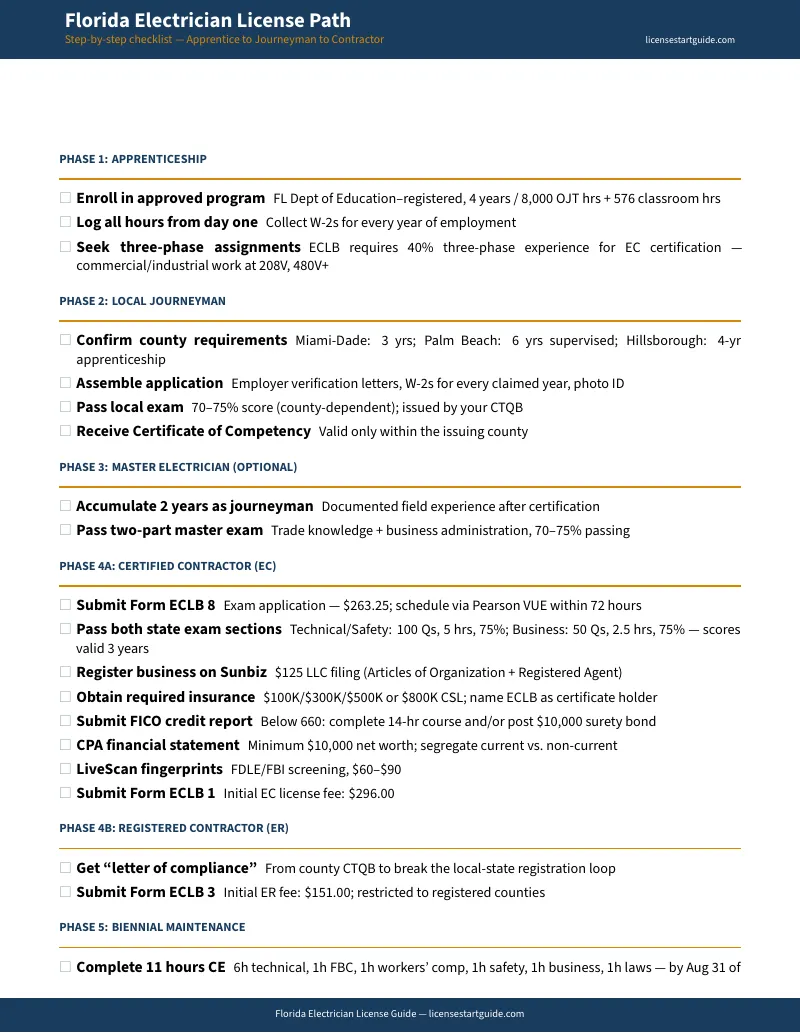
Download includes 7 printable PDFs: the complete 15-chapter dual-track roadmap guide, a 26-item licensing checklist organized across 6 career phases, plus 5 standalone planning worksheets — an apprenticeship hour tracker, experience documentation checklist, application cost calculator, license renewal tracker, and agency communication log. Free tier available — download the checklist alone to see the scope before deciding.