Three Agencies. One Wrong Step. Weeks Wasted.
You sign a contract, order materials, and line up a crew — then discover you can't pull a permit because your Basic Business License application is sitting in a 30-day correction queue. A single address mismatch between your insurance certificate and your Home Occupation Permit. A tax classification you selected on OTR's Form FR-500 that doesn't match what the Corporations Division has on file. A surety bond whose language is missing one of the five statutory clauses DLCP requires.
The District of Columbia splits contractor licensing across three separate municipal agencies — DLCP, DOB, and OTR — each with its own portal, its own requirements, and its own processing timeline. They feed each other in a specific sequence, and attempting them out of order creates circular errors that stall everything. The official portals document their own piece but never the complete sequence. Competitor guides still show the old $654.50 fee structure that the BEST Act replaced in October 2025.
The Three-Agency Licensing Sequence
The District of Columbia General Contractor License Guide maps the complete administrative pathway — entity formation through permit authorization — in the exact order the District's three systems expect. It covers both licensing tracks (General Contractor classes A through H and Home Improvement Contractor), both entity types (domestic formation and foreign registration for Maryland/Virginia contractors), and every supporting document with the formatting precision that avoids Deficiency Notices.
This is the filing sequence itself, laid out as a single linear path: which portal to use first, what each agency needs before it will process your application, and what to have ready before you log in.
What's Inside the Guide
- The three-agency dependency chain — DLCP, DOB, and OTR in the exact sequence, with the handoff points that cause circular errors when you skip ahead
- Two licensing tracks compared — General Contractor/Construction Manager (five classes by contract value) versus Home Improvement Contractor (residential work over $300), with the criteria that determine which track applies to your work
- BEST Act fee schedule — the flat $99 biennial BBL fee that replaced the old $654.50, the $49 short-term option, and the $0 exemption for businesses earning under $10,000 annually
- Bill 25-737 grandfathering analysis — the upcoming competency exam and 4,000-hour experience mandate, and why securing your BBL before the board's transition date exempts you from both
- Entity formation step by step — LLC Articles of Organization (Form DLC-1), trade name filing (Form TN-1), the $55/$220 filing costs, and the name-consistency rule that triggers Deficiency Notices when your entity name doesn't match your insurance certificate exactly
- Foreign entity registration — the complete sequence for Maryland and Virginia contractors entering DC, including Form FN-1, the 180-day Good Standing Certificate, and the registered agent mandate
- Zoning clearance — Home Occupation Permit ($72.60) requirements and restrictions, Certificate of Occupancy for commercial addresses, and the out-of-District exemption
- Tax registration and Clean Hands — Form FR-500 on MyTax.DC.gov, the correct entity classification to avoid cascading errors, and the $1,000 Clean Hands threshold (raised from $100 in October 2024, DMV debts excluded)
- CGL insurance by GC class — Class A ($2.5M per occurrence) through Class H ($500K), the A.M. Best B+ rating mandate, and the exact certificate holder text formatting that DLCP requires
- The full HIC compliance stack — the $25,000 surety bond, the Home Improvement Salesperson (HIS) designation, the police background report, sample contracts under 17 DCMR § 3905, and the consumer-protection clauses whose absence triggers immediate application rejection
- BBL-to-DOB permit linkage — connecting your approved license to the Permit Wizard and ProjectDox through the AccessDC portal, and the trade permit restriction (GC licenses cannot pull electrical, plumbing, or HVAC permits — those run through the Board of Industrial Trades)
Eight Planning Tools Included
- Three-Agency Sequence Tracker — maps every milestone across DLCP, DOB, and OTR in chronological order so you never submit to the wrong portal first
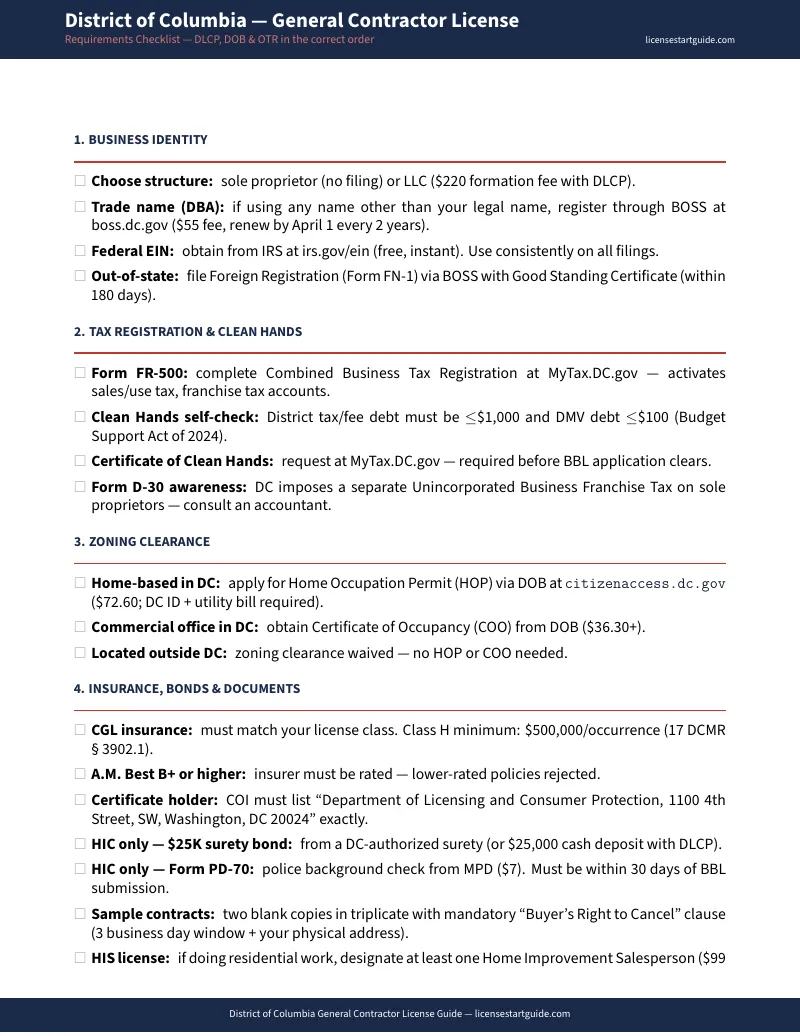
- Entity-Insurance-Bond Assembly Checklist — the exact documents you need assembled before logging into BOSS, with the formatting rules that cause rejections
- BBL Application Pre-Submission Audit — a self-check for address mismatches, insurer ratings, certificate holder text, and contract clause compliance before you enter the 30-day processing queue
- Clean Hands Resolution Flowchart — step-by-step path from automated hold to cleared certificate, including how to identify the source and set up an OTR installment plan
- HIC Document Assembly Worksheet — every element of the Home Improvement Contractor application in filing order: bond, salesperson designation, background report, sample contracts, insurance
- CGL Coverage Matrix — per-occurrence and aggregate minimums for every GC class and the HIC pathway, cross-referenced against the A.M. Best rating requirement
- Permit Authorization Checklist — the AccessDC/DOB connection sequence and the scope boundaries (under 500 sq ft for instant permitting versus full ProjectDox plan reviews)
- Bill 25-737 Readiness Tracker — grandfathering eligibility criteria, experience documentation framework, and timeline milestones for the new board's implementation
Who This Is For
Experienced subcontractors stepping out independently who need to convert their hands-on expertise into a licensed contracting business. Maryland and Virginia operators expanding into the District who just learned their home-state credentials don't transfer. Home improvement remodelers assembling the full HIC compliance stack — bond, salesperson, contracts — for the first time. Existing BBL holders who want to understand the Bill 25-737 grandfathering window before the new board takes effect.
This guide is built for people who already know construction. The administrative process is the part they haven't done before.
Why Not Free Resources?
The regulatory requirements are technically public. The problem is the sequence. DLCP's BOSS portal documents how to file a BBL application — it doesn't tell you that you need OTR tax registration and DOB zoning clearance first, in that order, or that registering with OTR before your trade name is on file with the Corporations Division creates systemic data conflicts. OTR's MyTax portal explains Form FR-500 — it doesn't mention that selecting the wrong entity classification creates franchise tax obligations that block Clean Hands certification down the line.
Commercial compliance services like Harbor Compliance charge hundreds of dollars per license for managed filings aimed at mid-sized firms. Local registered agent websites still publish the old $654.50 fee structure and ignore the HIC consumer protection stack entirely. Construction law firms bill $350–$600 per hour for advice that's accurate but economically irrational for a solo operator filing a straightforward BBL application.
This guide costs less than the $99 BBL filing fee itself. It's the non-circular sequence that the official portals never lay out, assembled in one place.
Satisfaction Guarantee
If the guide doesn't deliver what you expected, email [email protected] and we'll make it right.
Get Started
Download the free requirements checklist to see the overview. When you're ready for the complete three-agency sequence, the full guide is — one download, no subscriptions, no recurring fees.