Delaware's Dual-Credential System Trips Up Experienced Educators — And Nobody Warns You in Advance
Most states hand you one teaching license and send you on your way. Delaware splits the credential into two separate pieces — a personal license and area-specific standard certificates — each with its own application track, its own documentation requirements, and its own approval timeline inside DEEDS 3.0. Apply for one without the other and the system holds your entire file until you fix it.
Now layer in the third-party submission rules. Your official transcripts must come directly from your university's registrar — upload them yourself and they get rejected. Your Form E experience verification must be mailed or emailed by your former employer's superintendent or personnel officer. Submit it yourself? Rejected. Each rejection toggles a red "Deficient" flag on your DEEDS dashboard, and clearing deficiencies during peak hiring season means competing for attention with every other new applicant in the state.
Meanwhile, the DDOE Educator Support Team's phone availability is measured in limited hours per week. The official website hosts the information you need — across dozens of legacy pages, PDF user guides, and scattered knowledge-base articles that have not been consolidated into a single timeline. The universities that rank in search results for "Delaware teacher certification" are selling degree programs. The commercial directories are selling ad inventory and often publish outdated fee information.
You need a neutral, sequential process map built for the current rules — including the HB 97 permitting changes and the elementary assessment transitions that most guides have not caught up with.
The Credential Route Navigator — From Your Background to a Delaware Classroom
The Delaware Teacher Certification Guide is a process-navigation toolkit. Not exam prep. Not a university recruitment funnel. Not affiliated with any certification board or school district. It maps every route from your current qualifications to an active Delaware teaching credential, with the exact forms, fees, timelines, and decision points at each step.
At the center is the Credential Route Navigator — a diagnostic framework that takes your background (degree type, GPA, existing license, teaching experience, subject area) and identifies your shortest legitimate pathway into a Delaware classroom. Career changers who assumed they needed a full education degree discover they qualify for ARTC with their existing bachelor's and 24 content credits. Out-of-state teachers who thought reciprocity was automatic learn that experience under four years means an Initial License while four or more years earns a Continuing License — a distinction that affects salary placement from day one. Recent graduates who expected their university to handle everything realize they still need to navigate EdAccess registration, score routing, and background clearances independently.
Every recommendation traces to the specific statute, DDOE policy, or PSB regulation that governs it.
What's Inside
- The dual-credential system decoded — how the personal license (Initial, Continuing, Advanced) and standard certificates interact, why you must apply for both simultaneously, and how stacking additional subject certificates costs nothing in extra state fees
- Three certification routes compared side by side — Traditional EPP, Alternative Routes to Certification (ARTC) for career changers with a 2.75+ GPA and 24 content credits, and out-of-state reciprocity under NASDTEC with experience-based license placement
- DEEDS 3.0 portal walkthrough — EdAccess setup, the critical registration split between eLearning accounts (non-employed/out-of-state) and ClassLink portal access (active employees), application submission, and how to read and respond to dashboard status banners and deficiency flags
- The third-party document rules that cause most rejections — exactly who must send transcripts, how to route Praxis and ACTFL scores using Recipient Code R7065, and the Form E submission protocol that trips up nearly every out-of-state applicant (the revised April 2026 version)
- Background clearance from start to finish — Child Protection Registry check via the DSCYF portal, state and FBI fingerprinting through IdentoGO, scheduling and fee breakdowns, and the validity windows you need to plan around
- The 91-day substitute teaching pathway — how long-term substitutes in non-core subjects can bypass traditional student teaching, the continuous-assignment requirement, and which testing steps remain
- Assessment transition timeline — the elementary education subtest phase-out, the December 2026 cutoff for subtest 5002, and the January 2027 shift to Teaching Reading: Elementary (5205)
- HB 97 permit requirements for 2025–2027 — which school positions now require permits, the exemptions, and the state funding clawback mechanism for non-compliant districts
- The $100 fee reimbursement under HB 307 — how the one-time licensing fee is automatically repaid via a semi-annual batch process once you are employed by a Delaware public or charter school
- Renewal and advancement — 90 clock-hour PD requirement, CE Tracker logging, credit-to-clock-hour conversion, and the path from Continuing to Advanced via National Board certification
- Five printable tracker worksheets — application readiness checklist, document submission tracker, background clearance timeline planner, clock hour renewal log, and agency communication log
Who This Guide Is For
- Out-of-state teachers relocating to Delaware — reciprocity is case-by-case, not automatic. Your experience level determines whether you receive an Initial or Continuing License, and the Form E your former employer must send directly to DEEDS is the single most rejected document in the out-of-state pipeline
- Career changers exploring ARTC — the 2.75 GPA threshold, 24 content credits, Emergency Certificate while completing coursework, and ARTC Welcome Letter association in DEEDS all need to happen in the right order or your timeline slips by a full semester
- Recent graduates of Delaware EPPs — your Institutional Recommendation is step one, not the finish line. EdAccess registration, electronic score routing, direct transcript submission, and background clearances all remain on your plate before a district can formally onboard you
- Substitute teachers exploring the 91-day route — the continuous-assignment rule, eligible subject areas, and remaining assessment requirements for candidates who qualified through long-term substitute service
- Current educators adding certificates or renewing — stacking additional subject certifications is free through DEEDS, and the Continuing License renewal clock-hour logging process through DELPROS and DEEDS has its own specific procedures
Why Free Online Resources Fall Short
The DDOE website is a regulatory archive — comprehensive in statute, scattered in navigation. When you need to know what to submit first, which documents must come from third parties, or what triggers a deficiency flag, you are reading across a dozen legacy pages and downloading PDF user guides that assume you already understand the system's vocabulary.
Commercial directories like Teaching-Certification.com claim Delaware teachers pay a renewal fee. The DDOE confirms license renewal is free — the $100 is a one-time application charge that is fully reimbursable. If you are making credentialing decisions based on commercial content that confuses one-time fees with recurring charges, you are planning around incorrect costs.
University program pages explain the ARTC pathway in detail — and then enroll you in a $10,000+ course sequence. They rarely explain that the traditional route or reciprocity route might get you there faster and cheaper, because those routes do not generate tuition revenue.
This guide covers every pathway — including the ones that cost the least — with equal detail. No commissions, no degree-program partnerships, no advertising revenue.
Your Purchase Is Protected
If the guide does not save you more in time, avoided confusion, and prevented delays than it costs, email us for a full refund. No forms, no hoops. A process tracker pays for itself by preventing one rejected Form E, one missed score-routing step, or one background clearance that expires before your application clears — any one of which can push your classroom start date back by weeks and default you to substitute pay rates in the meantime.
Get the Delaware Teacher Certification Guide →
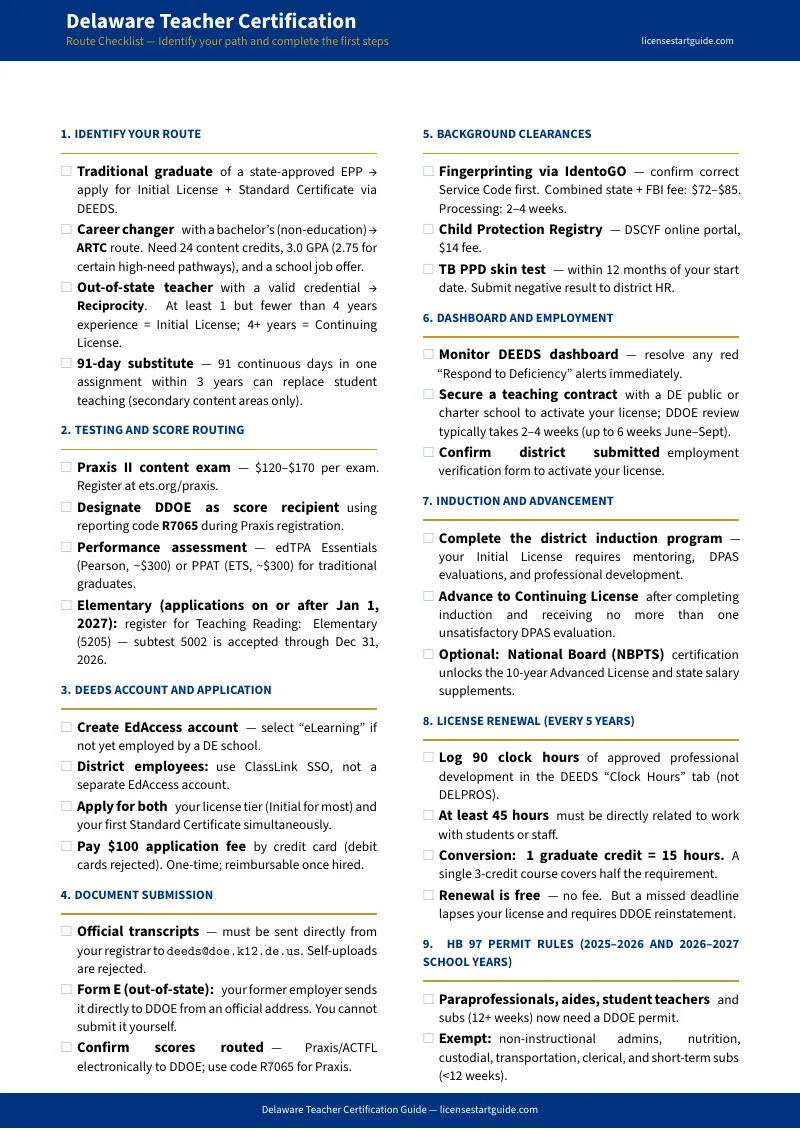
The free checklist compares routes at a glance. The full guide walks you through each one — documents, deadlines, DEEDS mechanics, and the tracker worksheets that keep the entire process organized from first application through classroom placement.