
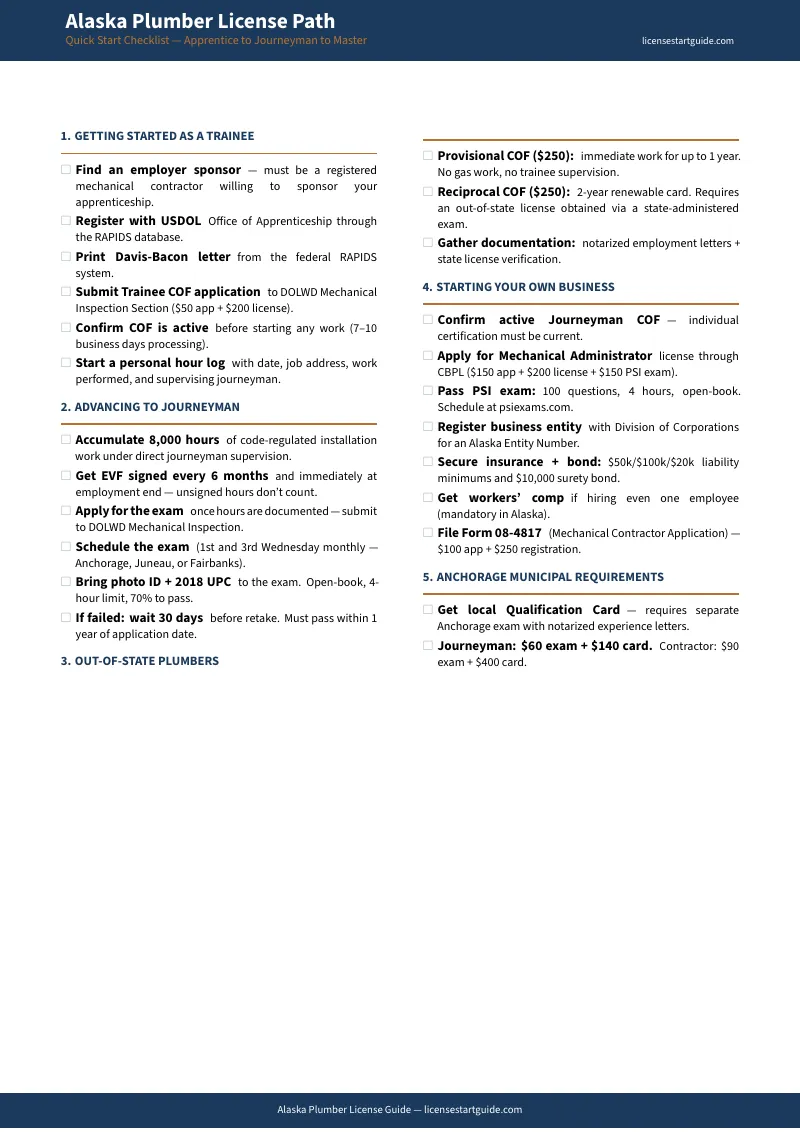
You did the work. Alaska's paperwork system is about to erase it.
You spent months on job sites under a licensed journeyman, running pipe, sweating fittings, learning the trade the hard way. But if you didn't file your Trainee Certificate of Fitness before your first day of work, the state of Alaska considers every one of those hours undocumented — and undocumented hours don't count toward your 8,000-hour journeyman requirement.
That's not a technicality. That's the difference between advancing your career this year and starting over.
And the hours trap is just one of four regulatory bottlenecks that stall plumbing careers in Alaska. The licensing system is split across two agencies that don't talk to each other — the Department of Labor handles individual trade certificates while the Division of Corporations, Business and Professional Licensing handles the business side. Getting from trainee to independent contractor means navigating both of them, plus municipal layers in cities like Anchorage (which requires its own Qualification Card with a separate exam) and Fairbanks (which enforces borough-specific plumbing code amendments for permafrost conditions).
The Dual-Agency Navigation System
The Alaska Plumber License Guide maps the entire dual-agency licensing system into one sequential roadmap. It doesn't teach you plumbing code — it teaches you how to document your experience so the state accepts it, file applications in the right order, avoid the naming-match rejection that kills contractor registrations, and coordinate state-level credentials with municipal permit offices.
Every chapter is built around the specific administrative failure that catches people at that stage of their career. The trainee chapter prevents the unregistered-hours trap. The journeyman chapter prevents Experience Verification Form errors. The reciprocity chapter prevents the fuel-gas exclusion surprise. The contractor chapter prevents the business-name mismatch that gets applications returned.
What You Get
- Trainee Registration Walkthrough — the complete USDOL RAPIDS enrollment, Davis Bacon letter, and DOLWD Trainee COF filing sequence, with the 2:1 supervision ratio rules and maintenance-hour exclusion that determine which hours actually count
- Experience Hour Protection Strategy — how to use the state's Experience Verification Form correctly, the six-month employer signature interval that prevents lost records, and the union-affidavit recovery process when a former employer disappears
- Reciprocity Decision Framework — the August 2025 Provisional COF vs. Reciprocal COF comparison, including scope restrictions, supervision rights, fuel-gas exclusions, and the documentation each pathway requires from your home state
- Mechanical Administrator Pathway — Alaska's version of "master plumber" requires combining a DOLWD Journeyman COF with a CBPL Mechanical Administrator license — two separate applications to two separate agencies with different experience windows and fee structures
- Contractor Business Registration Sequence — Alaska Business License, Mechanical Administrator credential, Mechanical Contractor registration, $10,000 surety bond, general liability minimums, and the one-employee workers' compensation trigger that surprises contractors from lower-48 states
- Exam Logistics and Scheduling — testing locations, scheduling windows, the 70% pass threshold, the 30-day retake wait, and proctored testing arrangements for rural Alaska through regional Job Centers
- Renewal and Continuing Education — the biennial cycle, the mandatory 8/8 CE hour split between UPC updates and general industry topics, and the re-testing requirement for renewals submitted more than two years late
- Municipal Permit Coordination — Anchorage Qualification Card requirements, Fairbanks permafrost code amendments, AWWU water and sewer permitting, and ADEC onsite septic regulations
Who It's For
- Plumbing apprentices and trainees registering their first hours in Alaska
- Journeymen preparing to sit for the state exam or document military and trade-school hours
- Out-of-state licensed plumbers relocating to Alaska for infrastructure, commercial, or oilfield work
- Licensed journeymen ready to start their own plumbing contracting business
- Rural and remote operators navigating testing logistics and environmental agency coordination
Why This Guide Instead of Free Resources
Every piece of information in this guide is technically available across four separate government portals. But the DOLWD Mechanical Inspection site doesn't explain the CBPL Mechanical Administrator requirements. The CBPL Professional Licensing page doesn't mention the DOLWD's hour documentation process. Neither agency warns you about the common filing errors — the unsigned EVF, the naming mismatch on the contractor application, the provisional-certificate fuel-gas exclusion — that cause months of delays and hundreds in non-refundable re-filing fees.
Exam-prep courses from national providers run $179 to $350 and cover code study only — nothing about hour documentation, reciprocity pathways, business formation, or municipal permits. Private licensing consultants charge $500 to $2,000 per filing.
This guide costs less than a single application fee and covers the entire pathway from first day as a trainee through registered mechanical contractor.
Satisfaction Guarantee
If the guide doesn't give you a clear roadmap for your specific licensing stage, reply to the confirmation email and we'll refund the purchase.
Get the Alaska Plumber License Guide →
Download includes 9 printable PDFs: the complete dual-agency roadmap guide, a 24-item filing checklist, an experience verification tracker, a reciprocity decision flowchart, a contractor registration checklist, a fee calculation reference, an exam logistics reference, a CE renewal tracker, and a forms directory. Free tier available — download the checklist alone to see the scope before deciding.