You registered the LLC. Now what?
You paid $25 to file with the Secretary of State. You got your Business Registration Certificate. You thought you were done. Then you found out that none of that actually makes you a licensed contractor in West Virginia.
The state contractor license lives in a different agency entirely — the Contractor Licensing Board — and getting it means coordinating the Division of Labor, the State Tax Department, WorkForce West Virginia, a surety bond company (maybe), a testing vendor called Prov, and whatever municipal offices happen to cover your project area. Each one has its own forms, its own timelines, and its own way of rejecting applications over mismatched business names.
The Multi-Agency Compliance Roadmap
This guide is built around one problem: West Virginia splits contractor regulation across agencies that don't talk to each other, and none of them gives you a start-to-finish checklist. You get fragments — a PDF packet from the Division of Labor, a fee schedule from the Board, a local B&O tax ordinance from city hall — and you're left to assemble the sequence yourself.
The West Virginia General Contractor License Guide maps every step in the order you actually encounter them, from business registration through your first permitted job. Every agency, every form, every fee, every deadline — connected into a single compliance roadmap so nothing falls through the cracks between departments.
What's Inside
- The full licensing sequence, agency by agency — Secretary of State registration, State Tax Department setup, WorkForce West Virginia enrollment, wage bond resolution, exam registration, Board application, and municipal permits, laid out in the chronological order the state actually requires them
- Classification decoder — Class A, B, B-2, B-3, and specialty classifications explained with their scope limits, experience requirements, and the specific restrictions that trip people up (like the $40,000 cap and no-structural-changes rule for Remodeling and Repair licenses)
- Wage bond exemption workflows — the three legal routes to skip the wage bond entirely (no employees, single-family residential only, or $100,000 tangible asset threshold), with the exact affidavit process instead of just pointing you at a surety broker
- Prov exam logistics guide — current testing procedures since the September 2024 transition to Prov Inc., including registration, the open-book format, approved reference materials, the 70% passing threshold, and the online proctoring option through Examroom
- The 31-day renewal trap — how the grace period works, what happens on day 31 when your license resets to new-applicant status, and how to avoid retaking both examinations over a missed renewal date
- Municipal compliance directory — local business license requirements, building permit processes, and B&O tax obligations for Charleston, Huntington, Fairmont, Bridgeport, and other municipalities where contractors routinely get surprised by a 2% gross-receipts tax they didn't bid into their projects
- 2025 reciprocity rules — how Senate Bill 458 lets out-of-state contractors skip equivalent trade exams, what residency and documentation steps are still required, and who qualifies for the existing NASCLA reciprocity pathway
- Trade boundary map — where your general contractor license ends and individual trade certifications begin for plumbing, HVAC, and electrical work, including the dollar thresholds that trigger separate licensing requirements
- Contract requirements under the new written-contract law — the mandatory elements for any project over $10,000, including the clause requirements most contractors miss
- Application verification checklist — a name-matching audit and document completeness check designed to catch the mismatches that get applications rejected before they're reviewed
Printable Worksheets Included
- Name-Match Verification Worksheet — fill-in sheet to verify your business name matches across all six documents before submitting
- Wage Bond Decision Worksheet — decision tree and bond calculation to determine if you need a bond or qualify for an exemption
- Pre-Application Document Tracker — check off every document the Board requires before mailing your application
- Fee Reference Card — one-page reference with every fee in the licensing process, from state to municipal
- Municipal Compliance Tracker — fill-in log to track local registrations and per-project permits across cities
Who This Is For
This guide is built for independent contractors, sole proprietors, and small construction businesses who are navigating the West Virginia licensing process on their own. It's particularly useful if you're transitioning from working under someone else's license to qualifying for projects in your own name, expanding from handyman work into jobs that cross the licensing thresholds, or moving to West Virginia from another state and trying to figure out what transfers and what doesn't.
What This Guide Is Not
This is a process navigation manual, not exam prep. It does not contain practice questions, test banks, or guaranteed passing strategies. It explains how to register for the Prov exams, what reference books are allowed, and what the format looks like — but passing the exam is on you. It also does not replace a lawyer for contract disputes or a CPA for complex tax structures. What it replaces is the 40+ hours of bouncing between agency websites trying to figure out which step comes next.
Free Checklist vs. Full Guide
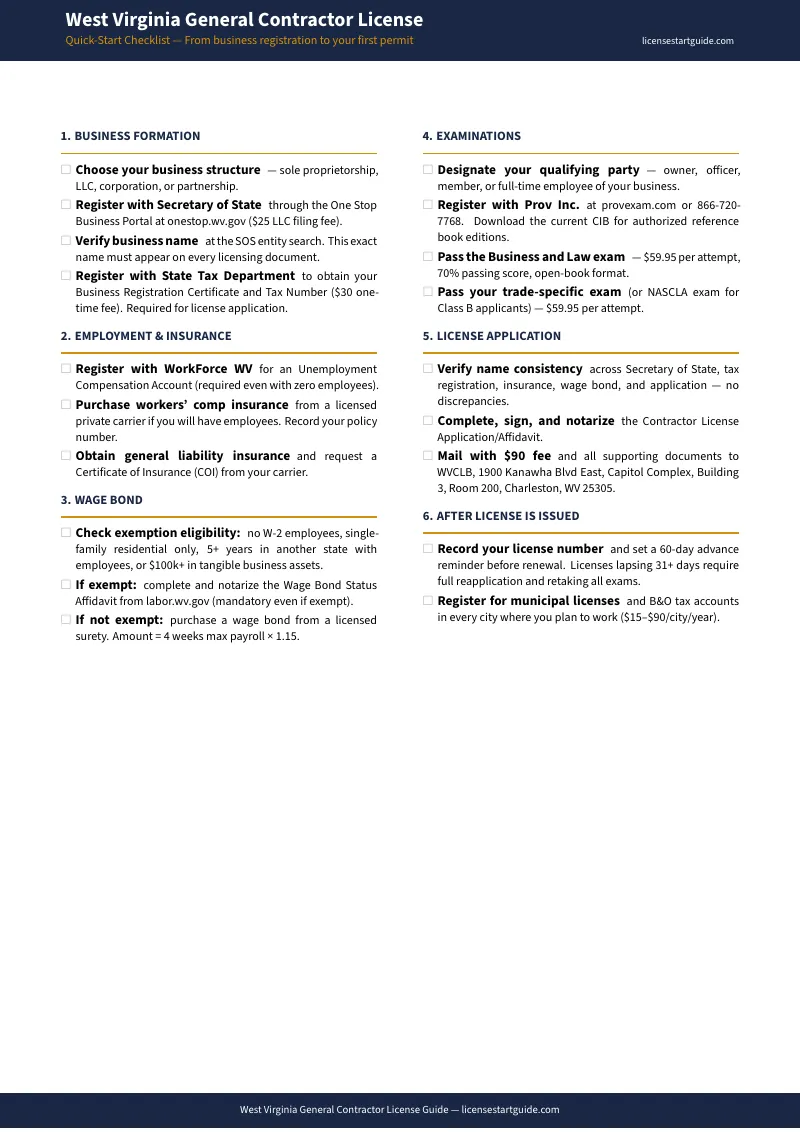
The free checklist gives you the high-level steps — register here, file there, take this exam. It's a solid starting point. The full guide goes underneath each step with the specific forms, the exact fees, the deadlines that matter, the exemptions you might qualify for, and the municipal layer that the state licensing process never mentions. If you've ever submitted an application and had it bounced back for something you didn't know was required, the full guide is where those details live.
Every purchase comes with a satisfaction guarantee. If the guide doesn't save you time and confusion navigating the licensing process, we'll refund your purchase — no questions asked.