You know Tennessee removed the license requirement. You just don't know what replaced it.
The Food Freedom Act sounds like permission to sell anything from your kitchen: no license, no inspections, no sales cap. But the moment you start reading the actual statute — T.C.A. § 53-1-118, plus the 2025 HB 130 expansion — the questions pile up. Which of your recipes are shelf-stable versus TCS? Can you ship cookies to a customer in Chattanooga, or does your frosting recipe push the product into perishable territory? Does the "no permit required" rule mean you can skip business registration entirely, or is your county clerk about to send you a letter?
The Tennessee Department of Agriculture website explains the exemption in broad strokes. Facebook groups give you conflicting advice about whether cream cheese frosting is legal. UT Extension publishes water activity tables that assume you have a food science background. And none of these sources mention the Nashville home occupation permit, the Memphis Accela registration portal, or the fact that your homeowner's insurance excludes every product liability claim that comes out of your kitchen.
Every week you spend sorting through these sources is a week of sales you're either not making or making without knowing whether your labels, your distribution channels, or your tax setup actually comply.
The Food Freedom Compliance Map
This isn't another summary of Tennessee's cottage food law. It's a structured compliance map that walks you through every requirement in the order you encounter them — from classifying your recipes using UT Extension's water activity and pH tables, through designing labels with all eight mandatory elements, to registering for the correct tax accounts and navigating your specific city's zoning rules.
Where free resources scatter requirements across the TDA website, the Department of Revenue portal, UT Extension publications, and four different city codes offices, this guide puts them into a single linear workflow. You work through it once, in order, and you know exactly where you stand before spending money on packaging, booth fees, or insurance you might not need.
What's Inside
- Product Classification Worksheet — determine whether each of your recipes qualifies as non-TCS (shelf-stable) or TCS (perishable) using the same water activity and pH decision tables UT Extension uses, without needing a food science degree to interpret them. Clear examples: buttercream frosting is non-TCS, cream cheese frosting is TCS; sourdough bread is non-TCS, sourdough with fresh herb paste requires process authority testing.
- Label Builder — fill-in fields for all eight mandatory label elements in the exact order the statute requires, including the verbatim disclaimer text ("This product was produced at a private residence that is exempt from state licensing and inspection. This product may contain allergens."), allergen disclosures for all nine FDA-recognized allergens, and sub-ingredient formatting rules for compound ingredients like chocolate chips or butter.
- Sales Channel Decision Tree — a visual walkthrough of which distribution channels are legal for your product category. Shelf-stable products can go through farmers' markets, online orders, in-state shipping, and third-party retail stores. TCS products are restricted to in-person direct sales only. Out-of-state shipping triggers federal FDA jurisdiction regardless of product type. The tree catches the boundary cases — delivery apps, consignment arrangements, restaurant gift shop displays — that the statute doesn't address directly.
- 2025 HB 130 TCS Rules — the complete framework for selling perishable foods from a home kitchen, including pasteurized dairy (butter, yogurt, kefir, hard cheese), eggs from flocks under 3,000 hens, cheesecakes and cream-filled pastries, and cooked poultry under the federal 1,000-bird exemption with the 75-pound-per-transaction limit. Each product type includes its specific temperature control requirements and delivery restrictions.
- Tax Registration Walkthrough — when to register for a sales and use tax account on TNTAP, how the resale certificate lets you buy ingredients tax-free, the three business license tiers based on gross receipts (under $3,000 exempt, $3,001–$99,999 minimal activity at $15/year, $100,000+ standard with annual returns), and why the sales tax rate varies from 7% to 9.75% depending on which county the transaction happens in.
- City Zoning Procedures — step-by-step registration instructions for Nashville (home occupation permit through Metro Codes, notarized zoning affidavit, adjacent property owner notification), Memphis (Accela Citizen Access portal, combined $30 city/county registration, 25% floor area limit), Knoxville ($15 county business license, no customer traffic, deed restriction warnings), and Chattanooga ($15 city license plus $20 Hamilton County license, codes compliance form in adjacent municipalities like Lakesite).
- Insurance Decision Guide — why standard homeowner's and renter's policies exclude commercial food operations, the $1M/$2M general liability coverage that most farmers' markets require, typical product liability quotes ($300–$800/year through providers like FLIP and Insureon), and how to determine whether you need coverage before your first sale.
- Batch Production Log — a landscape tracking sheet for recording ingredients, batch numbers, production dates, and customer contacts so you can respond to a TDH complaint investigation with documentation instead of memory.
- Commercial Transition Planner — the exact triggers that move you from exempt home kitchen to licensed commercial operation (out-of-state sales, restaurant supply, red meat or fish production, commercial food service), which TDA license type applies, and what the plan review, facility requirements, and fees involve.
- 22-item startup checklist — every step from recipe classification through your first legal sale, sequenced so you clear each requirement before investing in the next.
Who This Is For
- Home bakers and seasonal sellers who want to sell cookies, pies, breads, jams, candies, or gift baskets at farmers' markets and holiday bazaars and need to know which recipes qualify, what goes on the label, and what their local market manager will require before letting them set up a booth
- Online and retail sellers who take orders through Instagram or a personal website, want to ship shelf-stable products within Tennessee or stock local boutiques and grocery stores, and need to understand the channel rules before their first out-of-state order triggers federal jurisdiction
- TCS producers who want to sell cheesecakes, cream-filled pastries, pasteurized butter or yogurt, or cooked poultry under the 2025 HB 130 expansion and need to understand the in-person-only delivery requirement, temperature control protocols, and the poultry transaction limits
- Operators dealing with local government — anyone whose county clerk is asking for a business license, whose Nashville Metro Codes office wants a home occupation permit, or whose HOA board is questioning the legality of a food business in a residential neighborhood
Why Not Piece It Together From Free Resources?
You can. The TDA publishes Food Freedom Act guidance. UT Extension produces PB1909 and the TCS classification tables. Forrager maintains a community-sourced state summary. These are legitimate sources — and this guide cites many of them.
But here's what those free resources don't cover together:
- The TDA explains the food exemption. It doesn't tell you how to get a home occupation permit in Nashville, where Metro Codes requires a notarized zoning affidavit and written notification to every adjacent property owner.
- UT Extension publishes water activity tables. They're written for food scientists, not for a home baker trying to figure out whether their strawberry lemon curd needs refrigeration.
- Forrager covers Tennessee's rules at the state level. It doesn't cover the split between Nashville's home occupation permit, Memphis's Accela portal, Knoxville's county-only registration, and Chattanooga's dual city/county license requirement.
- Online guides mention the "no sales cap" rule. They don't explain that gross receipts above $3,000 require a minimal activity license, that receipts above $100,000 require annual business tax returns on TNTAP, or that sales tax rates range from 7% to 9.75% depending on the county.
The guide doesn't replace those resources — it organizes them into a single compliance map so you're not spending your first month of business researching instead of selling.
Satisfaction Guarantee
If the guide doesn't save you time and confusion navigating Tennessee's home food business requirements, email us and we'll refund your purchase — no questions asked.
Start With the Free Checklist or Get the Full Guide
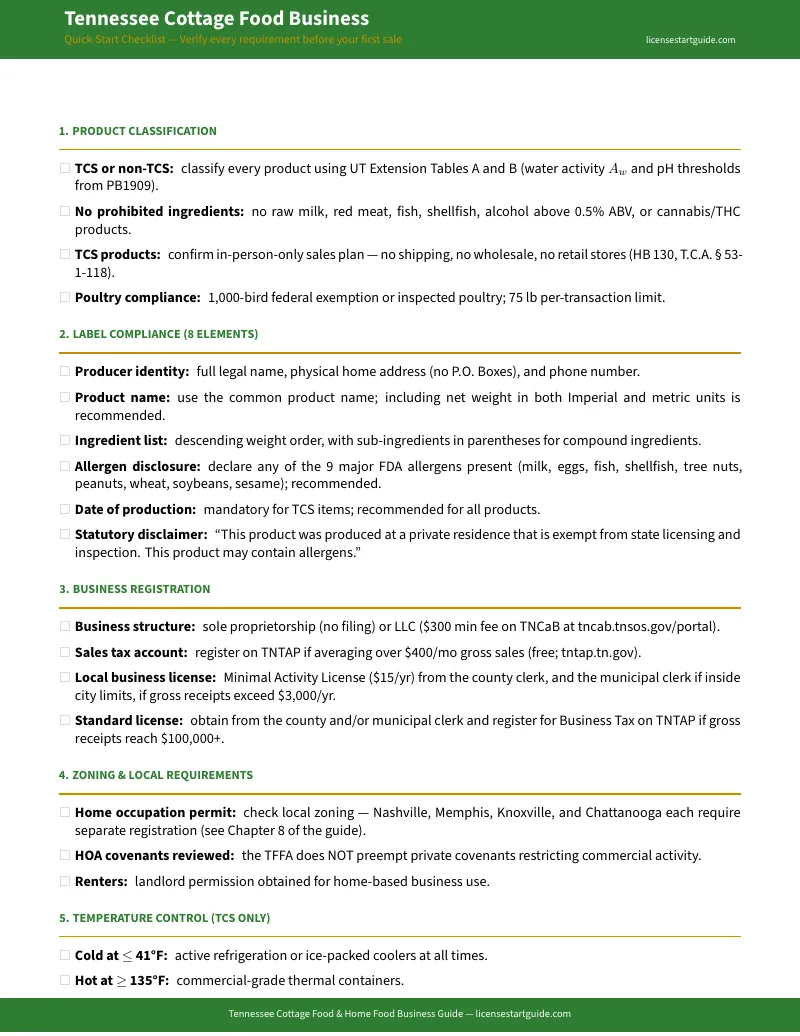
The free checklist gives you a quick startup overview — 22 items covering the core Food Freedom Act requirements so you can verify whether your product, kitchen, and sales plan meet the basics. Download it, work through it tonight, and see where you stand.
When you're ready for the full compliance map — Product Classification Worksheet, Label Builder, Sales Channel Decision Tree, City Zoning Procedures, Tax Registration Walkthrough, Insurance Decision Guide, and production tracking worksheets — get the full guide for .