Five State Agencies, a Newly Preempted Zoning Code, and a Subsidy System That Changed the Rules Mid-Year
You have been watching children in your home — your sister's toddler, a neighbor's kindergartner, a coworker's infant on shift days. The arrangement works, and now more families are asking. Someone wants to pay with a CCAP certificate. Someone else needs infant care. You know you need to get licensed, but "getting licensed" in Tennessee turns out to be a web of overlapping systems that never talk to each other: TDHS for your state license, IdentoGO for background checks, the State Fire Marshal's Office for safety codes, your city or county for zoning clearances, and the CCAP program for subsidy enrollment.
The information is technically free. The TDHS website has the rules. The IdentoGO portal has the fingerprinting registration. Your city hall has the zoning ordinance. But none of them explain the order. So you pay for background checks before discovering that your local zoning office never heard of HB 1175's preemption — or that the CCAP subsidy program eliminated most rate differentials in October 2025, making the reimbursement math look nothing like what the blog posts from last year promised.
The Pre-Licensure Compliance Sequencer
This is a 13-chapter guide organized around a single principle: never pay a non-refundable fee or schedule a state inspection before confirming you are clear to proceed. Every step is ordered so that zero-cost feasibility checks come first — your property layout, your zoning classification, your household members' eligibility for background clearance — and money only changes hands after you have confirmed your home qualifies for the provider category you are targeting.
The guide covers both home-based provider categories (Family Child Care Home and Group Child Care Home), the 2025 HB 1175 zoning preemption that reclassifies family homes as residential use, the April 2025 building code transition from NFPA 101 to the International Residential Code, and the practical differences that matter in Nashville, Memphis, Knoxville, and Chattanooga. You will not confuse your TDHS license with your local business permit, and you will not discover a fire code transition three weeks before your inspection.
What's Inside
- Provider category decision framework — Family Home (5–7 unrelated children, 12 total) or Group Home (8–12 children, 15 total with school-age bonus). The guide walks through capacity limits, infant-toddler ratios, staffing triggers, zoning implications, and fee differences so you choose the right category before contacting TDHS.
- 10-step pre-licensure process walkthrough — the exact sequence from your first Informational Intake Meeting through your provisional license, including registration for the virtual orientation, the Small Business Academy, and the eLicensing Portal application.
- HB 1175 zoning preemption analysis — what your city is now legally prohibited from requiring (conditional use permits, zoning variances, or restrictions beyond standard residential rules) versus what they can still enforce (business registration, noise, fire codes). Includes the specific municipal situations in Nashville (home occupation permit and 20 percent floor-area limit), Memphis (Unified Development Code home business rules), Knoxville (the local 6-child cap that state preemption now overrides), and Chattanooga (the clearance letter requirement).
- Background screening filing guide — every person in your household aged 15 and older must be screened through IdentoGO. The guide breaks down the TBI/FBI fingerprint process, the state registry check, the out-of-state registry check, excludable offenses, and the state fee coverage that makes fingerprinting free for providers under an active pre-licensure application.
- Room-by-room inspection prep checklist — modeled after the TDHS Observation Tool and Tenn. Comp. R. & Regs. 1240-04-01. Covers indoor space (30 sq ft per child), outdoor fencing (50 sq ft per child), water hazard barriers, safe sleep equipment, medication storage, fire safety installations, and every item the licensing analyst will check.
- Mixed-age capacity calculator — the "youngest-child rule" means a single infant can change the supervision requirements for your entire group. The worksheet helps you model different enrollment scenarios with your own children under nine included in every count, so you can project realistic revenue before committing to a provider category.
- Training requirements roadmap — the 8-hour virtual Intake/Orientation, the 2-day Small Business Academy, the 18 annual clock-hours for primary educators, CPR and First Aid certification, and where to find approved courses through TrainTN and ProSolutions Training.
- Building code transition guide — how the April 2025 switch from NFPA 101 to the 2021 International Building Code (IBC for centers, IRC Appendix AM for family homes) simplifies your physical requirements by aligning home inspections with standard residential construction standards.
- CCAP subsidy enrollment pathway — how to register as a CCAP provider through the One DHS Portal, current reimbursement rates, the October 2025 rate restructuring that eliminated most differentials, the mandatory 5 percent parent co-pay, enrollment-based billing, and strategies for collecting co-pays and maintaining attendance records that protect against audit clawbacks.
- CACFP food program integration — how to enroll through an approved sponsoring organization, current Tier I and Tier II reimbursement rates, nutritional documentation requirements, and meal participation record-keeping.
- Insurance and business structure — general liability coverage requirements, auto liability for transportation, LLC vs. sole proprietorship considerations, and how to separate business and personal assets.
Who This Is For
ECE professionals going independent. You have worked in center-based care or as a private nanny. You know child development, ratios, and safety protocols. But you have never navigated state licensing, coordinated household background checks, or dealt with municipal zoning offices. This guide handles the regulatory infrastructure so you can focus on the childcare you already know how to deliver.
Parents building a home-based income. You want to earn while staying home with your own children — but you need to understand how your kids under nine affect your licensed capacity, whether your local zoning code allows a daycare after HB 1175, and what physical modifications your home might need before the licensing analyst arrives. The feasibility-first sequencing answers all of that before you spend a dollar.
Informal caregivers going legal. You are already watching four children, and a parent just asked about CCAP certificates — or a fifth family wants in, which legally triggers mandatory licensure under T.C.A. § 71-3-501. This guide transitions you from informal to compliant without guesswork about which provider category fits, whether your household members will clear screening, or what the CCAP reimbursement math actually looks like after the October 2025 changes.
Why Not Just Use the Free State Resources?
The TDHS website has the rules, the orientation registration, and a general overview of requirements. It does not tell you which steps to complete first, how to coordinate your state application with your city's business registration process, or how to confirm your zoning before paying for anything. The portal is a reference library organized by regulatory chapter, not a sequenced plan organized by what you need to do next.
Brightwheel publishes state-level licensing guides, but their Tennessee content regularly misses the 2025 HB 1175 zoning preemption and the October 2025 CCAP co-pay changes. Wonderschool offers structured coaching that leads into ongoing platform fees tied to your enrollment. The Tennessee Child Care Resource and Referral Network provides excellent quality coaching and training, but does not cover municipal zoning navigation, business formation, or subsidy billing mechanics.
This guide fills the gap: a one-time purchase that sequences every step from property feasibility through your first year of compliance, covers the municipal and subsidy layers that generic tools skip, and stays out of your way once you are operational.
What You Get
Your download includes 8 printable PDFs:
- The full guide (49 pages) — 13 chapters covering provider categories, the 10-step pre-licensure process, background screening, physical home standards, training requirements, zoning and HB 1175, daily operations and record-keeping, CCAP subsidies, CACFP food program, insurance and business structure, planning worksheets, and key resources and contacts.
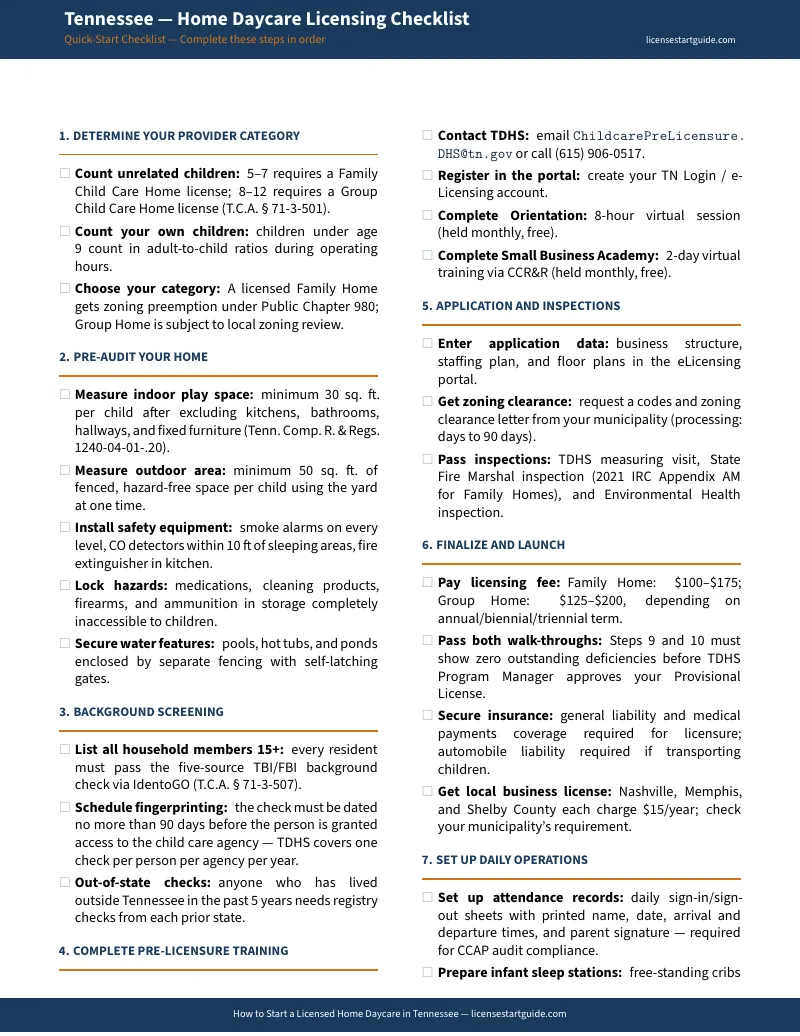
- Quick-start checklist — 30 items organized by phase, from eligibility verification through your first week of licensed operation. Print it, work through it in order, check off each step as you go.
- Home safety pre-audit worksheet — Walk through every room and outdoor area against the TDHS inspection standards. Pass/fail each item and note what needs fixing before your measuring visit.
- Usable space calculator — Enter your room measurements, excluded areas, and fixed furniture to calculate your maximum child capacity under the 30 sq ft per child rule.
- Background check tracker — Track IdentoGO appointments, submission status, and five-source verification results for every household member aged 15 and older.
- Licensing timeline planner — Map the 10 TDHS pre-licensure steps against your own target dates, flag delays before they cascade, and track parallel tasks like zoning clearance and insurance.
- Daily attendance log — TDHS-compliant sign-in/sign-out sheets with parent signature fields. Print one per week for your licensing binder and CCAP audit documentation.
- Agency communication log — Record every call, email, and visit with TDHS, codes offices, fire marshals, and health inspectors. Dates, names, and outcomes for escalation if a clearance stalls.
Satisfaction Guarantee
If the guide does not help you move forward, email us and we will refund you. No time limit, no hoops.
Download the free checklist to see the structure. When you are ready for the full sequenced guide with city-specific zoning guidance, background check breakdowns, and inspection prep tools, the complete toolkit is here.