You searched for a "South Dakota contractor license" and landed on a tax registration page
That's not a mistake — that's the reality of how contractor licensing works in this state. South Dakota doesn't issue a general contractor license through a central board. What it does is split your obligations between a state tax registration and a patchwork of municipal licensing ordinances that each have their own exams, bonds, insurance thresholds, and fee schedules.
Most new contractors discover this the hard way: they get their Contractor's Excise Tax number, assume they're licensed, start bidding on work, and get hit with a stop-work order the first time they try to pull a permit. That's a Class 1 Misdemeanor — fines up to $1,000, potential jail time, and a reputation problem before the business even gets off the ground.
The Dual-Tax Navigation System
This guide exists because the information you need is scattered across dozens of unlinked state and municipal portals, and getting any piece wrong costs real money. The South Dakota General Contractor License Guide maps the complete regulatory sequence — from business entity formation through your first pulled building permit — with the dual-tax mechanics and city-by-city requirements that nobody else puts in one place.
Here's what the guide navigates you through, step by step:
The state tax layer
The 2% Contractor's Excise Tax sits on top of the 4.2% state sales tax on materials, creating a dual-tax structure that erodes your margins if you don't price contracts correctly. The guide breaks down the 2.041% bid factor — the exact mathematical adjustment you need to recover the excise tax without eating into your profit — and walks you through non-utility vs. utility project rules, use tax on out-of-state purchases, and the filing schedule that keeps you audit-clean.
The municipal licensing layer
Each city in South Dakota has its own contractor licensing system. Sioux Falls uses a triennial cycle with a $20,000 compliance bond and a residential code exam. Rapid City requires a Pearson VUE exam and carries a $1,000,000 insurance threshold. Aberdeen sends every application through a City Council vote. The guide covers five major municipalities in detail — the exam format, the bond amounts, the insurance minimums, and the application sequence for each one — so you know exactly what to prepare before you walk into any building department.
The subcontractor liability gap
Under South Dakota's statutory employer doctrine, if you hire a subcontractor who lacks workers' compensation insurance and their employee gets injured on your site, the liability flows upward to you. The guide covers the verification protocol, the Form 1346 exemption certificate process, and the workers' comp non-participation pathway for sole proprietors — the administrative steps that separate protected contractors from exposed ones.
What's inside the toolkit
- 17-chapter process guide — covers entity formation, CET registration, insurance thresholds, bonds, municipal licensing for Sioux Falls, Rapid City, Aberdeen, Brookings, and Watertown, electrical and plumbing trade boundaries, subcontractor management, speculative builder rules, out-of-state entry, tribal considerations, and startup cost budgeting
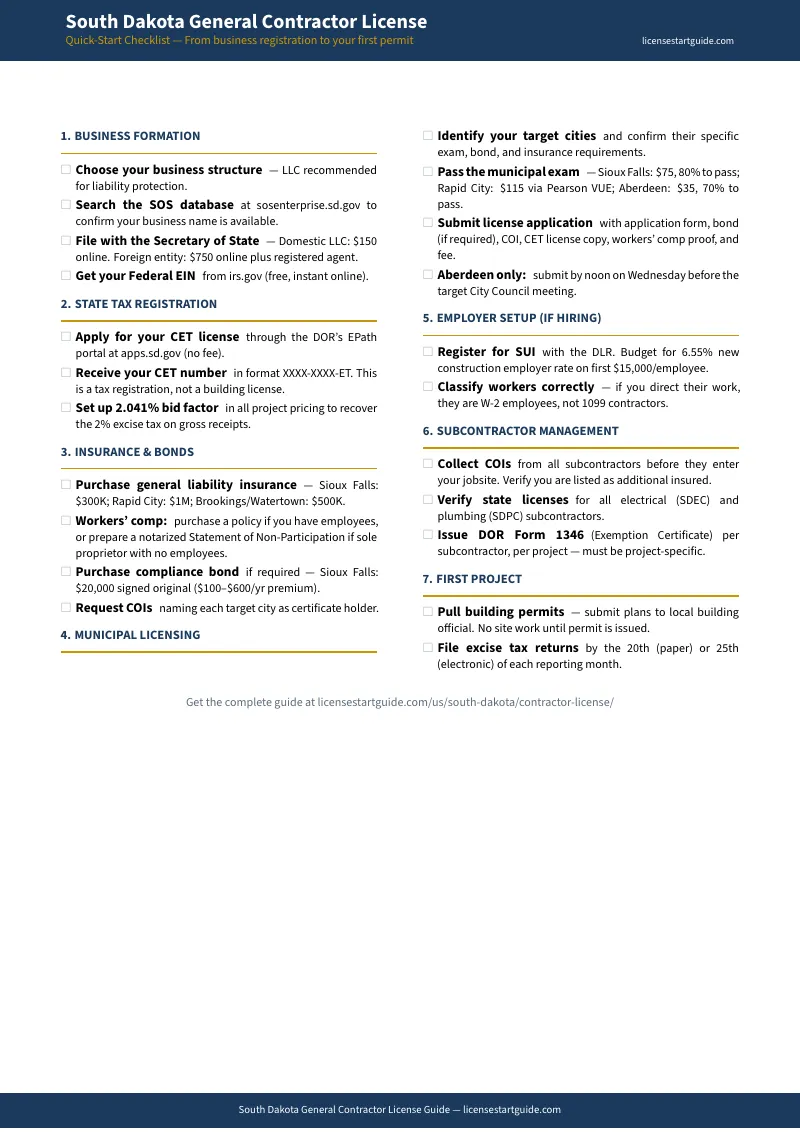
- 23-item setup checklist — the complete registration sequence from LLC filing through first permit pull, in the order dependencies require
- Bid factor reference card — the dual-tax math on one printable page, with a quick-reference table and a fillable bid worksheet
- Municipal licensing comparison — exams, bonds, insurance minimums, and fees for five cities side by side
- Startup cost worksheet — track estimated vs. actual costs from formation through first permit
- Registration sequence tracker — 10-step tracker with space for reference numbers and completion dates
- Subcontractor verification checklist — per-subcontractor form for insurance, trade licenses, and Form 1346 tracking
Who this is for
- Experienced construction workers, framing leads, and finish carpenters transitioning from employee to independent contractor
- Specialty subcontractors (roofing, concrete, mechanical, siding) setting up their own business for the first time
- Out-of-state contractors expanding into South Dakota who need to understand the foreign entity registration and local licensing requirements
- Remodelers and spec builders who need to understand the speculative builder tax classification before they buy and flip property
Why this exists when free information is available
The Department of Revenue covers the tax side. Municipal websites cover local permits. The Secretary of State handles entity formation. None of them talk to each other, and none of them explain how their requirements interact. You can spend a full week piecing it together across dozens of PDFs, buried municipal code sections, and phone calls to building departments that are open four hours a day — or you can follow a single sequence that maps the whole system in one sitting.
Professional licensing services charge $150 to $350 per hour to walk you through what this guide covers for the price of . Attorneys and CPAs are excellent at what they do, but most bootstrapping contractors don't have the budget for professional consultations before they've pulled their first permit.
The guarantee
If the guide doesn't save you more time and confusion than it costs, email us and we'll refund the purchase. No forms, no hoops — just a reply to your order confirmation.
The free checklist shows you what to do. The full guide shows you how — with the city-by-city details, the tax math, and the liability protections that keep your first year as an independent contractor from becoming your last.