Rhode Island Was the Last State to Legalize Home Food Sales. Its Rules Are Still the Strictest.
You have a recipe people love. You want to sell it — from your own kitchen, on your own schedule, without taking on commercial rent you cannot afford yet. Rhode Island law technically lets you do that now. But the gap between "technically legal" and "actually compliant" is where most home food businesses either stall or get shut down.
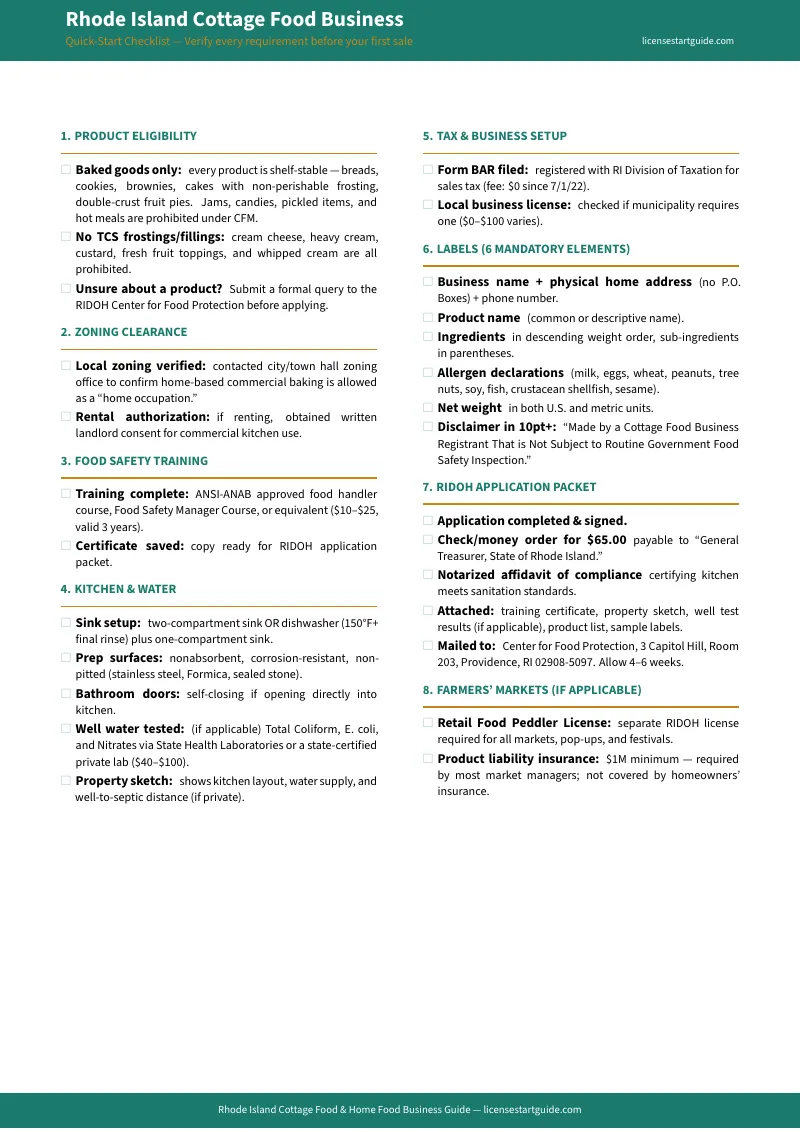
The cottage food registration application is not a form you fill out and mail. It requires a notarized affidavit of compliance, a property sketch with measured distances between your well and septic system (if applicable), proof of ANSI-accredited food safety training, water test lab results, and product labels that meet a set of formatting requirements strict enough to reject first-time applicants for a misplaced allergen declaration or an address in the wrong size font.
One missing element — and the $65 registration fee, the notary charges, and the lab testing costs are gone. You start over.
The Compliance Navigation System
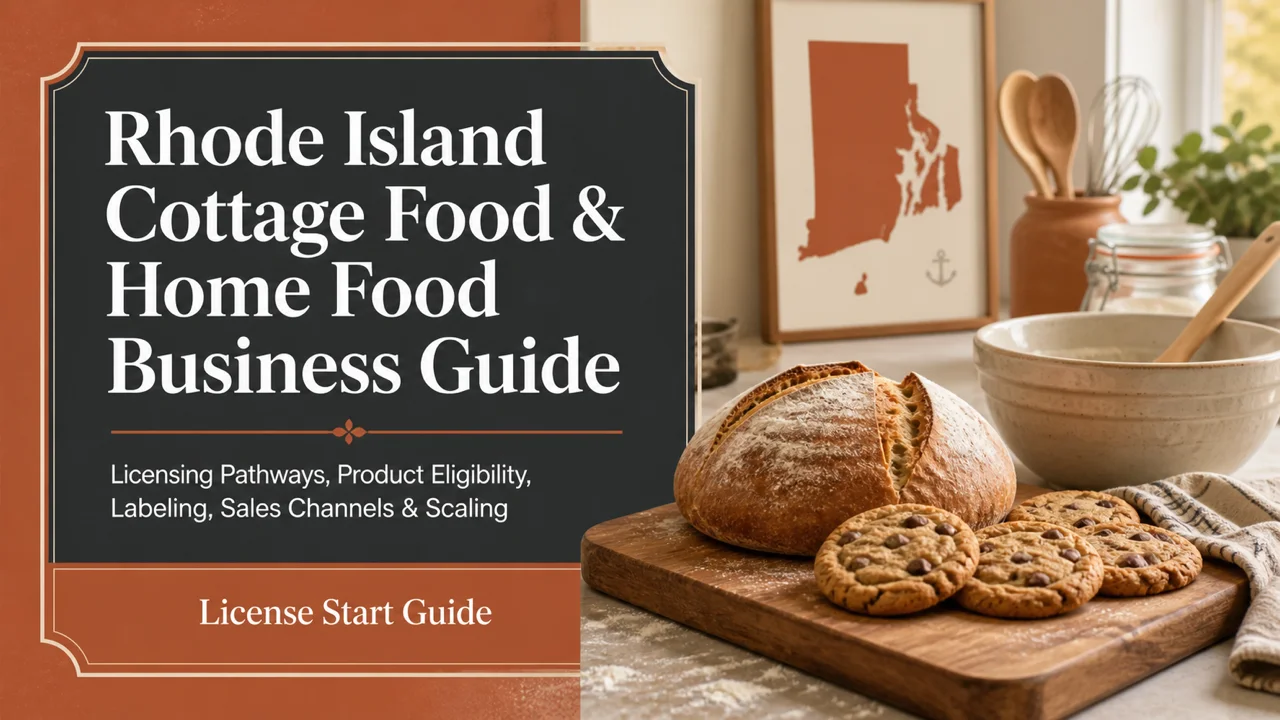
This guide is not a recipe collection or a food safety course. It is a compliance navigation system built specifically for Rhode Island's home food regulations — the licensing pathways, product eligibility criteria, labeling rules, sales channel restrictions, tax obligations, and financial modeling that determine whether your home food business is legal, viable, and worth scaling.
It covers the three distinct state licensing pathways (Cottage Food Manufacturer, Farm Home Food Manufacturer, and Commercial Food Processor), maps out which products fall under each one, and gives you the decision frameworks to avoid the most expensive mistakes home food entrepreneurs make in Rhode Island.
What's Inside
- Three-pathway licensing comparison — Cottage Food, Farm Home Food, and Commercial Processor mapped side by side with eligible operators, product restrictions, sales caps, fees, and permitted venues. You pick the right path before you spend anything on applications.
- Product eligibility decision framework — a systematic walkthrough of Rhode Island's strict "baked goods only" rule for cottage food, including the TCS (time/temperature control for safety) criteria that determine whether your frosting, filling, or topping is legal. Standard American buttercream passes. Cream cheese frosting does not.
- Label rejection-proofing system — the exact layout RIDOH requires: the verbatim 10-point disclaimer, your physical home address (no P.O. boxes), sub-ingredient formatting in descending order of predominance, allergen bolding for the nine major allergens, and the common formatting mistakes that trigger immediate application rejection.
- The delivery versus shipping legal map — Rhode Island law requires face-to-face, in-person transfer within the state. USPS, UPS, and FedEx are prohibited for cottage food, despite what popular national directories publish. The guide explains the statute, identifies the misinformation sources, and maps out compliant delivery options including the "designee" framework.
- Dual-licensing blueprint for farmers' market and festival sales — your cottage food registration alone does not authorize you to sell at a farmers' market. You need a separate Retail Food Peddler License ($60/year), market manager documentation, product liability insurance, and compliant labeling before you can set up a stall. The guide walks through the full dual-licensing process.
- Tax compliance framework — when your sales are tax-exempt as unprepared groceries, when the 7% sales tax applies, when the additional 1% meals and beverage tax kicks in, and how to register for a Retail Sales Tax Permit with the Division of Taxation.
- Kitchen infrastructure self-audit — the minimum housing standards and kitchen requirements under § 21-27-6.2(1): sink configurations, dishwasher specifications, self-closing bathroom doors, nonabsorbent preparation surfaces, and laundry isolation during production.
- Municipal zoning and infrastructure checklist — local ordinances are not preempted by state law in Rhode Island. The guide covers how to check your home occupation permit requirements, rental property restrictions (landlord-registration cities like Warwick can revoke rental licenses for zoning violations), and the well/septic distance documentation that RIDOH requires for private water systems.
- Scaling and transition calculator — financial models showing the exact volume of sales required to make the jump from a zero-rent home kitchen to a commercial incubator like Hope & Main (default rates of $33.05/hour or memberships up to $1,200/month). The guide helps you model whether your current revenue justifies the overhead — or whether premature scaling will compress your margins into insolvency.
- Insurance guidance — product liability coverage requirements for farmers' market vendors, general liability for home-based operations, and what market managers and event organizers typically require before assigning stall space.
Who It's For
- Home bakers validating their first sales — you need to know whether your recipe is legally producible before you invest in packaging, labeling, and the registration process
- Parents and caregivers building a home microbusiness — the guide is structured to show you the lowest-cost, lowest-risk path to compliant sales without requiring a commercial lease
- Farmers' market and festival sellers — the dual-licensing requirement catches vendors off guard every spring; this guide covers both registrations and the documentation market managers demand
- Ethnic food entrepreneurs — if your traditional recipes do not fit Rhode Island's baked-goods-only cottage food definition, the guide maps out whether recipe reformulation or a commercial kitchen is the better path
- Growers and homesteaders adding value to crops — the Farm Home Food Manufacturer pathway lets qualifying farmers produce jams, preserves, syrups, and candies without a sales cap, but the eligibility requirements are strict
Why Not Piece It Together from Free Sources?
The RIDOH website provides the application packet and a brief FAQ, but it is written in regulatory language that outlines what the rules are without explaining how to comply. It does not walk you through sub-ingredient formatting, municipal zoning research, or the tax classification of your specific products.
National cottage food directories — StandScout, CottageCMS, and others — provide overviews of Rhode Island's law, but several of them actively publish incorrect information about shipping legality. One widely cited resource claims you can ship cottage food products via USPS to in-state addresses. The statute explicitly prohibits it.
Social media groups and Reddit threads move fast, but food-safety misinformation in peer forums carries real liability. A bad tip about labeling or ingredient eligibility can result in a rejected application, a wasted $65 fee, or worse — a cease-and-desist after you have already invested in inventory and marketing.
This guide consolidates the regulatory language, the practical compliance steps, and the financial planning into a single reference that protects your startup capital from the most common and most expensive mistakes.
What You Get
The complete package includes 10 downloadable PDFs you keep forever: the full guide, a 27-item startup checklist, plus eight fillable compliance tools — a recipe eligibility worksheet, label compliance checklist, kitchen self-inspection checklist, application packet checklist, farmers' market prep checklist, startup cost worksheet, scaling calculator worksheet, and an annual compliance calendar. A free checklist is available if you want to start with the basics.
100% satisfaction guarantee. If the guide does not help you navigate Rhode Island's home food regulations more clearly than the free resources you have been reading, email us and we will refund you — no questions, no forms, no waiting period.
Get the Rhode Island Home Food Business Guide →
Or start with the free checklist — a one-page compliance roadmap covering the registration steps, kitchen requirements, and labeling basics.