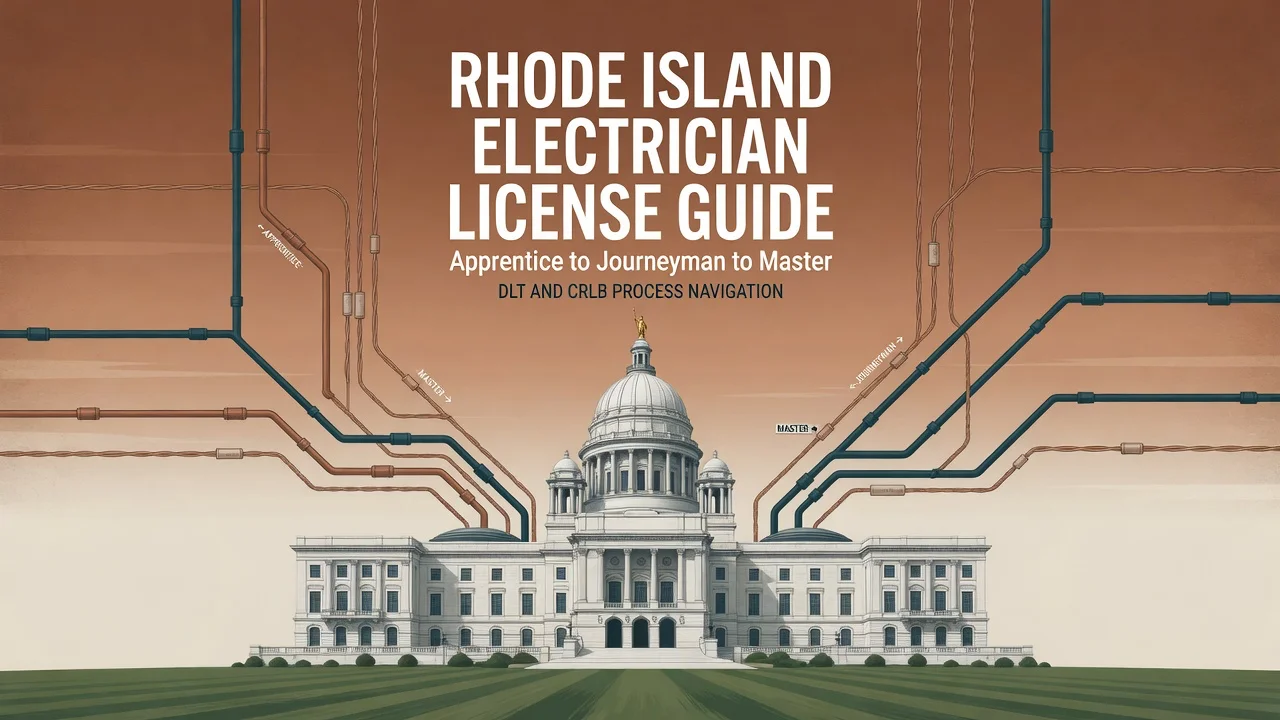
You've logged the hours. Rhode Island's dual-agency system won't let you prove it.
You finished your apprenticeship, documented your 8,000 hours, completed your 576 hours of classroom instruction — and now you're staring at an application process that runs across two state agencies, neither of which explains how it connects to the other. The Department of Labor and Training licenses you as an electrician. The Contractors' Registration and Licensing Board licenses your business. Both have their own applications, their own requirements, and their own ways of rejecting paperwork that doesn't match their expectations.
Submit your Certificate B application with a database printout instead of an official state-certified verification, and it comes back unprocessed. Fill out the DLT forms on your iPhone, and the board gets a PDF with overlapping, unreadable text — rejected. Miss the apprentice-to-journeyworker ratio requirement on even one jobsite, and the hours you logged there are invalid. Apply for Certificate A before holding Certificate B for two full years, and you're told to wait. Register with the CRLB before completing their mandatory 5-hour pre-registration class, and you're sent back to square one.
The Dual-Agency Licensing Map
The Rhode Island Electrician License Guide maps both regulatory tracks — the DLT trade licensing system and the CRLB business registration system — into one sequential roadmap. It doesn't teach the National Electrical Code or prepare you for trade exams. It teaches you how to compile documentation the DLT will accept on the first submission, navigate the transition from journeyperson to independent contractor across two separate agencies, and avoid the administrative errors that delay applications by months.
Every chapter targets the specific regulatory friction that catches people at that career stage. The apprenticeship chapter prevents unregistered hours. The exam chapter maps what Rhode Island's closed-book format requires you to memorize. The business chapter walks through CRLB registration, Secretary of State filings, and the $500,000 insurance requirement before you discover them on a rejected permit application.
What You Get
- Dual-Agency System Map — how the DLT Board of Examiners and the CRLB divide authority, why a Certificate A trade license and a CRLB contractor registration serve completely different functions, and where each credential gives (and doesn't give) you the right to work
- The Lettered Certificate Hierarchy — what Certificate B (Journeyperson), Certificate A (Contractor/Master), and the specialty certificates (Oil Burner, Fire Alarm, Sign Installer, Limited Maintenance) actually authorize, with the specific hour and experience thresholds for each
- Application Documentation Strategy — how to compile the employer verification letters, notarized statements, and registration forms that survive DLT review, including the mobile-PDF corruption warning and the certified-verification-vs-database-printout distinction that gets applications returned unprocessed
- Closed-Book Exam Preparation Framework — the NEC tables, voltage drop calculations, conduit fill formulas, and Rhode Island-specific regulations you need to memorize for a state-administered exam with no code book allowed
- Out-of-State Transfer Pathway — how to bypass the four-year apprenticeship requirement with an official state-certified license verification, the notarized employer letter requirements, and the two-year Certificate B residency rule before Certificate A eligibility
- Hour Recovery Protocols — what to do when employment records are lost or employers are uncooperative, with the DLT's secondary documentation options including tax records and prevailing wage filings
- CRLB Business Registration Sequence — the mandatory 5-hour pre-registration class, $500,000 general liability insurance naming the CRLB as certificate holder, Secretary of State entity formation, registered agent requirements, and the payroll registration steps that must happen before your first permit pull
- W-2 vs. 1099 Classification Rules — why a Certificate B holder cannot legally operate as a 1099 subcontractor in Rhode Island, the misclassification penalties under R.I. Gen. Laws § 5-6-32, and how to structure subcontractor relationships that comply with state labor law
- Municipal Permitting — how local building departments interact with state licensing, permit fee structures across Providence, Cranston, Warwick, and East Providence, the homeowner exemption limits, and the rough-in and final inspection sequence
- Renewal and Continuing Education — the 15-hour MCE requirement on the current NEC cycle, the birthdate-based biennial renewal system, late fees, and approved CE providers
Who It's For
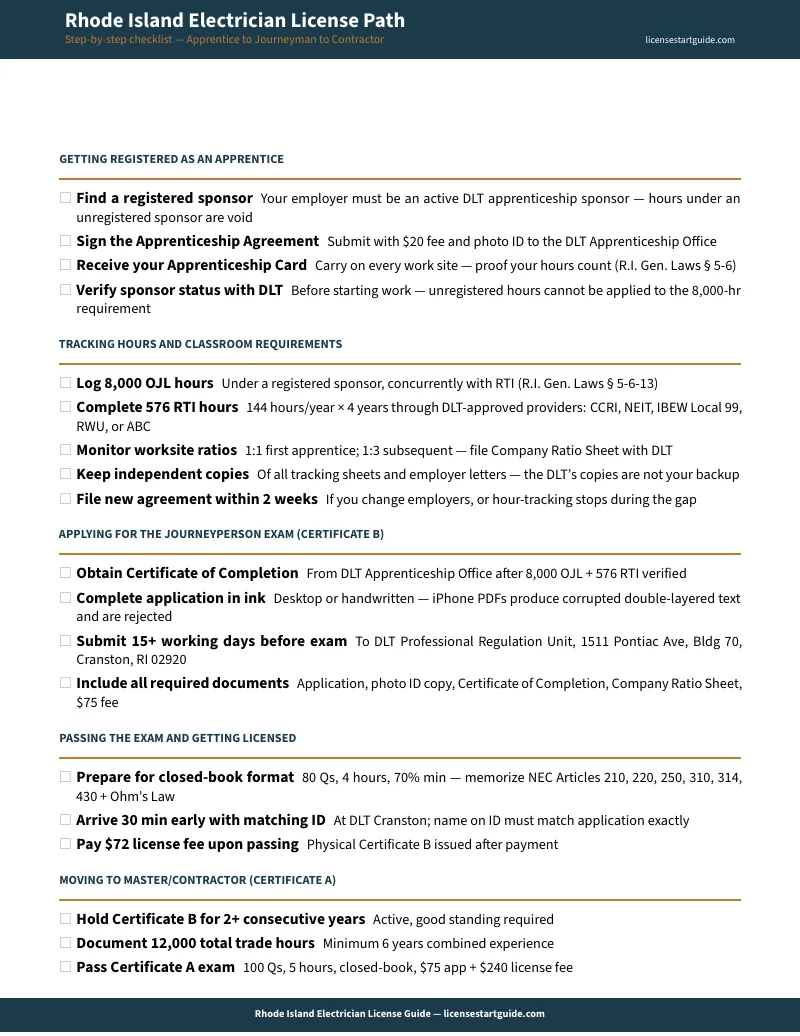
- Apprentices approaching 8,000 hours who need to compile a DLT exam application packet that gets accepted on the first submission — including employer verification letters, ratio documentation, and the uncorrupted PDF forms the board requires
- Trade helpers with undocumented or gapped hours who need to understand which work the DLT will recognize and how to reconstruct incomplete employment records
- Journeypersons holding Certificate B who want to know exactly what the Certificate A exam covers, how to document 12,000 total hours, and what the CRLB requires before they can pull permits under their own entity
- Out-of-state electricians relocating to Rhode Island who've discovered the state doesn't offer reciprocity and need to navigate the exam-waiver and credential-verification pathway
- Certificate A holders launching an independent business who need to align their DLT trade license with CRLB registration, liability insurance, Secretary of State filings, and worker classification compliance
Why This Guide Instead of Free Resources
Everything in this guide is technically available across the DLT Professional Regulation website, the CRLB portal, the Rhode Island General Assembly statutes, and municipal building department sites. But the DLT doesn't explain how its trade licensing connects to CRLB contractor registration — that's a different agency. The CRLB doesn't explain the Certificate A exam or apprenticeship requirements — that's DLT jurisdiction. Neither agency warns you about the mobile-PDF corruption issue, the certified-verification requirement, or the jobsite ratio rules until your application is already returned.
Exam-prep packages from At Home Prep and GetLicenseReady run $85 to $539 and cover NEC code study — nothing about hour documentation, the DLT–CRLB regulatory split, business formation, or out-of-state credential transfer. Roger Williams University's classroom program costs $2,000 per year and covers technical instruction only.
This guide costs less than a single DLT application fee and covers the entire dual-agency pathway from apprenticeship registration through independent contractor operations.
Satisfaction Guarantee
If the guide doesn't give you a clear roadmap for your specific licensing stage, reply to the confirmation email and we'll refund the purchase.
Get the Rhode Island Electrician License Guide →
Download includes 8 printable PDFs: the complete 13-chapter dual-agency roadmap guide, a 24-item licensing checklist organized across 6 career phases, plus 6 standalone planning tools — an apprenticeship hour tracker, RTI completion log, exam application pre-flight checklist, employer verification letter template, business launch checklist, and agency communication log. Free tier available — download the checklist alone to see the scope before deciding.