You're allowed to sell food from your home kitchen in Ohio. But "allowed" doesn't mean "simple."
Ohio's cottage food exemption sounds straightforward: make shelf-stable foods at home, sell them directly to customers, no license required. No fees. No inspections. No annual revenue cap.
But the exemption only protects you from the Ohio Department of Agriculture. It doesn't protect you from:
- Your city's zoning office — which can issue a home-occupation violation the first time a customer pulls into your driveway for a porch pickup
- Your county health district — which has its own permit requirements the moment you sell at a privately-run craft fair or corporate event
- The Ohio Department of Taxation — which charges automatic $50 penalties for every missed filing, even when your sales tax owed is zero
And if your product needs refrigeration — a cheesecake, a cream pie, a custard-filled pastry — the cottage food exemption doesn't apply at all. You need a separate Home Bakery license with a kitchen inspection, a pet ban, and a well-water test.
Most home food entrepreneurs don't discover these overlapping requirements until they've already received a citation, a cease-and-desist, or a surprise penalty notice.
The Compliance Pathway System
This guide maps every regulatory layer — state food safety, local health districts, municipal zoning, and state tax — into a single decision framework. Instead of piecing together information from the ODA website, OSU Extension bulletins, local health department PDFs, and scattered Reddit threads, you get one structured resource that shows you exactly where the rules intersect and where the gaps can catch you.
What's Inside
- Product Classification Decision Tree — walk through the OAC 901:3-20-04 approved list step by step. Know within minutes whether each of your products qualifies for the no-license cottage food exemption, requires a $10 Home Bakery license, or needs a full commercial facility
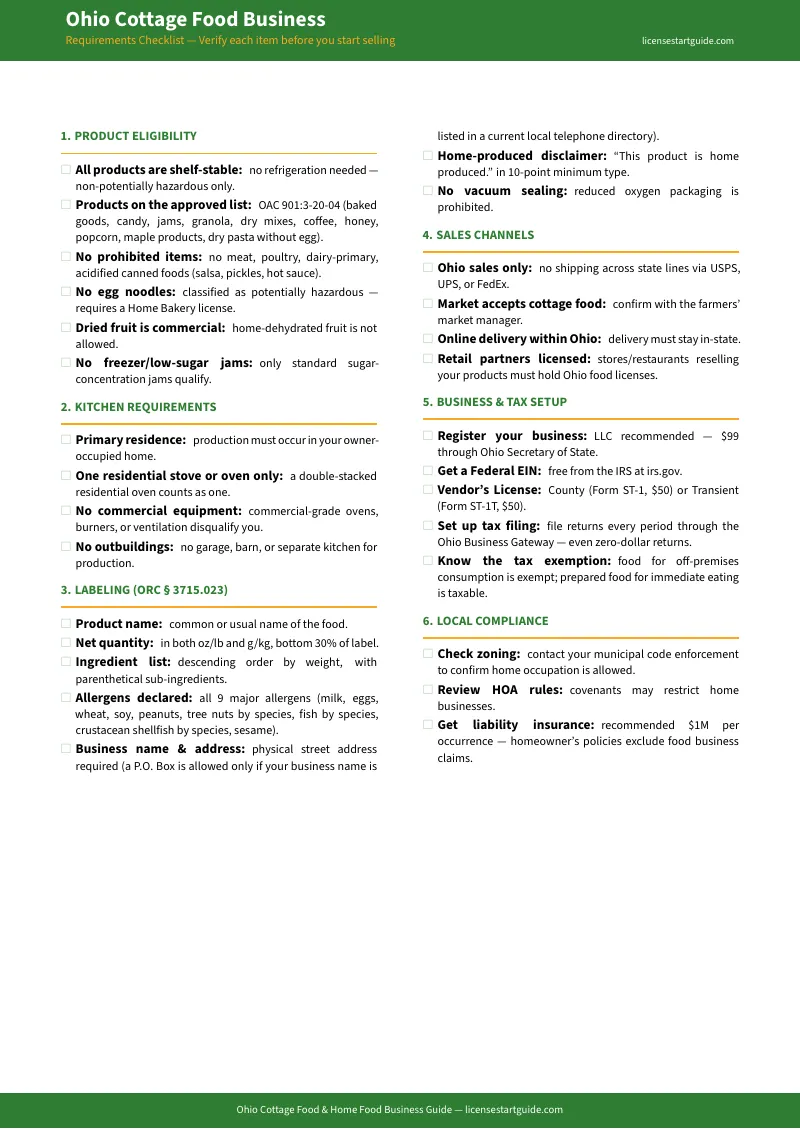
- Home Kitchen Property Audit — the exact physical requirements the ODA enforces for both cottage food and home bakery operations: one residential oven, primary residence only, no commercial equipment. Plus the additional home bakery rules: no pets inside the home at any time, no carpet in the kitchen, calibrated refrigerator at 45°F or below
- Zoning Risk Assessment — how to check whether your municipality's home-occupation ordinance allows residential food sales before you start advertising. State law does not preempt local zoning — and most home bakers don't learn this until the violation letter arrives
- Label Templates — fill-in-ready templates that satisfy the six mandatory label elements under ORC § 3715.023, including the verbatim "This Product is Home Produced" disclaimer in 10-point minimum font, proper ingredient ordering by weight, parenthetical sub-ingredients, and allergen declarations for all nine major allergens
- Sales Channel Map — which venues are exempt from local health permits (registered farmers' markets), which trigger a temporary or mobile food license (private craft shows, corporate events), and exactly why shipping a package out of state invokes federal FDA jurisdiction
- Vendor's License and Tax Filing Walkthrough — the step-by-step process for getting a County ($50) or Transient ($50) Vendor's License through the Ohio Business Gateway, plus a fillable monthly filing tracker so you never miss a zero-dollar return
- Home Bakery Application and Inspection Guide — every form, fee, and physical requirement for the ODA Home Bakery license under ORC Chapter 911, including the complete inspection checklist ODA sanitarians use during their kitchen visit
- The 2024 Low Risk Mobile Food License — how the February 2024 MRFE rule change lets home bakery licensees sell refrigerated goods at outdoor markets using ice coolers instead of commercial refrigerators, cutting both fees and equipment costs
- Commercial Kitchen Scaling Framework — cost comparisons for Ohio's major shared kitchen incubators ($120–$150 annual membership, $15–$30/hour), so you know exactly when it makes financial sense to move out of your home kitchen
- HB 134 Status Tracker — the current legislative position of Ohio's proposed Microenterprise Home Kitchen Operation bill, what it would allow if signed into law, and what you cannot legally do until then
Who This Guide Is For
- Hobby bakers testing local sales — you've been giving away cookies and cakes to friends. Now you want to sell at the neighborhood farmers' market without accidentally breaking a rule you didn't know existed
- Social media sellers — you take custom orders through Instagram or Facebook Marketplace and coordinate porch pickups. You need to know the geographic and product limits before a customer in Kentucky asks you to ship
- Market vendors expanding beyond their home county — you've outgrown your local market and want to sell at events across Ohio. The Transient Vendor's License and Low Risk MRFE rules apply to you
- Specialty food makers — you sell gluten-free, allergen-friendly, or health-conscious products. The moment you put "low-sugar" or "high-protein" on your label, you trigger Nutrition Facts panel requirements that most home producers don't know about
- Home cooks who want to sell meals — you want to know whether Ohio law allows prepared meal delivery from a home kitchen (it doesn't, yet) and what HB 134 would change if enacted
- Growing businesses deciding when to go commercial — you're producing at capacity in your home kitchen and need to compare the $10/year Home Bakery license against $150+/month in shared kitchen costs
Why Not Just Use the Free Resources?
The Ohio Department of Agriculture publishes a cottage food fact sheet. OSU Extension offers bulletins and a $25 online course. Local health departments have their own guides.
Here's what none of them cover:
- How your city's zoning code can override the ODA's cottage food exemption — and how to check before you start selling
- The exact process for filing zero-dollar tax returns to avoid automatic penalties when you hold a Vendor's License but all your sales are tax-exempt
- How the state-versus-local jurisdiction split works when you sell at a privately-run craft show versus a registered farmers' market
- The specific physical requirements ODA sanitarians check during a Home Bakery inspection — including rules about pets that apply to your entire home, not just the kitchen
- A side-by-side cost comparison of staying in your home kitchen versus renting space at a shared commercial facility
Each free resource covers one slice of the picture. This guide connects them all — state food safety, local health permits, municipal zoning, tax obligations, and commercial scaling — into a single, step-by-step business roadmap.
Satisfaction Guarantee
If the guide doesn't save you time and help you understand Ohio's home food regulations more clearly, email us and we'll make it right.
Start Selling Legally
Download the free checklist to see whether your products qualify for the cottage food exemption. When you're ready for the complete regulatory roadmap — including label templates, inspection checklists, tax filing walkthroughs, and commercial scaling analysis — get the full guide.