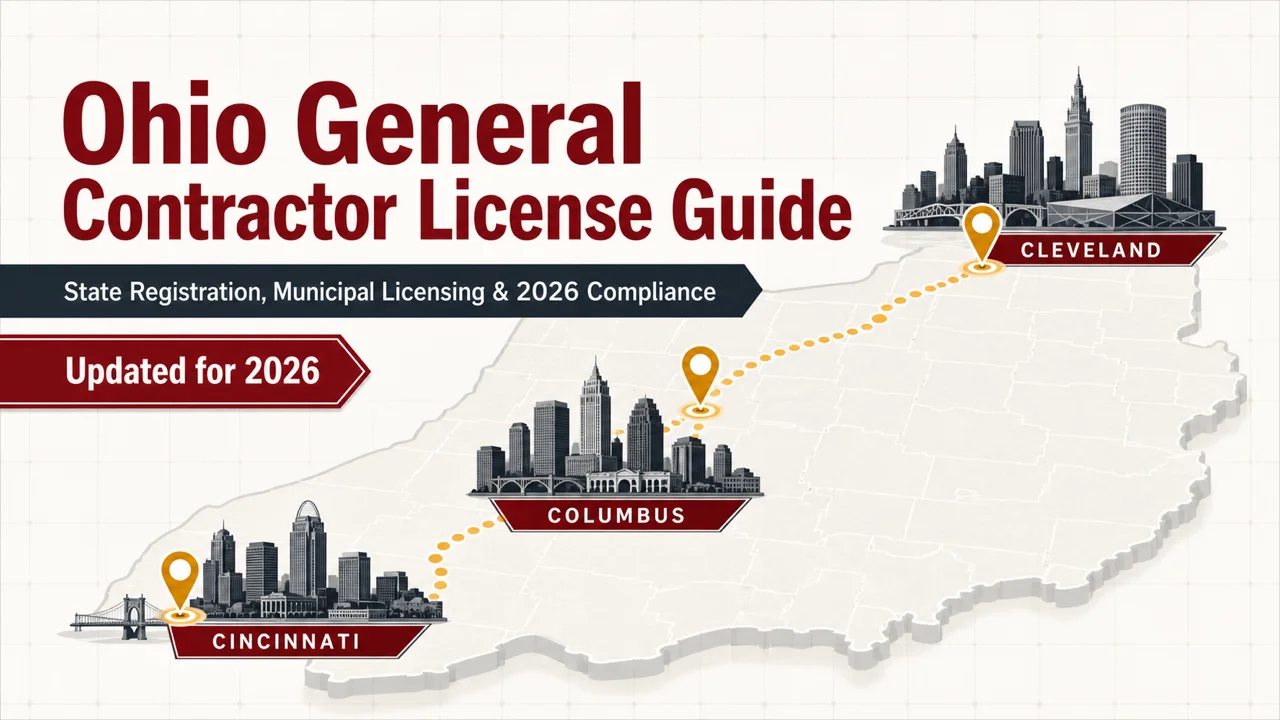
Ohio Doesn't Have a State Contractor License. That's the Problem.
You searched for an Ohio contractor license and expected to find one application, one agency, and one credential. It doesn't exist. General contracting in Ohio is regulated city by city — Columbus has one process, Cleveland has a completely different one, Cincinnati runs a third, and every smaller municipality in between has its own rules.
The result is a regulatory patchwork where getting a single detail wrong — filing a bond on the wrong city's form, missing a municipal tax registration, or assuming your Columbus registration covers a Cleveland job — can hold up your permits for weeks and cost you thousands in project delays.
The Jurisdiction Navigation System
The Ohio General Contractor License Guide is a plain-language process guide that maps every layer of Ohio's contractor licensing structure — state specialty trades, municipal registrations, consumer protection statutes, and workforce compliance — into a single reference you can actually follow.
Instead of cobbling together information from six different city websites and three state agencies, you work through the guide's decision framework to identify exactly which registrations, bonds, insurance policies, and tax filings apply to your specific situation. Then you follow the step-by-step sequences for each one, with the forms, fees, and deadlines already documented.
What's Inside
- The State-vs-Local Decision Tree — determines whether your work requires an OCILB state trade license, a municipal general contractor registration, or both, so you don't waste time applying for credentials you don't need
- Metro Registration Walkthroughs — Columbus ($350 annual fee, $25,000 bond, DBZS process), Cleveland ($150 fee, Dec 31 bond expiration, DB Housing process), Cincinnati ($131.25 fee, no bond for standard GC, income tax registration), plus Toledo, Dayton, and county-level requirements
- The ORC Chapter 4722 Compliance Section — every disclosure, deposit limit, and insurance minimum for residential contracts over $25,000, with the exact language your contracts need to include
- The HB 614 Myth Debunked — competitor sites and surety bond portals claim a statewide home improvement license is required in 2026. It isn't. This chapter shows you what the real law actually says, so you don't buy bonds you don't need
- 2026 E-Verify Playbook — the complete compliance pipeline for commercial contractors under Substitute House Bill 246, including the three-day verification window, record retention rules, and subcontractor contract language
- OCILB Specialty Trade Licensing — application steps, PSI exam logistics, background check procedures, experience documentation rules (including the September 2024 update on W-2/Schedule C verification), and biennial continuing education requirements for all five state-regulated trades
- Business Formation Sequence — LLC filing with the Secretary of State, EIN, Vendor's License, and enrollment in Ohio's monopolistic Bureau of Workers' Compensation state fund, in the order you actually complete them
- Municipal Bonding Navigator — which cities require bonds (and which don't), the face values ($5,000 to $25,000), why you need the specific city's bond form (generic bonds get rejected), and how to time your purchase around renewal cycles
- Five Print-and-Fill Planning Tools — a Municipal Registration Tracker with renewal calendar, a pre-submission Licensing Application Checklist, an HCSSA Contract Compliance Checklist, an Insurance and Bond Verification Log, and an E-Verify Onboarding Log — each one a fillable PDF you print and write on
Who This Is For
- First-time contractors stepping out from W-2 employment and setting up their own business — you need the full formation-to-permit sequence in order
- Established contractors expanding into new cities — you need to know what each municipality requires without calling every building department
- Residential remodelers crossing the $25,000 contract threshold — you need to understand ORC Chapter 4722 before the Attorney General's office does it for you
- Out-of-state firms entering Ohio — you need the foreign qualification steps, BWC enrollment, and the 2026 E-Verify requirements in one place
Why Free Resources Fall Short
City websites tell you their own requirements but nothing about state formation, workers' comp, or how their rules compare to the next jurisdiction over. State agencies cover the five OCILB trades but say nothing about general contracting. Surety bond sites and exam prep companies publish information designed to sell you their services — including the manufactured "HB 614" statewide license requirement that doesn't exist.
The gap isn't that the information is hidden. It's that it's scattered across dozens of sources, some of which are actively wrong, and none of which connect the dots between your specific situation and the specific sequence of registrations you need.
Try the Free Checklist First
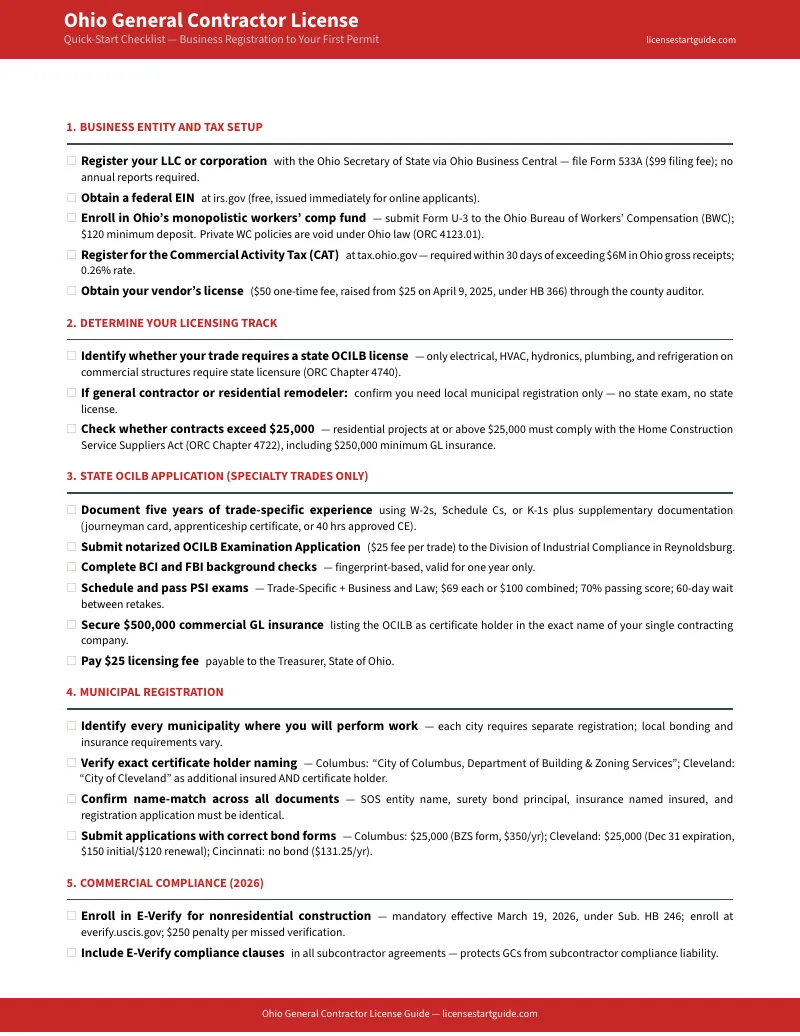
Download the Ohio General Contractor License Requirements Checklist at no cost. It covers the core licensing steps and document requirements in a printable two-page format. If you need the full walkthroughs, decision frameworks, and metro-by-metro breakdowns, the complete guide is and available as an instant PDF download.