North Carolina hands you the rules. Nobody hands you the sequence.
The Division of Child Development and Early Education publishes every rule, form, and administrative code you need to open a family child care home. What it doesn't publish is a timeline. So prospective operators pay the $75 pre-licensing workshop fee, then discover their municipality requires a zoning permit they should have secured first. They complete their ABCMS background checks before their household's teenager turns 16 — and the system flags the home because that teenager's check wasn't submitted within five days of their birthday. They prepare their home for the DCDEE consultant visit without understanding the difference between fire safety codes and environmental health requirements, and a single failed lead-water test holds up their license for weeks.
These are real sequencing failures, and the state's free resources don't prevent them because those resources aren't organized as a workflow. They're organized as regulations.
The NC Daycare Licensing Roadmap puts every step — state licensing, municipal zoning, background checks, training certifications, home inspections, and subsidy enrollment — into a single chronological sequence designed to prevent wasted fees, rejected paperwork, and inspection failures.
What's Inside
- Step-by-step licensing sequence — from zoning verification through your first day of enrolled care, ordered so each step completes before the next one needs it. The guide flags every point where doing things out of order costs you money or delays your timeline by weeks
- Municipality-specific zoning guidance — Raleigh's UDO Section 6.4.1 (no non-resident employees, 15-foot playground setback), Charlotte's UDO Section 15.6 (400-foot separation rule, rear-yard play requirement), Cary's building-use permit process ($100 fee), and a general framework for other NC municipalities. Includes HOA protections under Senate Bill 1051
- ABCMS background check walkthrough — how to set up your NCID, navigate the Automated Background Check Management System, manage checks for every household member aged 16 and older, the five-day submission deadline when a resident turns 16, and what to do about provisional caregiver supervision requirements
- Capacity option calculator — the three statutory capacity configurations under G.S. § 110-91(7)(b): Option A (8 children, mixed-age), Option B (9 children, infant-heavy), and Option C (10 children, all over 24 months). Explains how your own preschool-age children reduce available paying slots and when hiring an assistant makes financial sense
- Training certification tracker — the pre-licensing workshop registration process, Pediatric First Aid and CPR requirements, ITS-SIDS safe sleep training, child maltreatment recognition, and the year-one continuing education requirements. Tracks expiration dates so nothing lapses before renewal
- Room-by-room home inspection prep — organized as a mock self-inspection that covers the exact items your DCDEE consultant, fire marshal, and county environmental health inspector will check. Includes the lead-water "first-draw" sampling protocol, the 10 ppb action level threshold, private well testing requirements, and the Clean Classrooms for Carolina Kids asbestos and lead-paint enrollment process
- Application assembly checklist — every form, document, and supporting record your DCDEE consultant needs to see, organized by submission sequence. Covers the common reasons applications are returned or delayed
- Star-rated licensing roadmap — how the one-to-five-star system works, why all new programs start at one star, the six-month operating requirement before applying for a higher rating, and the exact points needed in program standards and staff education to reach three stars
- Subsidy enrollment guide — the NC FAST Provider Portal setup process, Business NCID registration, the three-star SCCA requirement for secular programs, and a private-pay bridge plan for managing cash flow during the months before subsidy payments begin
- Printable operations templates — enrollment forms (G.S. 110-91 compliant), daily attendance logs, emergency drill logs, medication administration and authorization records, and parent liability insurance disclosures
Who This Is For
Parents or caregivers starting from scratch. You've been caring for your own children and one or two neighbors' kids. A third family just asked. You know you need a license once three unrelated children are in your home regularly, but the DCDEE website gives you 14 separate rule chapters without a clear starting point. This guide sequences the entire process so you're never guessing what comes next.
Early childhood professionals going independent. You know child development — you've worked in centers, you have your CDA or associate degree. What you don't know is residential licensing: how zoning works differently from center permitting, which background check system covers household members (not just employees), and what the home inspection actually checks that a center inspection doesn't. The guide bridges that gap.
Informal providers who need to get legal. You've been babysitting for multiple families without a license. North Carolina's DCDEE conducts complaint investigations on unlicensed operations, and exceeding the two-child limit carries administrative penalties. The guide walks you from informal care to a fully licensed program, including how to accept state subsidy vouchers once you reach a three-star rating.
Renters and HOA residents. Your landlord says no commercial activity. Your HOA covenant bans home businesses. Senate Bill 1051 aims to make these restrictions unenforceable for licensed family child care homes. The guide includes notification templates and statutory references for those conversations.
Why Not Just Use the Free DCDEE Resources?
Because the DCDEE tells you what's required. It doesn't tell you the order that avoids rejected applications and duplicate fees.
The state's Getting a License page links to application packets, background check instructions, and administrative codes — spread across the DCDEE site, county DSS offices, local planning departments, environmental health portals, and fire marshal contacts. National daycare checklists from Brightwheel and Wonderschool cover generic steps but miss North Carolina's municipal zoning variations, the ABCMS-specific background check process, and the Clean Classrooms environmental health enrollment. Local Smart Start partnerships and CCR&R agencies offer coaching, but their availability varies by county and wait times can eat into your startup timeline.
This guide doesn't sell training, doesn't sell software, and doesn't have a vendor relationship. It sequences the exact state and local steps, flags the exact mistakes that delay licensing, and gives you printable templates for the records your DCDEE consultant will check during unannounced visits — so you spend your time and money on what's legally required and nothing else.
Satisfaction Guarantee
If the guide doesn't give you a clear, actionable path to your North Carolina family child care home license, email us and we'll refund your purchase. No forms, no waiting period.
Get Started
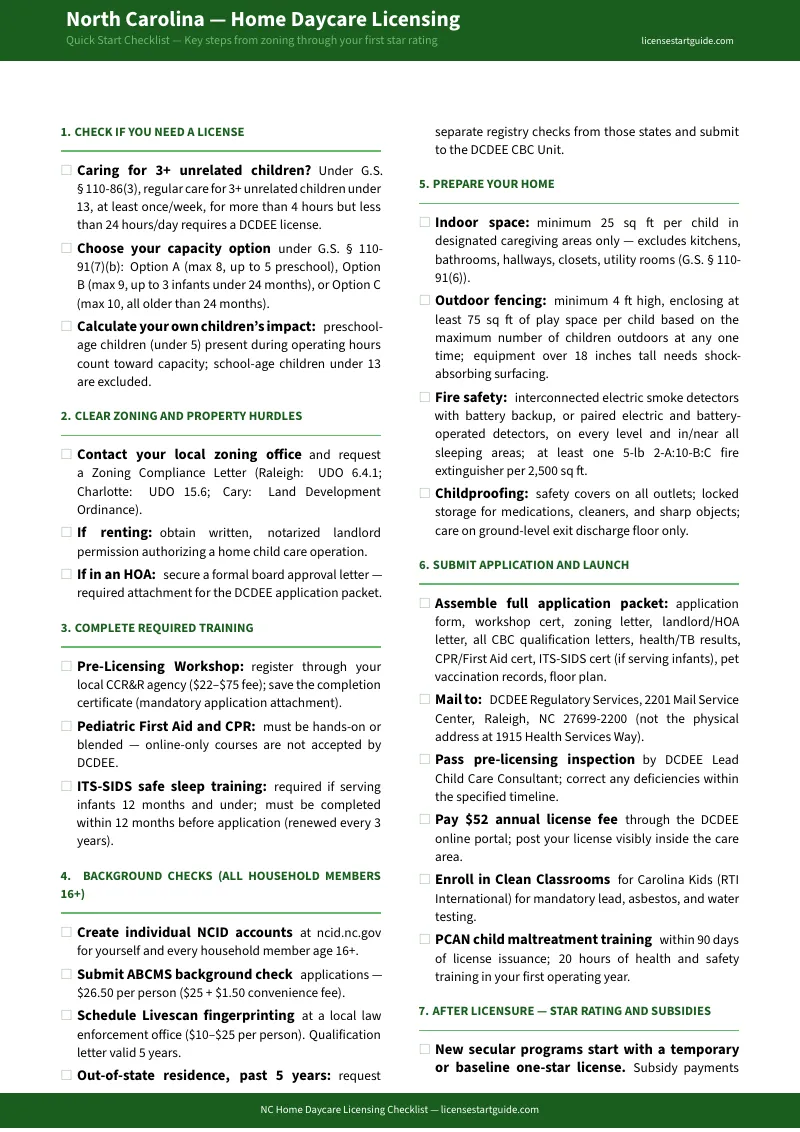
Download the free checklist for a quick overview of the licensing steps, or get the full NC Daycare Licensing Roadmap for — the 15-chapter guide plus printable templates: quick-start licensing checklist, capacity option calculator, room-by-room home inspection prep, training certification tracker, application document checklist, and operational record-keeping forms.