Five Agencies. One Wrong Step Burns Months of Premiums.
You've got the field skills. You can diagnose a failed compressor, size ductwork by the book, and run refrigerant lines in your sleep. But none of that matters to the State Board of Examiners until you've threaded your paperwork through five separate regulatory bodies — in the right order, with the right documents, at the right time.
Get the order wrong and the consequences are expensive. Register your LLC and bind a $500,000 general liability policy before the Board reviews your experience documentation, and you could spend three to six months paying premiums on a business entity that cannot legally contract for a single job. The Board meets once a month. A missing W-2 or an unregistered USDOL apprenticeship triggers a deficiency letter that sends you to the back of the line. Meanwhile, your insurance premiums keep billing.
Free checklists from insurance carriers and software companies cover bits of this — but none of them map the full sequence across all five agencies, and most of them get the order wrong because they're optimized to sell you their product, not to protect your capital.
The Five-Agency Sequencing System
This guide maps every step of New Jersey's HVAC licensing process in the order you should actually execute them — Board pre-qualification first, exams second, business formation third, bonding and insurance fourth, municipal permits last. Each chapter tells you what to file, where to file it, what it costs, and what must be complete before you move on.
The result: you never pay a non-refundable fee before the gate that precedes it is locked in, and you never show up at a government counter without the documents they actually need.
What's Inside
- Regulatory architecture map — how the State Board of Examiners, Division of Consumer Affairs, Department of Community Affairs, Division of Revenue, and your municipal building department divide jurisdiction, and why confusing them delays your application
- Four qualification pathways decoded — the USDOL apprenticeship route, trade-school equivalents, related-trade crossover, and the reciprocity pathway, with the specific documentation each one requires under N.J.A.C. 13:32A
- The unregistered apprenticeship trap — the board does not convert unregistered hours after the fact. This chapter shows how to verify your USDOL registration, file a new agreement if yours was never recorded, and use the accredited two-year trade-school substitution where it applies. A separate section covers what to do when a former supervising master has retired or will not sign
- Application walkthrough — the MyLicense portal step by step, required file formats, the monthly Board review cycle, the abandonment rule that auto-closes incomplete applications, and exactly what a deficiency letter means for your timeline
- PSI exam preparation — the two-part structure (Trade and Business/Law), minimum passing score, authorized open-book codebooks, scheduling through Pearson VUE, and what happens if you fail a section
- Business setup in the correct sequence — LLC vs. S-Corp filing with the Division of Revenue, the Bona Fide Representative requirement (1% equity, profit, and voting-stock mandate under P.L. 2018 c. 125), and how to structure ownership when partnering with a non-licensed investor
- Bonds, insurance, and the licensing seal — the $3,000 state licensing bond, the $500,000 CGL policy, naming requirements on certificates of insurance, and why mismatched entity names trigger administrative rejection at the final step
- HICB dual-credential rule — unlike licensed plumbers and electricians, Master HVACR contractors do not get a broad trade exemption. Residential central HVAC work needs both the Master license and HICB registration, with tiered compliance bonds ($10,000–$50,000) under the 2023 licensing act; commercial-only shops skip HICB
- Digital signature and NIST seal setup — the May 2026 mandate, approved software protection keys, third-party verification, document retention requirements, and the compromise notification procedure
- Municipal UCC permitting — the distinction between Ordinary Maintenance, Minor Work, and Major Alterations; the F100 and F145 forms; and how inspections work at the local level
- Trade scope boundaries — what falls inside the Master HVACR license vs. what requires a separate electrical or plumbing credential, with the enforcement consequences of crossing the line
- Reciprocity barriers — the 26 states the Board has determined do not maintain equivalent standards, and the examination-only pathway for relocating contractors
- Renewal, CE, and reinstatement — the June 30 biennial deadline, the 5-hour continuing education requirement, late fees, and the reinstatement process for lapsed licenses
- Complete cost reference table — every state fee, exam fee, bond premium range, and insurance estimate in one place, sequenced by the order you actually pay them
- Official contacts directory — direct links, phone numbers, and mailing addresses for every agency you'll interact with
- Ten fillable worksheets — Qualification Pathway Worksheet, Pre-Submission Document Tracker, Exam Day Prep Card, Business Setup Sequencing Card, BFR Ownership Worksheet, Bond and Insurance Quote Sheet, HICB Tier Decision Worksheet, Municipal Permit Log, Digital Signature Setup Checklist, and Renewal and CE Tracker
Who This Is For
- Journeypersons going independent — you have five years of field experience under a licensed Master HVACR Contractor and you're ready to apply. The guide sequences the Board application, PSI exams, entity formation, BFR structuring, bonding, and insurance so you don't waste money on steps you're not ready for.
- Apprentices approaching eligibility — you're accumulating hours toward the requirement and want to collect the right documentation now, so your Board application goes through on the first review instead of triggering a deficiency letter.
- Out-of-state contractors relocating to New Jersey — you hold an active credential from another state and assume it transfers. For 26 states — including New York, Pennsylvania, and Florida — it doesn't. The guide maps the examination pathway and the specific documentation format the Board accepts.
- Multi-trade business owners expanding scope — you already hold the Master HVACR license and you're adding residential work outside your trade scope. The guide explains exactly when HICB registration kicks in and what the tiered compliance bonds cost.
Why Free Resources Get the Order Wrong
Insurance carriers like Next Insurance publish NJ HVAC licensing guides — but their goal is to sell you a CGL policy, so they lead with insurance requirements and mention the Board application as an afterthought. Enterprise software companies like ServiceTitan provide high-level overviews designed to funnel you into a SaaS demo, not to walk you through the MyLicense portal. Exam-prep companies like Tecnico and RocketCert cover the PSI exam in depth — but stop there, leaving you without guidance on BFR structuring, HICB registration, or digital signature setup.
None of them map the full sequence across all five agencies. None of them explain that unregistered apprenticeship hours cannot be reconstructed after the fact, or how the 1% equity requirement works when you're partnering with a non-licensed investor, or why the Board auto-closes applications that sit incomplete for too long.
This guide covers every agency, in the order that protects your capital.
Satisfaction Guarantee
If the guide doesn't give you a clear, step-by-step path through New Jersey's licensing process, email us and we'll make it right. No hoops, no time limit.
Get Started
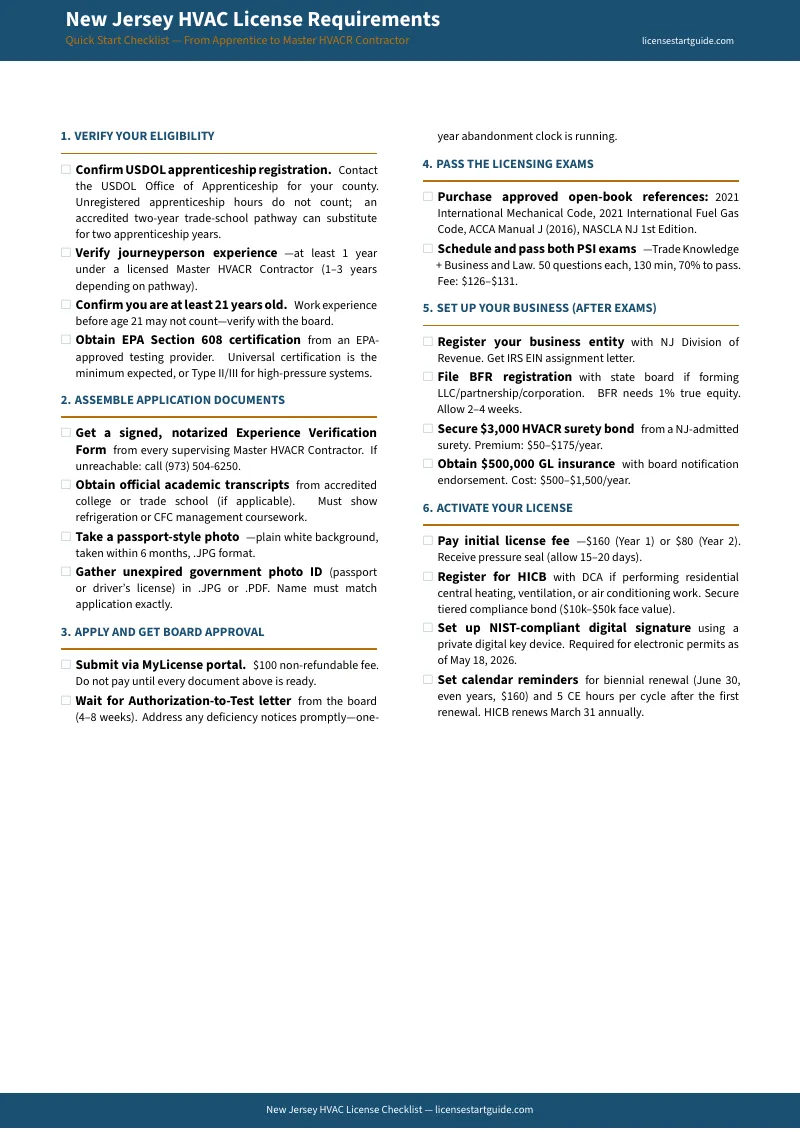
Download the free checklist to see the 20 steps at a glance — then grab the full guide for the chapter-by-chapter walkthrough, the ten fillable worksheets, cost tables, and the sequencing system that keeps you from paying for steps you're not ready for.