You Have the Field Skills. New Hampshire's Licensing Maze Is the Problem.
You can size a furnace by memory and bend gas pipe in your sleep. But when you try to go independent — or take on your first direct contract — New Hampshire's regulatory framework stops you cold. There is no general HVAC license. No single application. No one place that tells you what comes first.
Instead, you face a stack of specialized credentials: the OPLC Mechanical Licensing Board regulates fuel gas fitting through a tiered ladder — trainee, piping installer, installation technician, service technician — each with its own education hours and field-experience thresholds. Your EPA Section 608 card covers refrigerant handling but does not let you pull a permit, advertise services, or sign a contract. And the moment you form a business, you discover that a personal gas fitter license does not authorize your company to operate — you need a separate Mechanical Business Entity License, and the OPLC will reject your application if you submit it before passing your trade exam.
The Licensing Sequence Navigator inside this guide maps the exact filing order across every regulatory layer so each application, fee, and credential lands in the right sequence. You never pay for an LLC before your exam scores clear. You never mail an application without the attachments that prevent a silent rejection.
What's Inside
A 13-chapter guide, a quick-start checklist, and eight printable planning worksheets — all written specifically for New Hampshire's fragmented licensing system.
- The OPLC Fuel Gas Fitting Ladder — every rung from trainee (16+, supervised work) through service technician (140 education hours, 2,000 field hours), with the exact education and experience thresholds the board requires. Most technicians do not realize that New Hampshire has no general HVAC credential — this chapter explains what actually exists and which classification covers your scope of work.
- The Examination-First Rule — New Hampshire requires you to pass your trade exam with an approved third-party provider (NH Gasfitters, Prov) before you submit your OPLC application. Submit without exam scores and the board delays or rejects your application — and keeps your fee. This chapter walks through registration, scheduling, and the attachments that prevent that outcome.
- Business Entity Setup — the Secretary of State LLC filing, EIN registration, general liability insurance, and the OPLC Mechanical Business Entity License, sequenced so you do not pay for insurance or a business registration before you know the OPLC will approve your application. Includes the workers' compensation LLC-member trap that catches solo operators who assume they are automatically exempt.
- Manchester and Nashua Municipal Permits — Manchester separates mechanical permits into fuel-gas and non-fuel-gas categories with unit-based fees. Nashua requires a separate Gas Piping Permit for LPG and natural gas lines, plus a $35 filing fee and a $25 Land Use review fee on every application. The guide details both cities' processes, fees, and inspection requirements so you do not discover a missing permit on a job site.
- HB 594 Reciprocity — New Hampshire's universal license recognition for "substantially similar" out-of-state credentials. If you hold an active license from Massachusetts, Maine, Vermont, or another state, the guide explains how the OPLC evaluates your credentials and the documentation you need to transfer without repeating classroom or field hours.
- Oil Heating and Plumbing Crossovers — the voluntary oil heating technician certification (NORA Gold/Silver or NATE plus 4,000 hours), the plumbing credential ladder for hydronic heating work, and how to determine which license covers boilers, radiant floor systems, and dual-fuel installations.
- CE Broker and Renewal — the OPLC's mandate for electronic CE verification, biennial renewal deadlines (within 60 days of expiration), and the online-only renewal process. Miss the window and you face reinstatement fees that dwarf the original application cost.
- Worksheets — licensing pathway tracker, business formation checklist, experience verification checklist, EPA Section 608 readiness audit, municipal permit application log, insurance and entity licensing budget planner, continuing education tracker, and agency communication log. Fill these in as you go — they replace the spreadsheet most people start and abandon.
Who This Is For
- Technicians going independent — you have field experience and a personal gas fitter credential, and you have been working under someone else's entity license. The guide sequences every filing from your trade exam through your Mechanical Business Entity License so you do not pay for an LLC or insurance before you know the OPLC will approve your application.
- Out-of-state transferees — you hold an active license in Massachusetts, Maine, or Vermont and you are relocating to New Hampshire. The guide walks through HB 594's reciprocity process so you avoid repeating classroom hours or field-experience requirements that your existing credentials already satisfy.
- AC specialists adding gas credentials — you hold an EPA 608 card and install cooling systems, but dual-fuel heat pumps and gas connections require a gas fitter credential you do not have. The guide maps the shortest path from EPA-only to OPLC-licensed gas work.
- Apprentices planning ahead — you are accumulating education hours and field experience, and you want to know exactly which documents the OPLC will require when you apply for your piping installer or service technician license.
Why Not Piece It Together for Free?
You can find fragments of this information across the OPLC website, the Department of Safety portal, the Secretary of State filing system, and individual city building departments. Here is what that approach gets wrong:
- The OPLC website lists forms but not sequence. It tells you what to submit — but not that you must pass your exam before applying, not that your business entity license is separate from your personal credential, and not which attachments prevent a silent rejection. Applicants who submit in the wrong order lose their non-refundable fee and start over.
- Generic national guides list New Hampshire as "no HVAC license" and stop there. They miss the fuel gas fitting ladder, the oil heating certification, the plumbing crossovers for hydronic work, and the municipal permit layer that varies by city.
- Exam-prep courses cover codebook navigation — the technical questions about NFPA 54 and the International Fuel Gas Code. They do not cover business entity setup, liability insurance, workers' comp, or municipal permits. Passing the exam is one step in a longer process.
- Managed compliance services charge $299 or more to handle paperwork you can file yourself once you know the sequence, the fees, and the required attachments.
The guide puts the entire sequence in one document — federal EPA, state OPLC credentials, business entity licensing, and municipal permits — with comparison worksheets and trackers that keep every filing on schedule.
Satisfaction Guarantee
If the guide does not save you time navigating New Hampshire's licensing system, email [email protected] and we will make it right.
Get Started
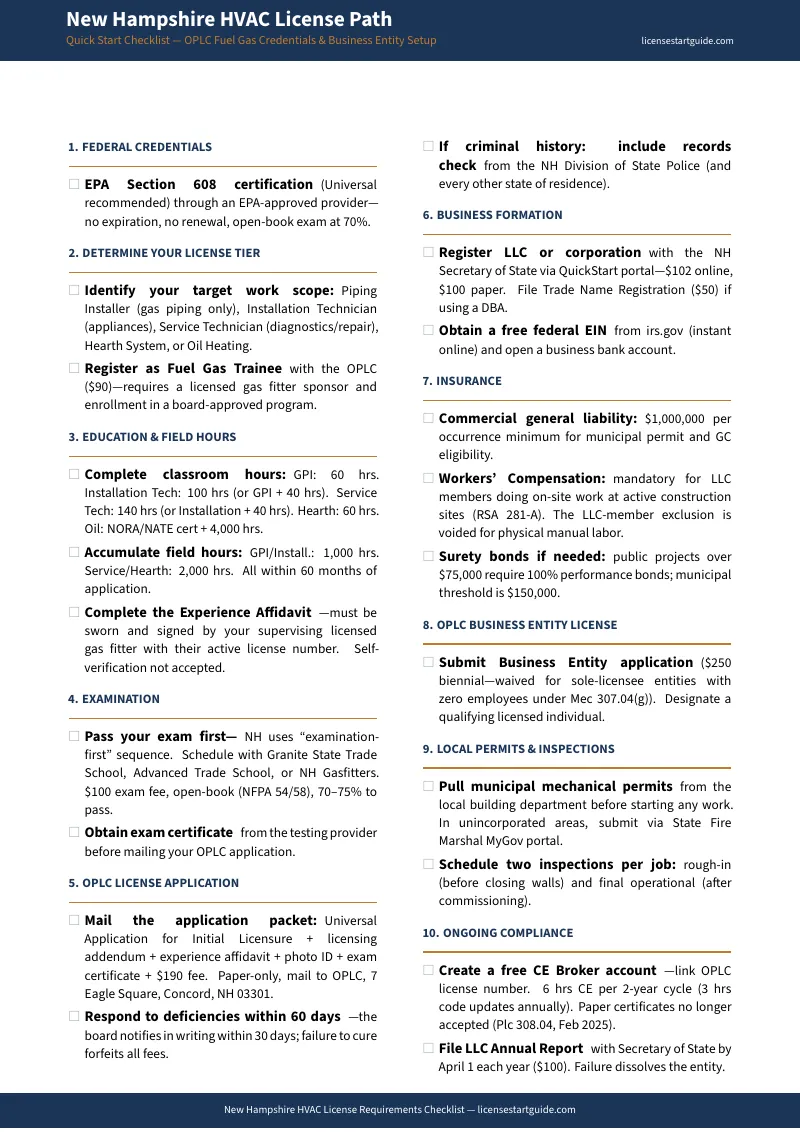
Download the free New Hampshire HVAC License Requirements Checklist to see every credential step at a glance. When you are ready for the step-by-step filing sequence, comparison worksheets, and planning tools, get the full New Hampshire HVAC License Guide for .