Your EPA card doesn't authorize contracting in Nebraska — and neither does your state registration
Most HVAC technicians discover Nebraska's licensing structure the hard way. They pass their EPA Section 608 Universal exam, register with the Secretary of State, and assume they're clear to contract. Then they show up at the Omaha or Lincoln permit counter and get turned away — because none of those credentials authorize them to pull a mechanical permit or supervise installations.
Nebraska distributes HVAC regulatory authority across five separate layers. The EPA handles refrigerant certification. The Department of Labor handles contractor registration. The Department of Revenue requires a sales and use tax election. The State Electrical Division licenses wiring connections. And individual cities — Omaha, Lincoln, Bellevue, Fremont, Grand Island — each run their own licensing boards with separate exams, bonds, insurance minimums, and renewal cycles. No single government website connects these layers. Each agency describes its own process in isolation.
That isolation is where contractors lose real money. Register your business with the NDOL before electing a tax option with the Department of Revenue, and you default to Option 1 — the most complex accounting path that about 80% of contractors actively avoid. Let your workers' compensation certificate lapse for a single day, and the NDOL's automated system quietly removes you from the active registry — meaning any general contractor who checks the database mid-project sees you as unregistered and is legally required to withhold 5% of your contract value. Hire a helper and treat them as a 1099 subcontractor without passing the four-criterion right-of-control test, and you're exposed to penalties of up to $5,000 per worker.
None of these mistakes are technical failures. They're sequencing errors — doing the right step at the wrong time because no one showed you how the five layers connect.
The Five-Layer Compliance Navigator
This guide maps the full licensing path across federal, state, and municipal agencies — from your EPA Section 608 card through your first permitted job in any Nebraska city. It works where government websites and exam-prep courses don't because it puts every filing from all five regulatory layers into one chronological sequence, with the exact forms, the documentation each form requires, and the rejection triggers that cause the most common delays. Zero-cost verification steps come first. Every paid filing sits behind the gate that confirms you're eligible for it.
What's inside the guide
- Nebraska's regulatory architecture mapped end-to-end — why five agencies share jurisdiction, how home rule distributes licensing to cities, and the sequencing mistakes that cost applicants the most time and money. This one chapter replaces hours of clicking through five separate government portals trying to figure out which agency handles what.
- EPA Section 608 certification — the Core + Types I–III exam structure, Universal vs. type-specific certification, approved testing organizations (ESCO Group, VGI), the two-year apprentice exemption for supervised refrigerant handling, and the critical distinction between the federal environmental card and the local trade credentials you still need to actually contract.
- NDOL contractor registration walkthrough — the Contractor Registration Act thresholds ($5,000 revenue or one employee), the upcoming fee increase to $40 in August 2026, workers' compensation certificate formatting (ACORD 25 with NDOL as sole certificate holder), and the silent suspension mechanism that pulls your registration if your COI lapses for even one day. Because discovering your registration is suspended when a GC checks the public database mid-project is not how you want to find out.
- Employee Classification Act compliance — the four-criterion right-of-control test that determines whether your field helpers are employees or independent contractors, first-offense penalties of $500 per worker, repeat-offense penalties of $5,000 per worker, and the debarment from state and municipal projects that follows unpaid penalties. The guide explains exactly how to structure worker relationships to satisfy the statutory test.
- Department of Revenue tax option election — the Option 1 / Option 2 / Option 3 framework, how each treats material purchasing, customer invoicing, and labor billing, the default-to-Option-1 trap if you don't actively elect, and the accounting implications of each choice. About 80% of Nebraska contractors choose Option 2 for simplified accounting — the guide explains why and helps you decide whether your billing model warrants a different choice.
- NSED specialty electrical licensing — the Special: Heating/AC/Refrigeration installer card that authorizes limited electrical connections within the mechanical footprint, the 80-question open-book exam based on the 2023 NEC, permitted reference materials (bound NEC book, Ugly's Electrical Reference, non-programmable calculator), the $60 application fee, and biennial renewal during even-numbered years.
- Omaha ACAD Board credentials — Apprentice, Journeyman, and Master classifications with experience requirements (four years apprentice to Journeyman, four more to Master), the ICC 2018 International Mechanical Code exam reference, the $10,000 surety bond and $300,000 general liability requirement for Masters, NATE Core certification credit toward experience, and the December 31 annual renewal deadline with 8-hour CEU requirements.
- Lincoln mechanical licensing — Master and Journeyman tiers under Title 25, the $350 Master registration fee, the $500,000 liability policy with the City of Lincoln named as additional insured, the right-of-way bond trigger ($5,000 when working in public right-of-way), continuing education hours (8 for Masters, 4 for Journeymen), and the October 1–December 31 renewal window.
- Bellevue, Fremont, and Grand Island — each city's mechanical licensing requirements, fee schedules, exam vendors, insurance mandates, and reciprocity rules compared side by side. Bellevue's $75 Master fee. Fremont's $65 Master fee with City as additional insured and proof of NDOL registration. Grand Island's IAPMO-based exam on the 2021 Uniform Mechanical Code. The guide maps which credentials transfer across jurisdictions and which require separate applications.
- Trade scope boundaries — exactly where the mechanical license ends and a separate credential begins. When HVAC electrical work requires the NSED specialty card vs. a full electrician's license. When gas-line extensions need a separate plumbing credential. When hydronic work crosses into boiler jurisdiction. The enforcement consequences of scope violations — because a stop-work order during a rough-in inspection is an expensive way to learn the boundary.
- Permitting and inspections — when a permit is required vs. like-for-like swap exemptions, how to pull permits through Omaha's Accela system vs. Lincoln's Building Safety office, what inspectors look for during rough-in and final inspections, and the energy code compliance requirements that apply regardless of project scope.
- Insurance and bonding summary — general liability minimums by city, surety bond amounts (Omaha's $10,000 local bond, the $25,000 out-of-state contractor bond for NDOL), certificate formatting requirements that prevent registration suspensions, and every cost listed in the order you actually pay it.
- Renewal, CE, and reinstatement — annual and biennial deadlines mapped across every jurisdiction, continuing education hour requirements, the consequences of letting any credential lapse, and reinstatement procedures when you miss a deadline.
- Official contacts directory — direct links, phone numbers, and mailing addresses for the EPA, NDOL, NDOR, NSED, Omaha ACAD Board, Lincoln Building Safety, Bellevue, Fremont, and Grand Island building departments.
What's included
Your purchase includes 8 PDFs, available for immediate download:
- guide.pdf — The 14-chapter Five-Layer Compliance Navigator covering every step from EPA certification through your first permitted job in any Nebraska city (45 pages).
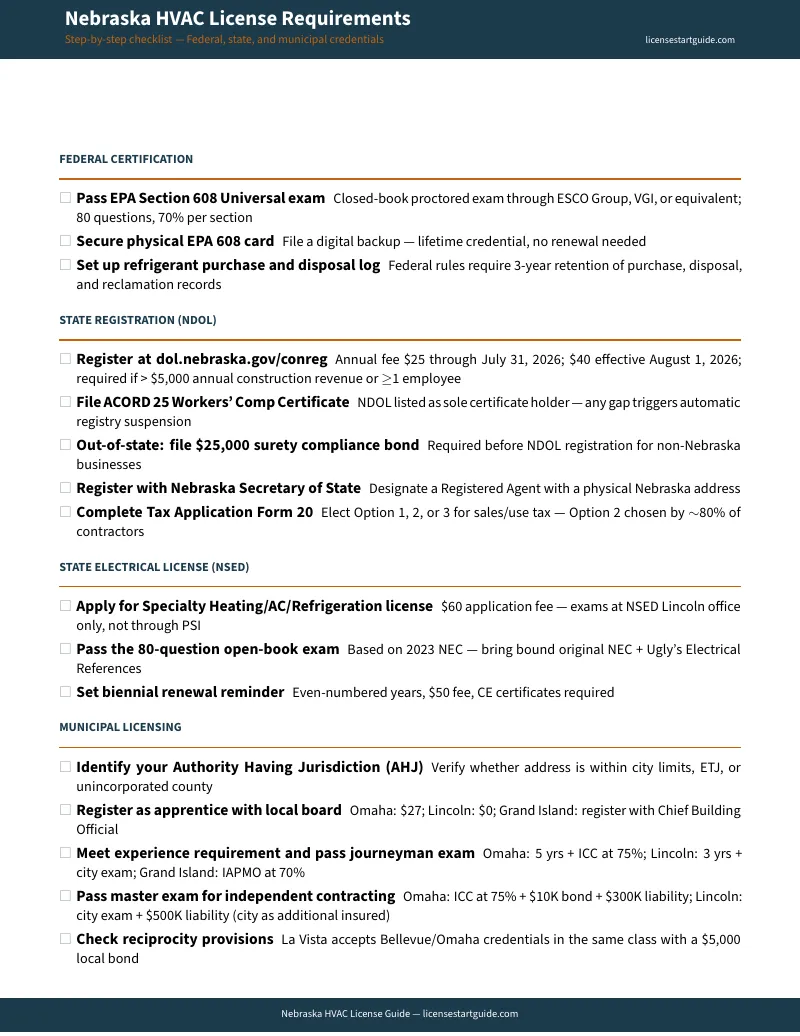
- checklist.pdf — Printable 24-item quick-start checklist covering federal, state, and municipal credential steps in order.
- licensing-pathway-tracker.pdf — Fillable tracker mapping your credential status across all five regulatory layers.
- compliance-calendar.pdf — Month-by-month renewal and filing calendar with write-in dates for every credential and policy.
- municipal-comparison-worksheet.pdf — Side-by-side worksheet for comparing requirements across your target cities.
- document-retention-checklist.pdf — Pre-formatted filing checklist organized by regulatory layer.
- project-permit-tracker.pdf — Per-project log for permits, inspections, and sign-offs.
- agency-communication-log.pdf — Running record of every interaction with regulatory agencies.
Who this is for
- Technicians going independent — you've been installing and servicing under an employer's license for years, but you've never navigated the contractor registration, tax election, local licensing, and bonding sequence yourself. The guide puts every step in calendar order so you don't pay for things you aren't ready to use.
- New HVAC business owners — you've filed with the Secretary of State and you're hiring your first field employee. The guide walks through NDOL registration, workers' comp certificate requirements, the Employee Classification Act's presumption rules, and the Department of Revenue tax option that fits your billing model — before a misclassification penalty or a registration suspension teaches you the hard way.
- Out-of-state contractors bidding in Nebraska — you hold an active credential from Iowa, Kansas, or Missouri and assume it transfers. Nebraska's municipal licensing boards don't maintain broad reciprocity, and the state-level registration carries a mandatory $25,000 surety bond for out-of-state entities. The guide maps the out-of-state compliance sequence for each regulatory layer.
- Cross-trade installers — your HVAC work touches electrical connections, gas lines, or refrigeration systems, and you need to know exactly where the mechanical license ends and a separate credential begins. The guide explains the NSED specialty electrical license, municipal gas-piping rules, and the enforcement consequences of scope violations.
Why not piece it together from government websites?
You can find most of this information yourself. The NDOL website explains contractor registration. The Department of Revenue describes the three tax options. Omaha's Accela portal lists ACAD license types and fees. Lincoln's Building Safety page covers mechanical trade registration.
The problem is that each agency's site describes its own process in isolation. The NDOL doesn't tell you that your contractor registration is useless without a local trade license from the city where you physically work. The Department of Revenue doesn't warn you that failing to elect a tax option defaults you to Option 1. Omaha's ACAD Board doesn't explain that you also need NDOL registration, an NSED specialty electrical card, and a Department of Revenue election before you can legally operate. Lincoln's Building Safety site doesn't mention the $5,000 right-of-way bond requirement until you're standing at the counter.
Exam-prep companies like 1 Exam Prep charge $100–$310 for study packages focused entirely on passing the trade exam, not on navigating the business registration, tax, insurance, and permitting process around it. National compliance platforms like Harbor Compliance and Trade-Bridge charge $99–$599/month for enterprise workforce tracking that doesn't include the city-by-city mechanical licensing details a single-shop contractor actually needs.
The guide fills the gap between what each agency publishes in isolation and what you need to know to navigate the full five-layer process without delays, rejected applications, or wasted fees — at a fraction of what a single non-refundable filing fee costs.
100% satisfaction guarantee
If the guide doesn't save you time and confusion navigating Nebraska's HVAC licensing process, email [email protected] for a full refund. No forms, no hoops.
Start with the free checklist — or get the full guide
The free Nebraska — HVAC License Requirements Checklist covers the key federal, state, and municipal credential steps in a printable format. It's a solid starting point if you want to audit where you stand before committing.
The full Nebraska HVAC License Guide goes deeper — 14 chapters covering every step from EPA certification through your first permitted job, plus fillable worksheets you can print and use immediately. The five-layer compliance map, tax option comparison, city-by-city licensing breakdown, insurance and bonding summary, and the permitting guide keep your paperwork moving instead of getting returned. For less than the cost of a single NDOL registration fee, you get the entire process mapped out before you start spending.