You Found Missouri's Two Cottage Food Laws. Now You Need to Know Which One Protects You.
Missouri doesn't have one cottage food law — it has two, and they protect different products in different places under different rules. Confuse them, and you could get turned away from a farmers market you already paid booth fees for, fined for selling without a tax license you didn't know you needed, or told your best-selling jam requires a commercial kitchen because the recipe doesn't meet the sugar ratio that keeps it legal.
The state says health departments can't inspect your home kitchen — but your city's zoning board, business license office, and tax authority absolutely can. And the rules change from county to county: a product that's legal to sell in Kansas City may get confiscated in St. Louis County. A vendor who sails through farmers market season in Springfield may face a multi-week inspection gauntlet to sell the same cookies in Independence.
The Missouri Cottage Food & Home Food Business Guide is a Dual-Pathway Compliance Navigator — the only resource that maps both of Missouri's home food laws, the local rules in every major metro, and the full registration sequence from product classification through your first legal sale. It replaces the scattered state PDFs, outdated blog posts, and county-by-county phone calls with one organized system you can follow start to finish.
What's Inside
- The Two-Pathway Product Classifier — because the Home Sales law (RSMo § 196.298) and the Individual Stands exemption cover different products, allow different sales channels, and give local governments different levels of control over your operation. The guide walks you through which pathway covers your specific products, what each one allows, and what happens when your product falls outside both.
- City-Specific Setup Sequences for Every Major Metro — because a Kansas City baker faces 25% floor-space zoning caps, a St. Louis County vendor needs a commercial kitchen for any public event, a Springfield seller may need a $144 Farmers' Market Food Permit for samples, and an Independence operator must pass inspections from four city departments before opening. The guide has the exact steps, fees, and timelines for each city instead of a single "check with your local authorities" disclaimer.
- Label Compliance Templates with Statutory Disclaimer Wording — because Missouri requires a specific disclaimer on every product and the exact wording differs between the two pathways. The guide includes the word-for-word text, field-by-field checklist (allergens, metric weight, ingredient order), and a label layout reference so your labels pass inspection the first time instead of needing reprints.
- Sales Tax Registration and Rate Walkthrough — because Missouri has no minimum sales threshold and operating even a weekend bake sale without registering exposes you to a $500 first-day penalty under Section 144.118. The guide walks you through mytax.mo.gov registration, shows you how to apply the reduced 1.225% state food rate instead of the standard 4.225%, and explains when local sales tax layers apply.
- Online Sales and Shipping Compliance — because the 2022 expansion legalized in-state e-commerce and common carrier shipping for Home Sales pathway products, but the Individual Stands exemption still prohibits online sales entirely. The guide clarifies exactly what you can sell online, the in-state buyer requirement, and how to structure your shipping to stay compliant.
- Commercial Kitchen Transition Triggers — because certain products (sugar-free jams, hot-pepper jellies, cream-filled pastries), sales channels (wholesale to retail stores), and infrastructure limits (septic capacity, well water testing) push you from a home kitchen into a licensed commercial facility. The guide maps every trigger so you can plan your growth path instead of discovering you've crossed the line after an enforcement action.
- Well Water and Septic System Compliance for Rural Kitchens — because producers on private wells and septic systems face practical mandates (annual coliform testing, system capacity limits) that aren't in any state cottage food checklist but that market managers, event coordinators, and liability insurers routinely require proof of.
- Printable Worksheets and Tracking Tools — a product classification worksheet, label compliance checker, batch production log, local compliance tracker, and well water testing log, plus a 24-item registration sequence checklist. The correct order matters (zoning verification before business entity registration, sales tax before your first sale), and doing them out of sequence means delays, rejections, and fees you can't get back.
Who This Guide Is For
You're a home baker who just got your first custom cake commission and need to know what's legal before you take the deposit. You're a jam maker gearing up for farmers market season and you want to make sure St. Louis County won't turn you away. You're a cottage food seller whose business is growing and you're trying to figure out whether you need a commercial kitchen or can keep operating from home. You're starting a home food business in Missouri and you don't want to spend 40 hours calling county offices to piece together what one guide can give you in an afternoon.
Why Not Just Use the Free Resources?
The state health department's FAQ covers the broad strokes of RSMo § 196.298, but it doesn't address the local layer — your city's zoning rules, business license requirements, and the places where county health departments can override the Food Code exemption. The University of Missouri Extension publishes excellent food safety science, but nothing on business registration sequences or city-specific licensing. Forrager's community directory is helpful for the basics, but it's crowd-sourced and doesn't track municipal-level restrictions. And your farmers market manager is an event coordinator, not a compliance officer — a vendor who relied on market-manager guidance at a St. Louis area market discovered on opening day that the county prohibits all home-prepared items.
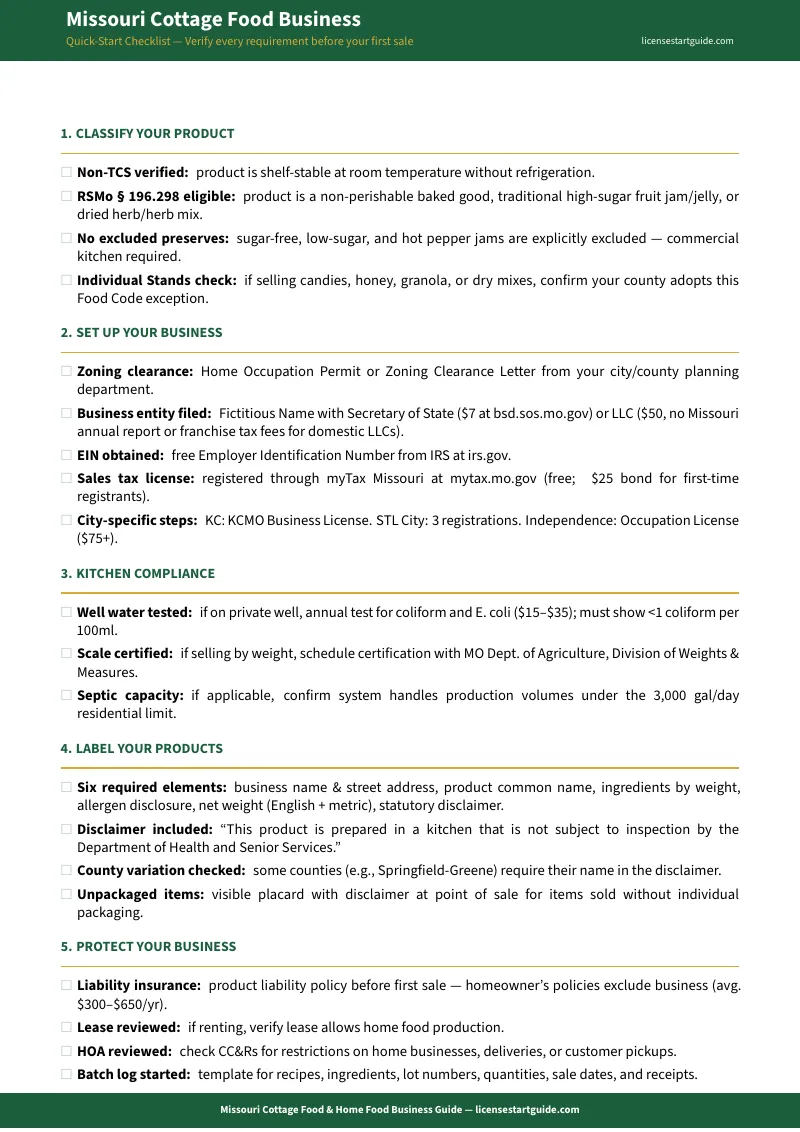
The free checklist we offer covers the basics — what's legal, what's not, and the broad steps. The full guide covers the how — the city-specific sequences, the exact forms and portals, the product classification logic, the label templates, and the worksheets that turn scattered requirements into a checklist you can actually follow.
Satisfaction Guarantee
If the guide doesn't give you a clearer path to your first legal sale than anything you've found for free, email us and we'll refund you. No forms, no hoops. We read every message at [email protected].
Start Selling Legally
Download the free checklist to see if your products qualify, or get the full Missouri Cottage Food & Home Food Business Guide with city-specific sequences, label templates, and tracking worksheets — everything you need to go from "I think I can sell this" to your first compliant sale.
The guide is a one-time purchase — — with no subscription, no recurring fees, and instant PDF download.