
Your Hours, Your License, Your Business — Without the Filing Mistakes That Set Plumbers Back Months
You've been installing pipe for years. You know the code. You can sweat copper in your sleep. But somewhere between tracking your 7,000 verified hours across three employers, figuring out which DLI form needs your old supervisor's signature, and discovering that your business name doesn't match your surety bond by one missing "LLC" — the administrative side of getting licensed in Minnesota starts costing you real time and real money.
The Minnesota Plumber License Guide is a career administration system built around the filing mistakes, hour-tracking gaps, and regulatory deadlines that actually delay working plumbers. It's not exam prep. It's not the code. It's the operational roadmap between where you are and where your credentials need to be — whether that's your PA registration, your journeyworker exam application, your master license, or your contractor business launch.
What's Inside
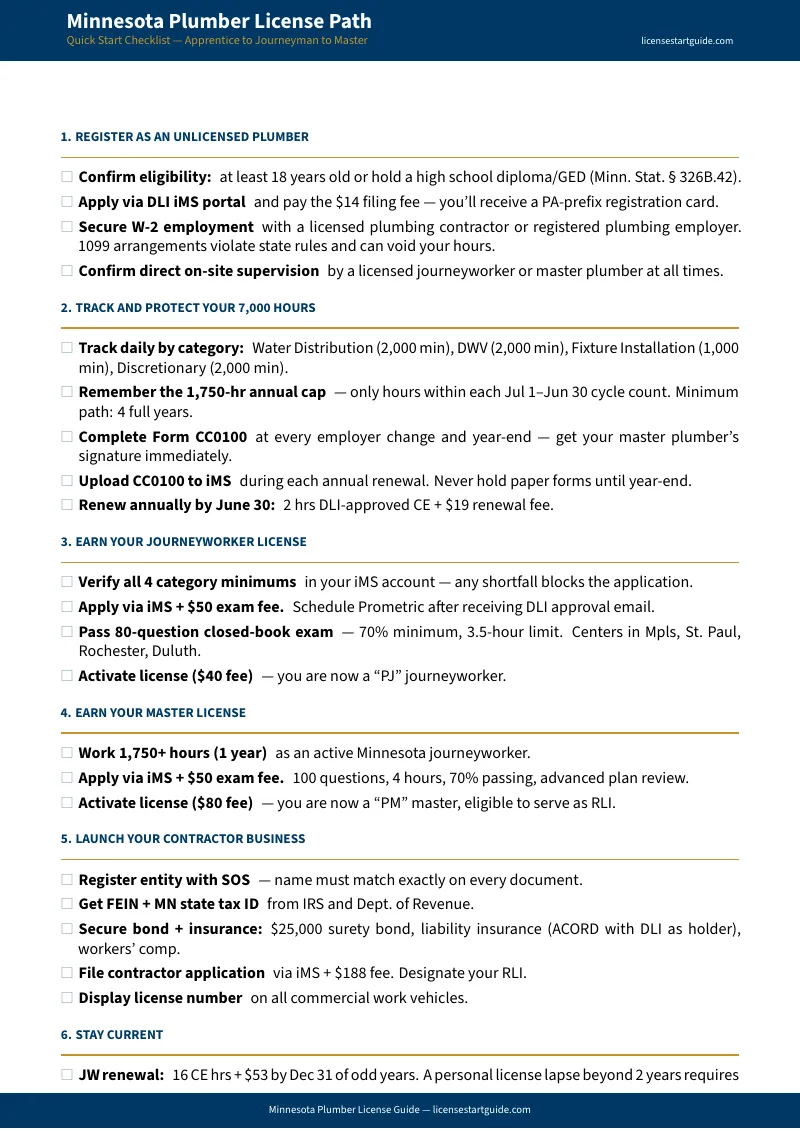
- Hour-by-hour category tracking system — because the DLI doesn't just want 7,000 total hours. They want 2,000 in water distribution, 2,000 in DWV, and 1,000 in fixture installation — and they'll reject your exam application if you're short in any single category, even with 8,000 hours total.
- Employer transition protection — the step-by-step process for getting Form CC0100 signed before you give notice, handling supervisors who delay or refuse, and filing a DLI dispute if your hours are being held hostage.
- Exam application walkthrough — what the iMS portal actually asks for, how to avoid the common documentation gaps that bounce applications back, and what happens if you fail (the 30-day retake wait and fee resubmission process).
- Master plumber upgrade path — the one-year, 1,750-hour experience window after your journeyworker license, the expanded legal scope (permit-pulling, RLI designation), and the exam differences from the journeyworker level.
- Contractor business launch checklist — entity filing with the Secretary of State, the $25,000 code compliance bond, general liability and workers' comp requirements, and the name-matching rule that trips up every first-time applicant (one missing "Inc." on your insurance certificate and the DLI sends the whole package back).
- Out-of-state transfer guide — reciprocity with North Dakota and South Dakota (exam-free), the two-year experience credit cap for everyone else, and how to prove equivalent state-level standards when your home state uses county or local licensing.
- Renewal and CE calendar — biennial renewal cycles (odd years for journeyworkers, even years for masters), the 16-hour CE requirement with the 8-hour core code minimum, and the permanent forfeiture cliff for restricted licenses expired more than 12 months.
- 2025–2026 regulatory updates — the MDH water service line plan review delegation effective January 2026, the Plumbing Board's Chapter 15 stormwater rulemaking pause, and proposed changes to the 2024 UPC adoption.
Who This Is For
- Registered unlicensed plumbers tracking hours toward the journeyworker exam — especially non-union apprentices managing their own documentation across multiple employers.
- Journeyworker plumbers preparing for the master exam and planning the transition from W-2 employee to business owner.
- Out-of-state plumbers moving to Minnesota who need to understand reciprocity limits, experience credit caps, and exam eligibility from a non-reciprocal state.
- Master plumbers launching a contractor business who need every piece of the entity filing, bonding, and insurance puzzle to align before the DLI will issue the contractor license.
Why Not Just Use the DLI Website?
The DLI publishes forms, fee schedules, and rule text — but it doesn't publish strategy. It won't warn you that the 1,750-hour annual cap means you can't accelerate your apprenticeship by working overtime. It won't tell you to get Form CC0100 signed before leaving an employer, not after. It won't explain that your insurance agent might write a policy under a business name that doesn't match your Secretary of State filing — and that mismatch alone will bounce your entire contractor application.
The difference between the DLI website and this guide is the difference between a parts catalog and an assembly manual. You need both, but only one shows you the sequence.
What This Is Not
This guide does not contain plumbing code questions, exam answers, practice tests, or technical training material. It is not affiliated with the Minnesota DLI, the Plumbing Board, or any trade union. It does not provide legal advice. What it does is organize every administrative step of the licensing process into a single reference that keeps you from making the filing mistakes that delay your career by months.
Satisfaction Guarantee
If the guide doesn't save you time on your licensing process, email us and we'll refund your purchase. No forms to fill out, no hoops to jump through.
Ready to Stop Guessing?
Download the free checklist to see the licensing path at a glance — or get the full Minnesota Plumber License Guide for the complete career administration system with step-by-step walkthroughs, worked examples, and every form reference in one place.
The guide is a one-time purchase — — with free updates as Minnesota's rules change.