You Know How to Run a Job. LARA's Paperwork Is the Part No One Teaches.
You can size ductwork, diagnose a failing compressor, and run a furnace swap from disconnect to final inspection. None of that matters to the State of Michigan until LARA's Bureau of Construction Codes issues you a Mechanical Contractor license — and the application process is where experienced technicians lose months and hundreds of dollars.
Submit your experience affidavits in the wrong format and your application sits in a queue until someone at LARA sends it back. Apply for the wrong classifications and you pass an exam that doesn't cover the work you actually do. Pay the $300 non-refundable application fee before your documentation is in order and that money is gone whether you get approved or not.
Meanwhile, exam prep companies charge $299 to $1,249 to help you memorize code references — but they don't tell you which of LARA's ten mechanical classifications to apply for, how to document your out-of-state hours, how to register your license locally, or what happens when your HVAC installation crosses into the electrical or plumbing trade scope.
The Administrative Sequence Map
The Michigan HVAC License Guide is a step-by-step compliance roadmap that covers every administrative, regulatory, and business formation step between where you are now and your first legally permitted job — sequenced so you never pay a fee before you're ready for the step that follows it.
This is not an exam prep course. It does not contain practice questions, code simulations, or book-highlighting instructions. It covers the business and regulatory sequence that exam prep companies skip entirely: experience documentation, LARA classifications, cross-trade boundaries, business entity formation, insurance triggers, municipal registration, and local permitting.
What's Inside the Guide
LARA's Ten Mechanical Classifications, Decoded — Classification A through J under MCL 339.5807, with the technical scope and experience requirements for each, so you know exactly which ones to apply for based on the work you actually do — not the work you might do someday.
The Experience Verification Process — How to compile, format, and submit the signed employer affidavits LARA requires under penalty of perjury. Covers trade school credits, military service substitutions, and what to do when a former employer has closed or won't cooperate.
The Full Application Sequence — From creating your Accela Citizen Access account through receiving your Authorization to Test, with the rejection triggers that delay applications by weeks.
PSI Exam Logistics — Registration, fees by classification, Michigan's seven testing centers, the open-book format, and the 70% passing threshold. Not exam prep — exam process navigation.
Cross-Trade Boundary Maps — The electrical disconnect rule, the gas piping overlap with plumbing, and the two-license requirement for gas water heater installations. Each boundary explained so you know exactly when a job requires you to subcontract work to another trade.
Business Formation in Order — LLC filing through LARA Corporations Division, IRS EIN, Michigan Treasury Online registration, Unemployment Insurance Agency setup through MiWAM — sequenced so you don't register for tax accounts before you have a legal entity.
Insurance Requirements Mapped — Commercial general liability, workers' compensation triggers, and the gap between LARA's requirements (none for the license itself) and local building department requirements (required for permits).
Municipal Registration and Permitting — How to register your state license locally, the statutory $15 fee cap, city-by-city portal platforms, and when mechanical permits are required under the Michigan Mechanical Code.
Renewal Calendar — The 3-year renewal cycle, continuing education requirements for qualifying officers, and the reinstatement process if your license lapses.
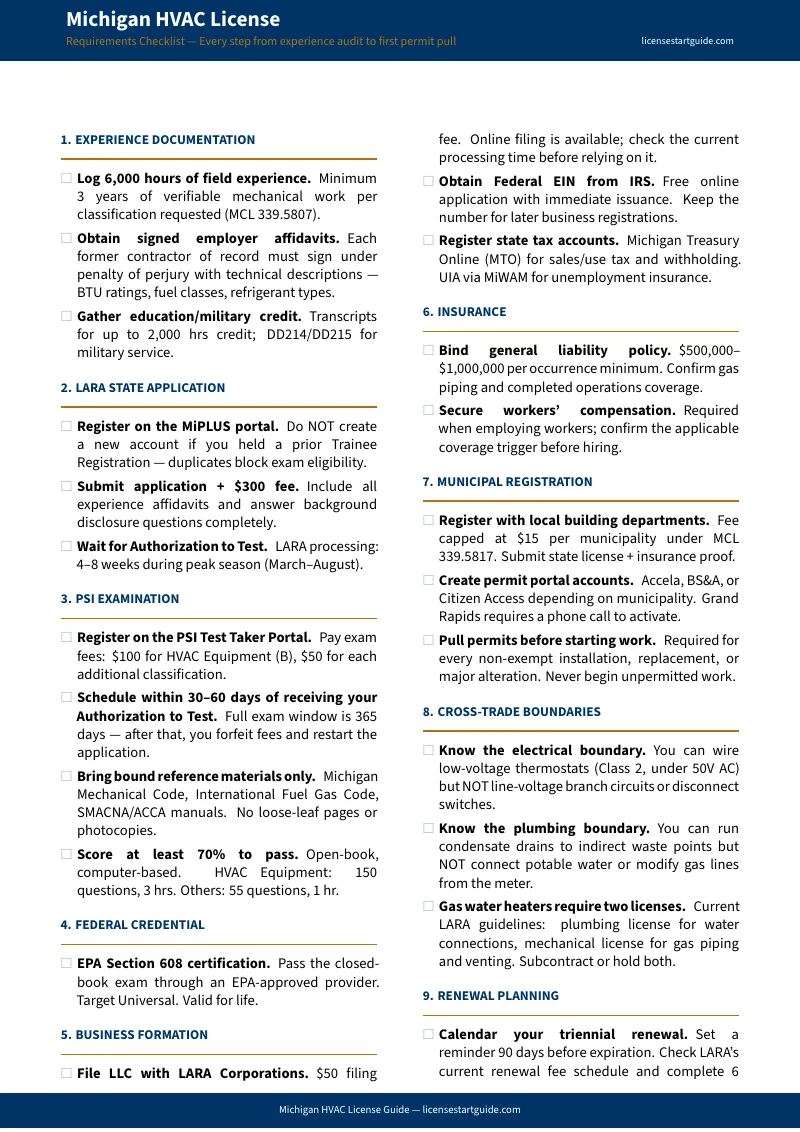
Printable Checklist — A 25-item quick-start checklist you can print and work through step by step, from experience audit through first permitted job.
5 Planning Worksheets — Fillable standalone PDFs you print and use alongside the guide: an experience documentation worksheet to catalog every employer and classification hour, a licensing cost calculator to budget your total startup investment, an application timeline planner to map target dates against known processing times, a municipal registration tracker for every building department where you plan to pull permits, and an agency communication log for every call and email with LARA, PSI, and local offices.
Who This Guide Is For
- Lead technicians going independent — You've been running installs and service calls on someone else's license. You understand the mechanical work. You need the administrative sequence to get your own license without burning the $300 application fee on incomplete paperwork.
- Out-of-state contractors — Michigan has no reciprocity for mechanical contractor licenses. The guide shows how to document your out-of-state hours in the format LARA's experience verification actually accepts.
- EPA-only operators getting compliant — You've been taking side jobs with nothing more than an EPA Section 608 card. The guide maps the path from environmental credential to fully licensed mechanical contracting business.
- Multi-classification contractors — You already hold one or two LARA classifications and want to add more. The guide covers how classifications interact and which combinations open up the most common residential and commercial work.
Why Not Just Use the LARA Website?
LARA's Bureau of Construction Codes publishes the statutory requirements — but the state portal doesn't tell you the order to do things in, doesn't explain how the ten classifications interact with each other, doesn't cover municipal registration, and doesn't warn you about the cross-trade boundaries that trip up mechanical contractors during local inspections.
Exam prep companies like RocketCert and Michigan Mechanical Code Exam Prep focus strictly on passing the PSI exam. They charge $200 to $1,249 and don't address business formation, insurance, or local permitting — the steps that happen after you pass the exam and before you can legally pull a permit.
This guide fills the gap between the state's raw requirements and the exam prep industry's narrow focus. For less than a single hour of billable mechanical work, you get the complete administrative sequence that neither source covers.
Satisfaction Guarantee
If the guide doesn't deliver what it promises, email [email protected] and we'll make it right.
Get Started
Download the free Michigan HVAC License Requirements Checklist to see the full licensing sequence at a glance. When you're ready for the complete guide with chapter-by-chapter process navigation, classification breakdowns, cross-trade boundary maps, and business formation steps, get the full Michigan HVAC License Guide for .