Michigan Changed Its Cottage Food Law. Most Guides Online Still Describe the Old One.
You want to sell food from your home kitchen in Michigan — baked goods, jams, honey, candy, dry mixes. The cottage food exemption lets you do that without a license, without a health inspection, and without renting a commercial kitchen. But on March 24, 2026, the rules changed fundamentally, and the information most people find online has not caught up.
State agency pages, university extension articles, and popular cottage food directories still reference the old $25,000 annual cap. Several of them still state that online sales are illegal. Some list foods as permitted that are actually prohibited, or describe registration requirements that no longer exist. Operating under these outdated rules means either leaving money on the table by staying below a cap that has doubled, or unknowingly violating a new requirement you did not know existed — like the two-way communication mandate for every online sale.
The gap between "technically legal" and "actually compliant" is where home food businesses get cited, get their products seized, or spend weeks fixing paperwork they could have gotten right the first time.
The Cottage Food Compliance System
This guide is not a restatement of the statute. It is a compliance navigation system built on the post-March 2026 regulatory framework — Public Act 51 of 2025 and Public Act 42 of 2025 — that translates dense legislative language into step-by-step operational procedures for Michigan home food businesses.
It covers the full scope of what a cottage food operator needs to know: product eligibility science, the dual-cap revenue tracking system ($50,000 standard / $75,000 high-unit), compliant e-commerce configuration, label formatting that passes inspection, the MSU Product Center privacy registration, zoning and HOA research procedures, insurance options, tax obligations, and the exact triggers and steps for transitioning to a commercial kitchen when you outgrow the exemption.
What's Inside
- Product eligibility decision framework — a systematic walkthrough of what makes a food "non-potentially hazardous" under Michigan law. Covers water activity and pH thresholds, the line between shelf-stable buttercream and prohibited cream cheese frosting, the honey and maple syrup exemptions under Public Act 42, and the gray areas that trip up experienced bakers — like fruit-only jam standards under 21 CFR Part 150.
- Dual-cap revenue tracking system — the new $50,000 standard cap and $75,000 high-unit-value tier (products priced at $250+ per unit) run simultaneously, with CPI inflation adjustments starting October 2026. The guide explains how to track against both caps, how per-person calculation works for multi-operator households, and what happens the day you cross either threshold.
- Compliant e-commerce setup — online sales are legal now, but not with a standard checkout cart. Michigan law requires a pre-sale two-way communication opportunity for every online transaction, and all shipping must stay within state boundaries. The guide provides compliant checkout workflows, platform configuration steps, and pre-written communication templates that satisfy the statutory mandate without adding friction to every sale.
- Label rejection-proofing system — the exact label elements MDARD requires, in the format they expect: product name, net weight in dual units, descending ingredients list, major allergen declarations, the verbatim 11-point-font MDARD disclaimer, and your identification (home address or MSU registration code). Visual examples show compliant formatting and the common mistakes that trigger citations.
- MSU Product Center privacy registration walkthrough — the $50 voluntary registration that lets you replace your home address on every label with a state-recognized code and phone number. Step-by-step enrollment, the exact label configuration options, re-registration triggers, and what to do if your phone number changes.
- Kitchen and water safety protocol — sanitation standards for home kitchens, commercial-grade sanitizer dilution ratios (the chlorine bleach standard), private well water testing requirements, and a Michigan-specific section on PFAS contamination that affects well water operators in dozens of counties.
- Zoning, HOA, and landlord research procedures — the cottage food exemption does not override local rules. The guide walks you through checking your municipal home occupation permit requirements, reviewing HOA deed restrictions, and verifying rental lease terms before you start producing.
- Insurance guidance with cost comparisons — standard homeowners policies exclude business activities, and most farmers market managers require proof of product liability insurance before assigning stall space. The guide compares food-specific providers, outlines typical coverage costs, and explains the Additional Insured endorsement that market applications demand.
- Farmers market preparation system — what market managers require beyond the cottage food exemption: proof of insurance, food safety certifications, display standards, and the questions MDARD inspectors can legally ask at your booth versus the ones you are not obligated to answer.
- Commercial transition blueprint — when your revenue, product line, or distribution ambitions force the move to a licensed facility, the guide covers shared-use kitchen options and costs, MDARD plan review procedures and fees, food manager certification requirements, pre-opening inspection preparation, and the annual licensing fee schedule. Timed to help you scale without a gap in sales or an unnecessary lease.
Who It's For
- Home bakers and candy makers testing the market — you need to know which of your recipes are legally producible under the exemption before you invest in packaging and labeling
- Custom cake decorators and event caterers — the high-unit-value cap and perishable ingredient restrictions create a compliance puzzle the guide solves with a clear decision framework
- Beekeepers and maple sugarmakers — Public Act 42 restructured your exemption thresholds, and the guide explains how the new $50,000 cap applies to your retail and honey house operations
- Online sellers launching Michigan e-commerce — the two-way communication mandate and intrastate shipping restriction require specific technical setup the guide walks through step by step
- Farmers market vendors applying for stall space — market applications demand documentation most first-time sellers do not have ready, and the guide covers every requirement in order
- Growth-stage producers approaching the sales cap — the transition from a rent-free home kitchen to a commercial facility is the highest-stakes decision in your business, and timing it wrong costs thousands
Why Not Piece It Together from Free Sources?
MDARD publishes the statutory text and a basic FAQ, but the information is written in regulatory language that outlines what the rules are without explaining how to comply. The MSU Extension runs webinars and offers a label registration service, but onboarding requires a mandatory application fee, a non-disclosure agreement, and scheduled counseling sessions rather than instant-access tools.
National cottage food directories and food business blogs provide Michigan overviews, but several of them still publish pre-March 2026 information — $25,000 caps, online sales listed as illegal, missing references to the privacy registration option. One widely cited resource claims online sales are unrestricted with no mention of the two-way communication mandate. Operating on that advice is a direct violation of Public Act 51 of 2025.
Private food business consultants and compliance software charge ongoing monthly fees starting at $10–$25 for tools, or $500–$2,000+ for legal services. These are premature expenses for a home kitchen operation that has not yet validated its first product line.
This guide consolidates the regulatory framework, the practical compliance steps, and the operational planning into a single reference — for the cost of a bag of specialty flour.
What You Get
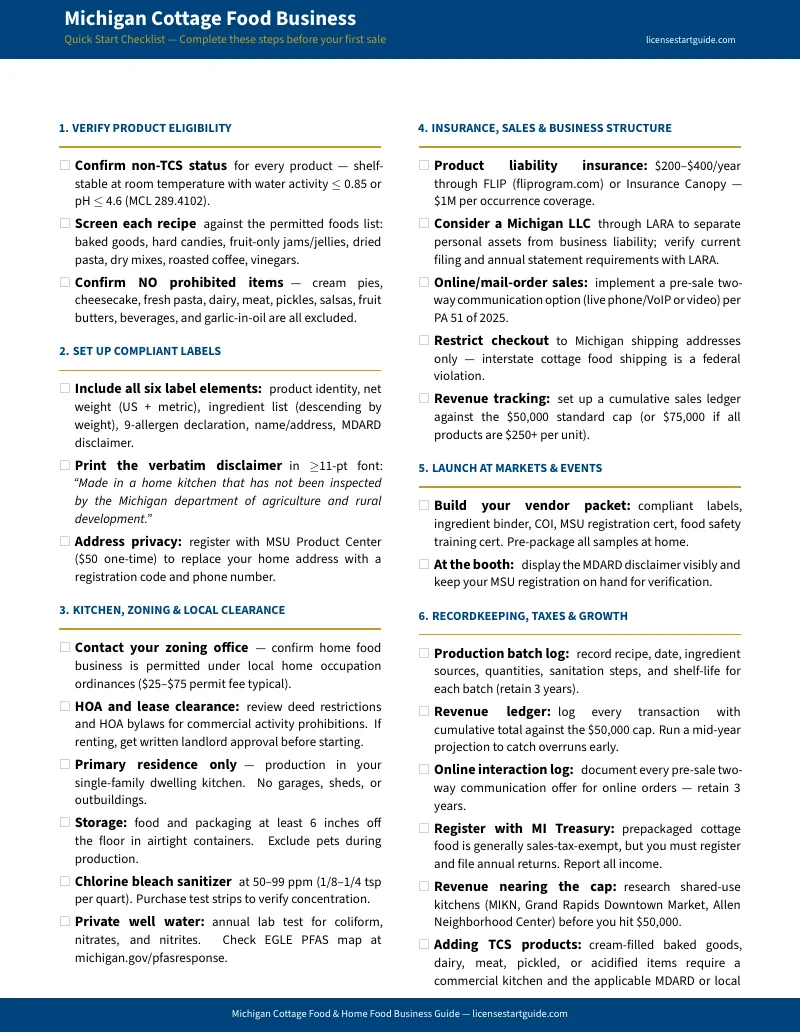
The complete package includes 9 downloadable PDFs you keep forever: the full 44-page guide, a 27-item compliance startup checklist, and 7 standalone worksheets — product eligibility screening, label compliance verification, revenue tracking, production batch logging, two-way communication documentation, kitchen sanitation, and commercial transition planning. A free checklist is available if you want to start with the basics before committing to the full guide.
100% satisfaction guarantee. If the guide does not help you navigate Michigan's home food regulations more clearly than the free resources you have been piecing together, email us and we will refund you — no questions, no forms, no waiting period.
Get the Michigan Home Food Business Guide →
Or start with the free checklist — a one-page compliance roadmap covering the cottage food startup steps, labeling basics, and the key boundaries you cannot cross.