You Know Electrical Work. You Don't Know LARA's Paper Trail.
You can wire a 200-amp service panel, pull a four-way switch from muscle memory, and calculate conduit fill faster than the inspector can find the code section. But when it comes time to actually sit for the journeyman exam in Michigan, your technical skills are irrelevant — because the first gate isn't the exam. It's the stack of notarized employer verification letters that LARA requires before you're even eligible to schedule it.
Every block of experience you're claiming needs a letter on company letterhead with exact employment dates, a detailed description of work performed, and the supervising master's license number. If that employer shut down, got bought out, or just won't return your calls, those hours are in jeopardy. LARA doesn't have a workaround form for uncooperative employers — you have to solve it yourself, and a rejected application resets the processing clock and costs you a non-refundable fee.
Then there's the municipal layer. Detroit and Grand Rapids both run their own electrical boards on top of the state license. Your state contractor license doesn't automatically let you pull permits in either city. Register with the wrong office, skip the local registration entirely, or miss a city-specific documentation requirement, and you're looking at fines for unpermitted work — even though your state credential is perfectly valid.
The Administrative Filing Navigator
This guide strips the Michigan electrician licensing process down to its administrative bones — what paperwork to file, in what order, and how to handle the common rejection triggers that cost applicants months of delay and hundreds of dollars in repeated fees. We call it the Administrative Filing Navigator because that's the gap no exam-prep course fills: not what the NEC says about grounding calculations, but how to get LARA to approve your application so you can actually take the exam.
Here's what the guide and its 6 printable standalone tools walk you through:
- Employer verification letter templates — the exact format LARA requires, including the supervising master's license number field that trips up most applicants, plus strategies for reconstructing documentation when an employer has closed, been acquired, or refuses to cooperate
- The 8,000-hour documentation audit — how to verify your hours before submitting, the 2,000-hour annual cap that silently disqualifies excess claims, how to handle gaps where your apprentice registration lapsed, and the notarization requirements that vary between state and city applications
- Detroit BSEED's stricter standards — why Detroit explicitly rejects paycheck stubs as proof, how their Board of Electrical Examiners verifies that every claimed hour aligns with an active apprentice registration period, and the local exam and registration process that exists alongside the state system
- Grand Rapids registration — the Building Inspections Office requirements, local contractor registration process, and the permit system differences that catch contractors who assume the state license covers everything
- PSI exam logistics — the three specific reference materials you're allowed to bring (and the binding requirements for each), the 75% passing score, the retake rules, and the double-failure lockout that can shut you out for a full year
- Journeyman-to-master advancement — the 12,000 total hours over six years with 4,000 as a licensed journeyman, how to verify that every supervisor held an active master license during your claimed periods, and the 180-minute PSI master exam
- Contractor licensing after 2025 — LARA's elimination of the separate contractor written exam, the remaining administrative requirements, Master of Record designation, business entity registration with LARA's Corporations Division, and the insurance thresholds that determine when workers' comp is mandatory
- Out-of-state credential evaluation — Michigan's case-by-case review process (no automatic reciprocity with any state), the Out-of-State License Verification form requirement, and the temporary 90-day journeyman permit available while your application is under review
- Renewals and CE — the December 31 annual expiration, the March 1 grace period, the 15-hour continuing education requirement, and the Accela online renewal process
- Fee waivers for veterans — LARA's Section 503 veteran fee exemption program and how to apply
Who This Is For
- The apprentice approaching 8,000 hours — you've been working in the trade for four years and you're ready to take the journeyman exam, but your experience documentation is a mess of verbal agreements, employers who've moved on, and registration periods you're not sure are continuous. The guide shows you how to audit and reconstruct your work history before submitting to LARA, so your application doesn't get returned.
- The journeyman aiming for master — you've held your journeyman license for at least two years and you're ready to advance. The guide walks through how to compile the additional 4,000 hours of post-licensure journeyman experience, verify your supervisors' license statuses, and navigate the master exam differences.
- The out-of-state electrician relocating to Michigan — you assumed your license would transfer. It doesn't — Michigan evaluates every out-of-state credential individually. The guide maps the documentation package LARA requires and covers the 90-day temporary permit that lets you start working during the review.
- The master electrician launching a business — the contractor exam is gone as of 2025, but the paperwork isn't. The guide sequences entity registration, Master of Record designation, insurance procurement, and the separate local registrations in Detroit and Grand Rapids so you don't pay fees before you're eligible for the next step.
Why Not Just Use LARA's Website?
You could. LARA publishes its application forms. The Bureau of Construction Codes posts the statutory requirements. PSI has its candidate bulletin online. Detroit BSEED has its own set of forms and fee schedules.
The problem isn't that the information doesn't exist — it's that no one source tells you how all the pieces connect. LARA doesn't explain how to handle an employer who closed. Detroit doesn't tell you which state requirements they accept and which ones they add to. PSI's bulletin doesn't mention the binding specification for your Part 8 rules that will get your materials rejected at check-in if you get it wrong.
Exam-prep courses — the $300-to-$500 ones — teach you NEC code lookup speed and load calculations. They don't cover a single line of the application paperwork. The gap this guide fills is the one between knowing the electrical code and actually holding the license: the administrative filing sequence that determines whether your application gets approved or returned.
Satisfaction Guarantee
If the guide doesn't deliver what you expected, email us at any time and we'll refund you, no questions asked.
Start With the Free Checklist
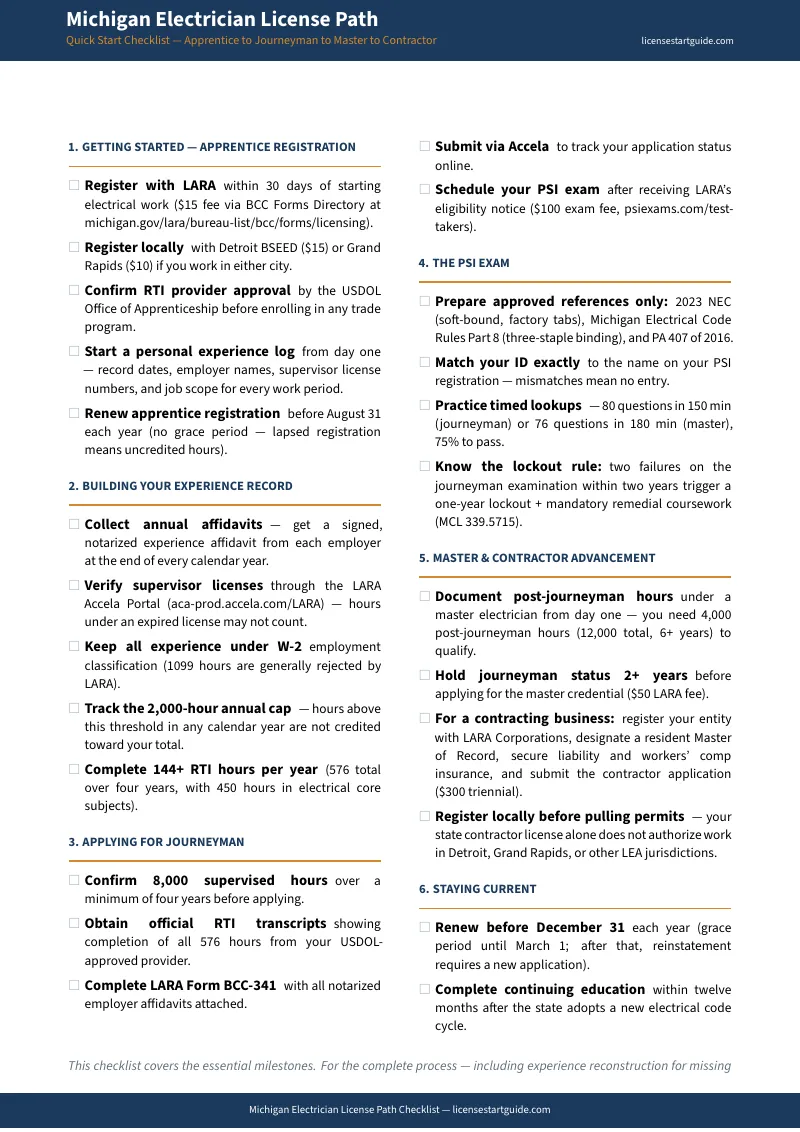
Not sure if you need the full guide? Download the free licensing checklist first. It gives you every LARA, Detroit, and Grand Rapids requirement on two pages — apprentice through contractor, with the hour thresholds, fee amounts, and filing deadlines side by side. If the checklist reveals gaps you need help filling, the full guide and its 6 standalone planning tools are waiting.