Indiana's Home Food Rules Are Splitting in Two — and Most Advice Online Covers Only Half
You want to sell your baked goods, jams, or prepared meals from your Indiana kitchen. You search for what's legal and find a patchwork of contradictions: one blog says you need ServSafe certification, another says you don't. A Reddit thread claims you can sell jerky from home, while a county health department page says meat is strictly off-limits. None of them mention that Indiana is about to replace its entire cottage food framework with the Homestead Food Sales Act on July 1, 2026.
The confusion isn't your fault — Indiana is genuinely running two parallel legal systems right now. The current Home-Based Vendor law (IC 16-42-5.3) restricts you to shelf-stable foods with strict pH and water activity limits. The incoming Homestead law (IC 16-42-5.4) opens the door to perishable meals, meat products, and TCS foods — but under a completely different labeling requirement, a different training trigger, and a $1.5 million gross sales threshold that didn't exist before. Operating under the wrong era's rules isn't a gray area — it's a path to cease-and-desist orders, fines up to $3,000, and confiscated product.
The Dual-Era Compliance System
The Indiana Cottage Food & Home Food Business Guide is a complete process navigation system built for both regulatory eras. It doesn't give you one generic overview and wish you luck — it walks you through each framework's specific requirements side by side, so you know exactly which rules apply to your products, your sales channels, and your county right now, and exactly what changes on July 1, 2026.
Where free resources give you a list of "allowed foods," this guide gives you the decision framework behind the list: the pH and water activity thresholds that determine whether your specific recipe qualifies, the county-by-county registration requirements that state-level summaries skip entirely, and the commercial kitchen triggers that tell you precisely when your operation outgrows the home exemption.
What's Inside
- Product Eligibility Decision Matrix — stop guessing whether your frosted cakes, pickled vegetables, or smoked meats are legal. The worksheet maps the pH ≤ 4.6 and water activity ≤ 0.85 thresholds that define what you can sell under the current HBV rules, and shows exactly which products become legal under the 2026 Homestead framework.
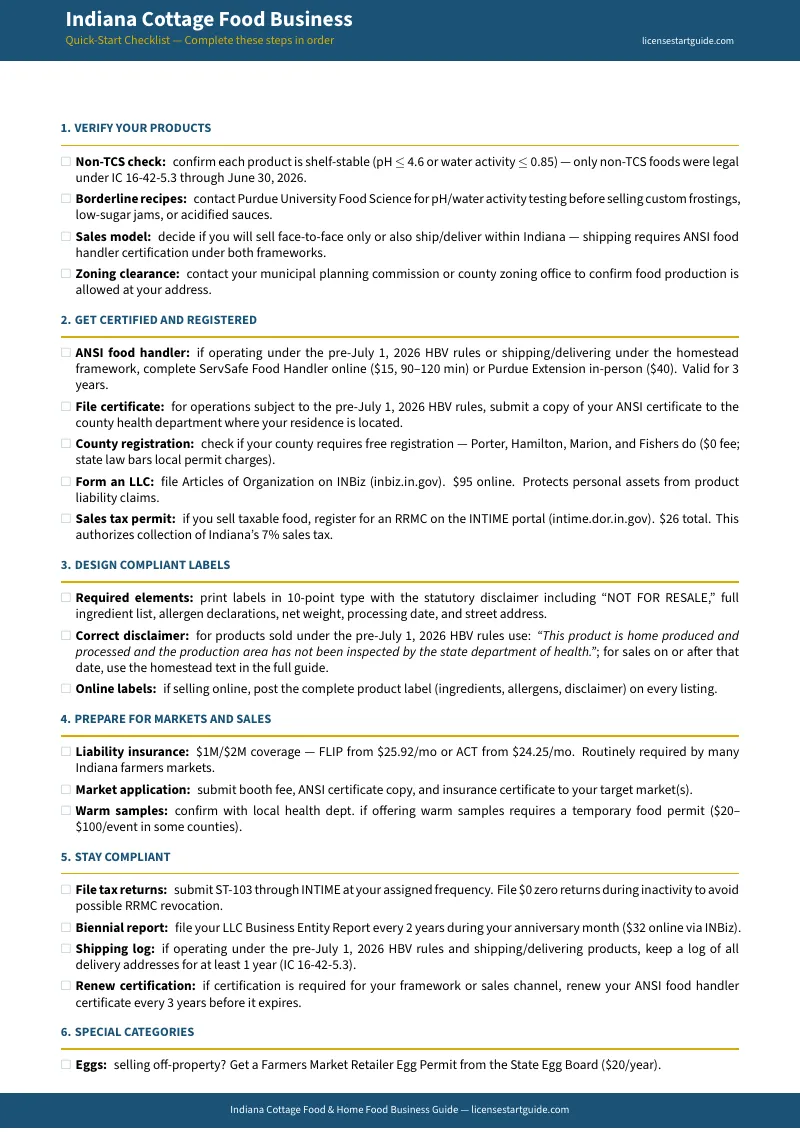
- The complete registration sequence — from verifying your product eligibility through filing your Registered Retail Merchant Certificate on INTIME ($26), securing your ANSI food handler certificate, and registering with counties that require it (Porter County, Fishers, and others). Every step in order, with the exact forms and portals.
- Dual-era labeling templates — copy-ready label text for both the current HBV disclaimer ("This product is home produced and processed…NOT FOR RESALE") and the 2026 Homestead disclaimer, with the exact font size and placement requirements. Print-ready, not paraphrased.
- Animal product rules — eggs, poultry, rabbit, and meat — the Board of Animal Health (BOAH) and State Egg Board add a layer of regulation that most cottage food guides ignore completely. This chapter covers egg grading exemptions, poultry processing limits, and when USDA custom-exempt processing applies.
- County-by-county compliance map — state preemption bars local health departments from requiring food permits, but it doesn't override zoning. The guide covers Home Occupation permit requirements, county-specific registration mandates, and the municipalities where you'll face additional local steps.
- Farmers market and event selling rules — booth applications, temporary event permits, required signage, sampling regulations, and the insurance minimums that most markets require but the state doesn't mandate.
- The Homestead transition timeline — what changes on July 1, 2026, what stays the same, and the specific steps to convert an existing HBV operation to Homestead status. Covers the new shipping training trigger, the TCS food expansion, and the $1.5M sales threshold.
- Commercial kitchen trigger checklist — five hard triggers that tell you when your home kitchen operation needs to move to a licensed retail food establishment. Not "when you feel ready" — when the law requires it.
- Business structure decision guide — sole proprietorship vs. LLC, sales tax collection mechanics, product liability insurance options ($2 million coverage for under $26/month), and when an EIN matters.
- Worksheets and planning tools — Product Eligibility Decision Matrix, Registration Sequence Tracker, Label Compliance Worksheet, Farmers Market Prep Checklist, Homestead Transition Tracker, Startup Cost Calculator, Market Revenue Tracker, and Commercial Kitchen Trigger Checklist.
Who This Is For
- Home bakers and cooks ready to move from giving away food to selling it legally — you need to know which products qualify and which steps come first
- Experienced food professionals transitioning from restaurant or catering work to a home-based operation — you know food safety, but you don't know Indiana's home production exemptions
- Homestead and small farm operators selling eggs, honey, poultry, or value-added products — you're dealing with BOAH, the Egg Board, and IDOH simultaneously
- Out-of-state movers who ran a cottage food business in another state and assume Indiana works the same way — it doesn't, and the differences can cost you
Why Not Just Use Free Resources?
Free resources exist — Purdue Extension covers the food science, Forrager.com summarizes the state law, and your county health department has a handout. The problem is that none of them cover the full picture:
- Purdue Extension explains pH thresholds and food safety science but doesn't walk you through INBiz LLC filing, INTIME tax registration, labeling layout, or business structure decisions
- Forrager gives a solid state-level summary but lacks county-specific forms, step-by-step registration tutorials, and the 2026 Homestead transition details
- County health department handouts cover local rules for one county but don't explain state preemption, don't address other counties you might sell in, and often contradict each other
- Blog posts from 2022 or 2023 predate the Homestead Food Sales Act entirely — following their rules after July 2026 can put you in violation of the new framework
This guide consolidates what those sources cover separately, fills the gaps between them, and gives you one coherent process from "Is my product eligible?" to "First legal sale" — updated for both eras of Indiana home food law.
What You're Getting
Your purchase includes the full Indiana Cottage Food & Home Food Business Guide (51 pages, 12 chapters), the Requirements Checklist (2-page quick-reference, 23 items), and eight fillable worksheets. All are instant-download PDFs — no waiting for shipping, no login required.
Not sure yet? Download the free Requirements Checklist first — it covers the step sequence. The full guide covers how to execute each step, with the templates, decision frameworks, and county-by-county details.
Get the Indiana Cottage Food & Home Food Business Guide →
Every purchase is backed by a satisfaction guarantee. If the guide doesn't give you a clear, actionable path to your first legal sale, email us and we'll make it right.