Five agencies. No coordination. One wrong step and your fees are wasted.
You want to open a licensed home daycare in Idaho. The state says you need a license from the Department of Health and Welfare. But DHW doesn't process your application directly — that goes through IdahoSTARS, a university partnership that runs the RISE digital portal. And IdahoSTARS doesn't handle your background check — that's the DHW Criminal History Unit, a separate division with its own fees and its own processing timeline. And neither of those agencies conducts your physical inspection — that's your regional public health district, one of seven independent districts with different fees, different schedules, and different procedures. And none of them controls whether your residential zone permits a home-based business — that's your city planning department, which still enforces local zoning even though House Bill 243 stripped cities of every other childcare licensing power in 2025.
If anyone has told you about Boise's old city childcare licensing process or Idaho Falls' municipal requirements, that information is obsolete. HB 243, effective July 1, 2025, consolidated all childcare licensing authority at the state level. But zoning, building permits, and fire codes stayed local. No government website maps where the state process ends and the local process begins.
The Idaho Daycare Compliance Roadmap — Every Agency, One Sequence
The How to Start a Licensed Home Daycare in Idaho guide consolidates requirements from every agency you will interact with into a single chronological process. It is built specifically for Idaho's post-HB 243 regulatory landscape — not adapted from a generic national template — and covers the state RISE/IdahoSTARS process alongside dedicated sections for local zoning clearance in Boise, Meridian, Nampa, and Idaho Falls.
Instead of bouncing between government portals trying to figure out what comes next, you work through one document that tells you exactly what to file, where to file it, what it costs, and what needs to be completed before you can move to the next step.
What's Inside
Licensing Thresholds and the Voluntary License Decision — Idaho requires a license at seven or more unrelated children. At six or fewer, you are exempt — but you can apply for a voluntary license to qualify for the Idaho Child Care Program (ICCP), the state's subsidy system. The guide covers the exact counting rules, the kinship exemptions under Idaho Code § 39-1103, and a decision framework for evaluating whether the subsidy revenue justifies the compliance overhead of voluntary licensing.
The HB 243 Preemption Breakdown — Before July 2025, a Boise provider needed both a city worker's license and a city facility license. Meridian, Nampa, and Idaho Falls each had separate municipal processes. HB 243 wiped all of that out. The guide explains precisely what changed, what your city still controls, and how to avoid wasting time on defunct municipal licensing offices that now redirect to IdahoSTARS.
Zoning Clearance — Why It Must Come First — Background checks cost $105–$110 per person across the DHW, ISP, and local rolling fees. Training costs time and tuition. If your city planning commission ultimately denies your home occupation application, every dollar spent on state requirements is lost. The guide walks through the zoning clearance process for Boise (compliance review), Meridian (Conditional Use Permit), Nampa (daycare-specific home occupation packet), and Idaho Falls (registration system) — and explains why this step must precede everything else.
The RISE Portal and IdahoSTARS Orientation — Every applicant must register in the Registry of IdahoSTARS Eligibility (RISE), complete the mandatory online orientation through the Professional Development System, and receive the official application — which is released only after orientation. The guide covers account setup, orientation logistics, and the common sequencing mistakes that stall applications at this stage.
Background Checks for the Entire Household — Idaho requires enhanced fingerprint-based criminal history checks through the DHW Criminal History Unit for every provider, employee, volunteer with unsupervised access, and household member aged 13 or older. The guide covers the full $105–$110 per-person cost across the three fee components, the fingerprinting process, typical processing timelines, what happens when a household member has a record, and the separate juvenile justice checks for minor household members through county courts.
The Points-Based Ratio Calculator — Idaho determines your maximum licensed capacity using a mathematical formula where each child costs a set number of points based on age: infants cost 2 points, toddlers 1.33, preschoolers 0.923, and school-age children 0.48. A single provider may not exceed 12 total points. The guide includes worked examples showing how to model different enrollment mixes and when you need to hire an assistant — because with the right age mix, you could care for twelve children alone, but three infants and a toddler already consume 7.33 of your 12 points.
Room-by-Room Inspection Preparation — Your physical inspection comes from a sanitarian at your regional public health district — not from IdahoSTARS or DHW. The guide converts regulatory requirements into a practical walkthrough: safe sleep surfaces, 4-foot self-locking pool fences, locked chemical cabinets, fire extinguisher placement, well-water testing, and food safety under the cottage-food exemption for non-TCS foods. It includes a district-by-district breakdown for all seven Idaho public health districts, with contact points and fee information.
ICCP Subsidy Enrollment — Once licensed, you can enroll in the Idaho Child Care Program to accept state-subsidized families. The guide covers the enrollment process, the higher training requirement (12 hours annually instead of 4), reimbursement rates, and how Quality Achievers participation increases those rates.
Who It's For
- Home providers at the six-child threshold who want to grow to seven or more and need a mandatory state license
- Small providers choosing voluntary licensure to qualify for ICCP subsidies or build market credibility with parents
- Educators and center workers who understand child development but not Idaho's multi-agency licensing bureaucracy
- Providers from the old municipal system in Boise, Meridian, or Idaho Falls who need to navigate the post-HB 243 transition
- Out-of-state operators relocating to Idaho whose existing credentials do not transfer
Why Not Just Use the Free Government Websites?
Every form and regulation this guide references is publicly available. IdahoSTARS publishes orientation requirements. The DHW Criminal History Unit accepts background check submissions. Each public health district posts its own inspection guidelines. Each city planning department maintains its own zoning application process.
The problem is coordination. The IdahoSTARS website does not tell you that your zoning clearance should be confirmed before you pay for background checks — not after. The DHW website does not explain how the Criminal History Unit's processing timeline interacts with the IdahoSTARS orientation sequence. Your public health district's website does not explain which of its requirements overlap with and which are separate from the state's licensing checklist.
National daycare startup blogs give you a generic ten-step list that applies identically to all fifty states. They do not cover Idaho's 2025 HB 243 preemption shift, the points-based ratio system that replaced traditional age-group ratio tables, or the fact that your physical inspection comes from an independent public health district with its own fee structure rather than from the agency that issues your license.
This guide does the coordination work once — mapping every agency's requirements into the order you actually need to complete them — so you do not pay for mistakes that come from filing things out of sequence.
What You Get
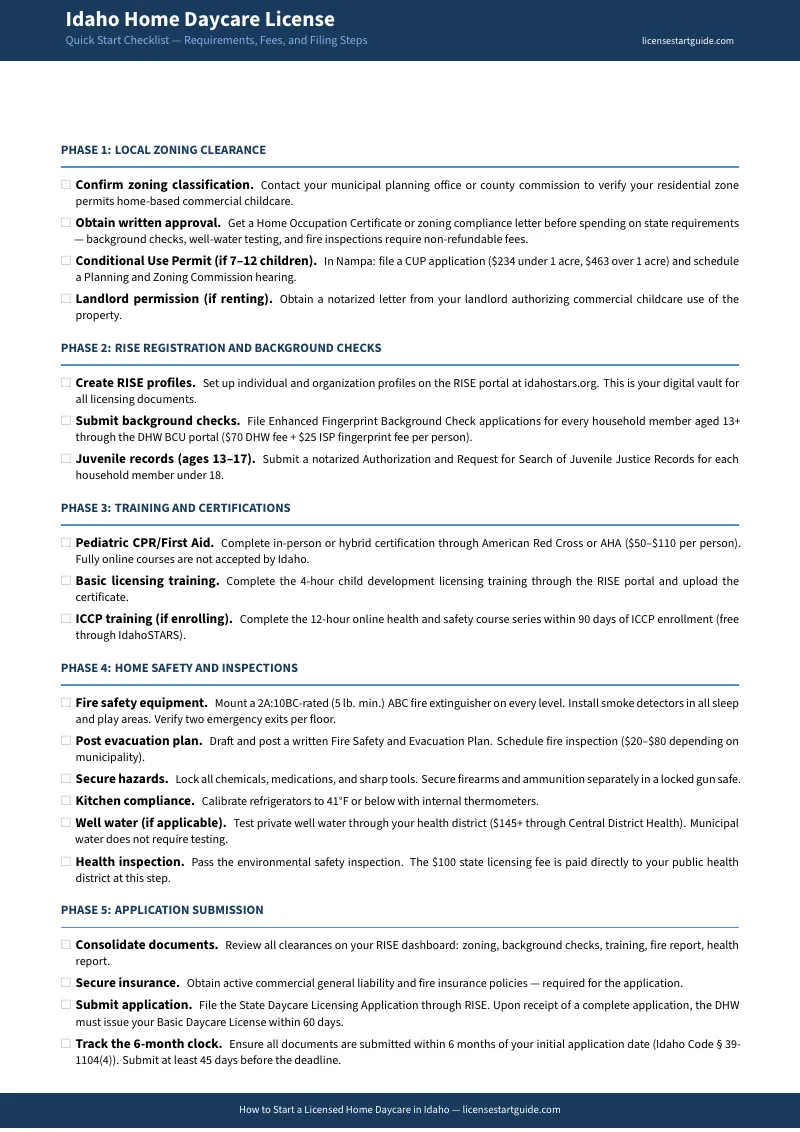
Eleven instant-download PDFs: a 46-page comprehensive process guide, a quick-reference licensing checklist, and nine fill-in planning tools — a Zoning Pre-Check Worksheet, Startup Cost Worksheet, Background Check Budget Tracker, Ratio Points Calculator, Home Safety Audit Checklist, Application Timeline Planner, ICCP Enrollment Decision Worksheet, Inspection Readiness Log, and Agency Communication Log. The guide covers every step from confirming whether you need a license through passing your inspections, calculating your capacity, and enrolling in subsidy programs. The checklist distills the process into a sequential task list, and each worksheet turns one decision or compliance step into something you can print and fill in with a pen. All of it is yours to keep — no subscription, no recurring fee, no platform lock-in.
The free checklist covers what to do. The full guide covers how — with agency-specific instructions, cost breakdowns, ratio calculations, and the post-HB 243 regulatory context that makes Idaho's process different from every other state.