
You Completed the Training. You Filled Out the Form. Then the County Clerk Turned You Away.
It happens more often than anyone talks about. You spent a couple of hours on the GSCCCA training course, printed your certificate, drove to the courthouse — and the clerk told you that you also needed a local background check from the sheriff's office, dated within the last 30 days, or a printed exam score of 90% or higher, or a cashier's check instead of the personal check you brought.
None of that was on the state website. Because the state website only tells you the state rules. Georgia's 159 counties each set their own additional requirements, and no single official source lists them all in one place.
The County Navigation System
This guide is built around a simple idea: the commissioning process has a specific sequence, and skipping ahead is the most expensive mistake you can make.
Most applicants treat the GSCCCA portal as the starting point. It isn't. Your county clerk's requirements come first — because everything else depends on what your specific county demands. A background check from the wrong agency gets rejected. A training certificate older than 30 days gets rejected. Showing up without the exam score printout, in counties that require it, means driving home and coming back.
The County Navigation System works backward from your courthouse visit to make sure every document, every fee, and every form of payment is correct before you leave your house.
What's Inside
- County requirement matrix — which counties require local criminal background checks, which mandate the 90% exam score, what payment methods each courthouse accepts, and whether your county offers mail-in processing or Zoom oath administration
- GSCCCA portal walkthrough — step-by-step navigation of the online application, including the PDF rendering issue that causes blank pages in certain browsers and how to fix it before you waste a trip to the courthouse with an incomplete printout
- Self-filer journal — a printable landscape journal with all eight mandatory data fields from the 2025 law (O.C.G.A. § 45-17-8(g)) — bring it to every real estate notarization involving a self-filer so you're not guessing what to document
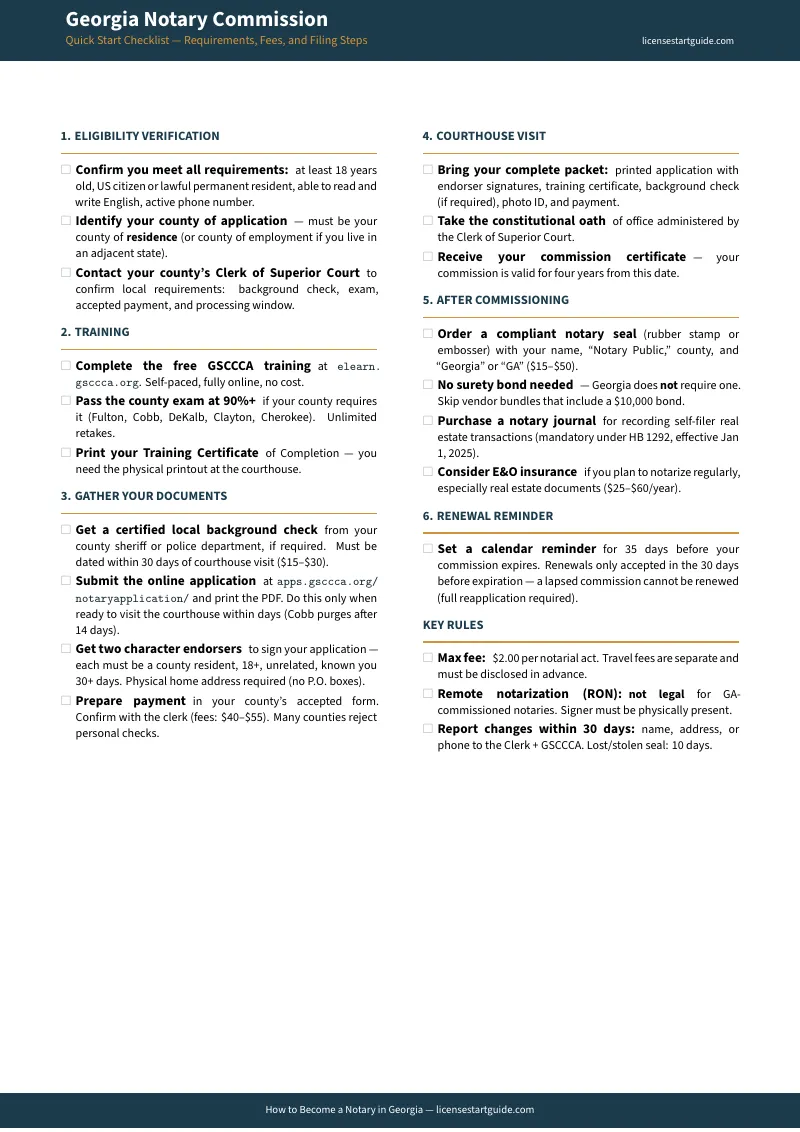
- Commission timeline tracker — a standalone reference sheet that tracks the 30-day renewal window, the 30-day deadline for reporting name or address changes, and the 10-day deadline for reporting a lost or stolen seal
- Cost breakdown by county — actual filing fees across major Georgia counties ($40–$55), background check costs ($15–$30), and seal pricing ($15–$50), plus a fill-in cost budget worksheet so you can track your actual spending against commercial vendor packages
- Bond myth-buster section — Georgia does not require a surety bond for traditional notary commissions, and the guide explains exactly why commercial vendors still push $10,000 bond packages and how to avoid spending $30–$60 on something you don't need
- RON and IPEN status guide — clear breakdown of what's legal (in-person electronic notarization), what's not legal (remote online notarization via webcam), and what the pending legislation actually says — so you don't invest in RON software you can't legally use
- Side business licensing overview — separates your notary commission from the additional permits you may need to run a mobile notary business, including local business tax certificates, DBA filings, and the distinction between your notary authority and occupational licensing
Who This Is For
- Administrative professionals and paralegals whose employers want notarized documents handled in-house — and who need to get commissioned without burning company time on rejected applications
- Real estate closing agents and settlement coordinators who need to understand the 2025 self-filer journal mandate before it creates compliance exposure
- People starting a mobile notary side business who want to know the actual startup cost — not the inflated number that commercial supply vendors quote
- Anyone renewing a Georgia commission who needs to navigate the mandatory training requirement that didn't exist when they were first commissioned
Why Not Just Use the Free Resources?
The GSCCCA portal is free and it's the only lawful filing channel. That's not in question. The problem is that the state portal doesn't warn you about the things that actually cause rejected applications — county-specific background check rules, payment restrictions, exam requirements that exist in some counties but not others.
The National Notary Association sells packages from $75 to $265 that bundle stamps, seals, and sometimes an E&O insurance policy you may not need. The American Association of Notaries still instructs Georgia applicants that they need a $10,000 surety bond — which the GSCCCA explicitly says is not required.
This guide isn't a replacement for the state portal and it isn't a supply package. It's a navigation layer that sits between the free state resources and the commercial vendor upsells — one that tells you what to do, in what order, for your specific county, without selling you anything extra.
Satisfaction Guarantee
If the guide doesn't save you at least one trip back to the courthouse, email [email protected] for a full refund. No forms, no waiting period.
Get Started
Download the free checklist to see the full commissioning sequence at a glance. When you're ready for the county-specific details, the self-filer journal, and the full cost breakdown, the complete kit — a 14-chapter guide plus five printable worksheets — is — a fraction of what you'd spend on a single unnecessary supply package.