Connecticut Changed Everything About Teacher Licensing — And Most Guides Haven't Caught Up
On July 1, 2025, the Connecticut State Department of Education collapsed its three-tier certification ladder into a two-tier continuum. The Provisional certificate is gone. Initial certificates now last ten years instead of three. Elementary grade spans were unified overnight. Fee structures were overhauled months later.
If you are applying for a Connecticut teaching credential right now, you are navigating a system where the official portal has not fully caught up with its own rules, the phone line is staffed two hours a day on two days a week, and a single paperwork mistake can bury your application in a processing queue that stretches past three months during peak hiring season.
The universities explaining certification routes are actually selling degree programs. The test prep companies want to sell you exams before checking whether you qualify for a waiver. The state portal hosts dense regulatory PDFs but offers no diagnostic roadmap.
You need something none of them provide: a neutral, sequential process tracker built specifically for the post-2025 system.
The Certification Route Mapper — Your Shortest Path to a Connecticut Classroom
The Connecticut Teacher Certification Guide is a process-navigation toolkit — not test prep, not a university recruitment funnel, and not affiliated with any certification board. It maps every route from your current qualifications to an active Connecticut teaching credential, with the exact forms, fees, timelines, and decision points at each step.
At the center is the Certification Route Mapper — a diagnostic framework that takes your background (degree, GPA, existing license, district job offer) and identifies the shortest legitimate pathway into a Connecticut classroom. Career changers who would have enrolled in a full graduate program discover they qualify for the nine-month ARC track. Out-of-state teachers who assumed they needed to retest learn they are eligible for Enhanced Reciprocity with a testing deferral. Recent graduates who thought their university handled everything realize they still need to navigate CECS, background checks, and fee payments on their own.
The guide does not guess. Every recommendation traces back to the specific statute, CSDE policy, or Cert Alert that governs it.
What's Inside the Toolkit
- The two-tier system decoded — how the ten-year Initial and Professional certificates work under Public Act 24-41, what happened to existing Provisional credentials, and the automatic transition rules that determine your next step
- Five certification routes compared in detail — Traditional EPP, Alternate Route (ARC) with GPA waiver guidance, Enhanced Reciprocity for 23 designated states, standard NASDTEC transfer, and the district-initiated DSAP for shortage areas
- CECS portal walkthrough — account registration, application submission, the "Check Status/Pay Now" dashboard, fee payment (credit card only — no debit), and how to print your updated certificate since the CSDE no longer mails physical copies
- Testing logistics mapped by endorsement — which Praxis Subject Assessment or Pearson CTCE exam your endorsement requires, how to register, how score reports route to the state (ETS Provider Code 7050), when to apply for SAT/ACT-based waivers, and the upcoming transition to the National Evaluation Series starting July 2026
- The fingerprinting and background check sequence — CCHRS pre-enrollment, district-specific Service Codes, Livescan appointment scheduling at CREC/ACES/EdAdvance, and the exact fees at each step (FBI $15, State Police $75, Livescan processing $30-$45)
- Transcript evaluation guidance — when a course-by-course evaluation is required versus a document report, which NACES member agencies the CSDE accepts, and why mailing sealed paper transcripts is safer than electronic submission
- Cross-endorsement pathways — how to add subject areas through examination or coursework, the $100 fee structure, and the unified elementary grade spans
- Six printable tracker worksheets — a certification route decision worksheet, application document tracker, testing registration log, background check clearance tracker, TEAM induction progress log, and fee-and-expense summary that keep the entire process organized from first application to classroom placement
Who This Guide Is For
- Out-of-state teachers moving to Connecticut — you need to know whether you qualify for Enhanced Reciprocity or fall back to the standard NASDTEC route, whether you can defer testing under an Interim Initial Certificate, and how to get your years of experience recognized
- Career changers exploring the classroom — the ARC program, DSAP, and Temporary 90-Day Certificate each have different eligibility rules, costs, and timelines that universities rarely explain side by side
- Recent EPP graduates — your university submitted the institutional recommendation, but you still need to navigate CECS, pass the right exams, clear background checks, and manage the gap between degree conferral and certificate issuance before your district contract starts
- Current Connecticut educators with expiring credentials — whether you hold a Provisional certificate approaching expiration or an Initial certificate you want to advance, the transition rules under the new framework determine your options
Why Not Just Use the Free State Resources?
The state's website is a regulatory archive — dense statutes, scattered knowledge-base articles, and multi-page Cert Alert PDFs. It will tell you what the law says. It will not tell you what to do first, what mistake will delay your application by three months, or whether you are about to pay for an exam you do not actually need.
The Bureau of Certification phone line is available Monday and Thursday, 12:00 PM to 2:00 PM. If you miss that window, you wait until the next available slot. If your question requires a certification consultant to review your transcript, the turnaround is measured in weeks.
TEACH Connecticut offers free coaching and checklist creators, but it functions as a top-of-funnel marketing channel for regional programs. It handles straightforward cases well. It does not troubleshoot the complex scenarios — reciprocity edge cases, transcript deficiencies, GPA waiver documentation — that are the difference between a credential this semester and a credential next year.
This guide fills the space between the state's regulatory language and the questions you actually need answered. It is independently published, receives no commissions from universities or test vendors, and covers every pathway — including the ones that cost nothing — with equal detail.
A Guarantee That Matches the Promise
If the guide does not save you more in time and avoided confusion than it costs, email us for a full refund. No questions, no forms, no hoops. The entire point of a process tracker is that it pays for itself by preventing one unnecessary exam registration, one rejected paper application, or one missed deadline that pushes your start date back by a semester.
Get the Connecticut Teacher Certification Guide →
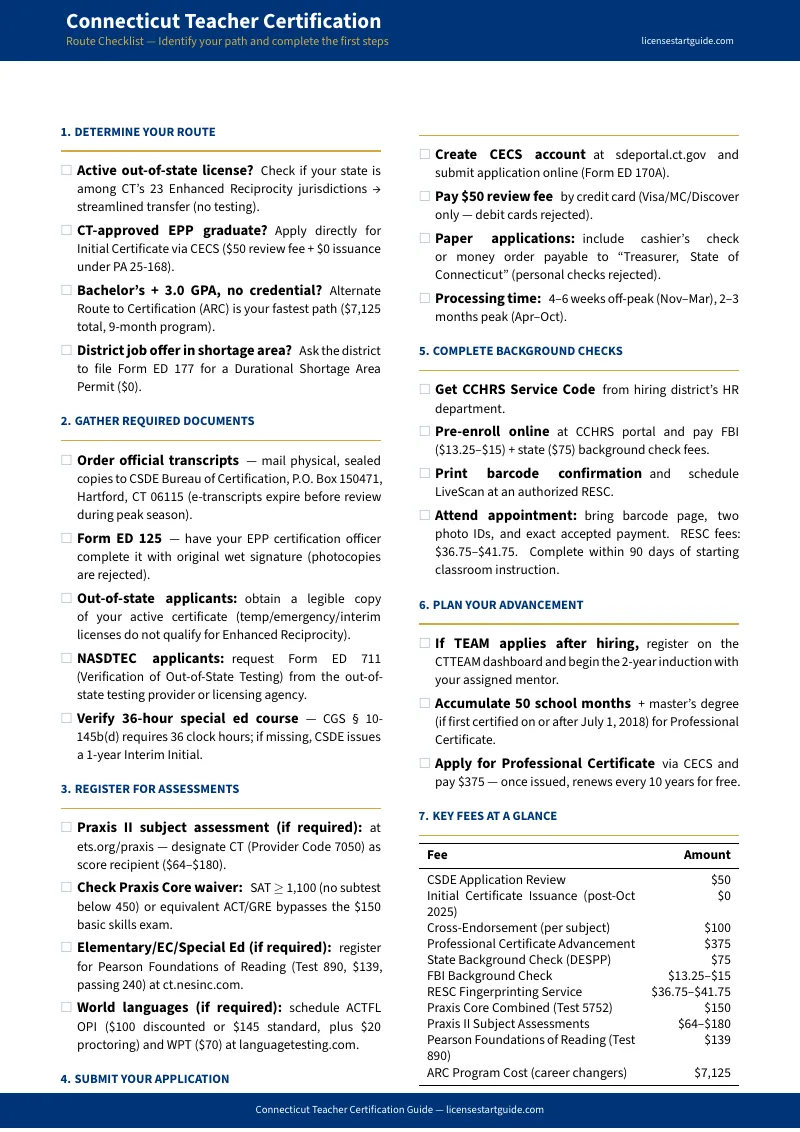
The free checklist compares routes at a glance. The full guide walks you through each one — forms, fees, timelines, and the tracker worksheets that keep the entire process organized from first application to classroom placement.