You Know HVAC. Alaska's Paperwork Is a Different Kind of Problem.
You can size a boiler for a Fairbanks winter and troubleshoot a heat pump at forty below. But when you try to go independent in Alaska, the technical skills that got you here don't help with the next part — a licensing process split across two state departments, three major municipalities, and a stack of filings where one name mismatch sends everything back to square one.
Alaska doesn't issue a single "HVAC license." Your authority to bid on work, pull permits, and operate legally comes from a Credential Alignment System — a coordinated stack of federal, state, and local filings that must reference the same entity name, the same insurance certificate, and the same bond number. Get one piece wrong and the whole application stalls.
The Alaska HVAC License Guide is a plain-language process map built specifically for this system. It walks you through every credential in the order you need to file them, with worksheets to keep your entity name, bond, and insurance aligned across every agency.
What's Inside the Full Guide
- The Dual-Department Roadmap — how CBPL and DOLWD divide authority over your career, and the exact sequence to file with each so nothing triggers a rejection
- EPA Section 608 Certification Logistics — testing locations across Alaska (UAA, AVTEC, Mat-Su College), online proctored options, and which certification type covers your actual work
- Mechanical Administrator License Walkthrough — all four categories (UHVCS, UR, HCPP, Residential) with experience documentation forms, the PSI exam scheduling process, and the engineering-degree shortcut
- Entity Alignment Worksheets — fill-in templates that coordinate your LLC name, NAICS codes, surety bond, and insurance certificates so every filing matches on the first submission
- Contractor Registration Sequence — business license, bonding ($10,000 surety with typical $100–$300/year premiums), insurance minimums ($20K/$50K/$100K), and the correct order to file each document
- Municipal Compliance Guides — Anchorage's closed-book exams and notarized hour verification, Fairbanks' city business license and zoning permits, Juneau's over-the-counter residential replacement permits
- Out-of-State and Military Transition Pathway — how to use the August 2025 provisional COF, map your existing hours to Alaska's verification forms, and start working legally within weeks
- Remote Area Exemption Map — which communities under 5,000 people qualify for the Mechanical Administrator waiver, and what documentation you still need
- Fee and Renewal Reference Table — every state and municipal fee for the 2025–2026 cycle consolidated in one place, with renewal deadlines and CE requirements
Who This Guide Is Built For
This guide is for HVAC technicians who already know the trade and need a clear path through Alaska's administrative process — not a technical training manual, not exam prep, and not a shortcut.
- Journeymen going independent — you've logged the hours under someone else's license, now you need to file the paperwork to bid on jobs yourself
- Out-of-state technicians — Alaska has zero reciprocity, but the provisional COF gives you a documented path to start working while you prepare for local exams
- Veterans transitioning from JBER or Eielson — your military HVAC experience counts toward state requirements, but the documentation process has specific forms
- Business owners who need to hire and assign a Mechanical Administrator to qualify their company for a Mechanical Contractor registration
Why Not Just Use the Free Government Sites?
The information exists across state and municipal websites — spread across CBPL's professional licensing portal, DOLWD's mechanical inspection pages, the Municipality of Anchorage's Building Safety Division, the Fairbanks City Clerk's office, and Juneau's Community Development Department. None of them explain how their requirements interact with each other.
A single mismatch between your registered LLC name, your surety bond filing, and the name on your general liability certificate triggers an automatic application rejection. The non-refundable application fees don't come back. The weeks you spent waiting for review don't come back either.
This guide connects the dots between agencies — telling you which document to file first, which name format to use everywhere, and which municipal quirks (like Anchorage requiring notarized experience letters instead of the state's standard forms) will catch you if you don't know about them in advance.
What You Get
Your purchase includes 9 PDF downloads:
- The Alaska HVAC License Guide (51 pages) — the complete process walkthrough covering every credential from EPA 608 through contractor registration
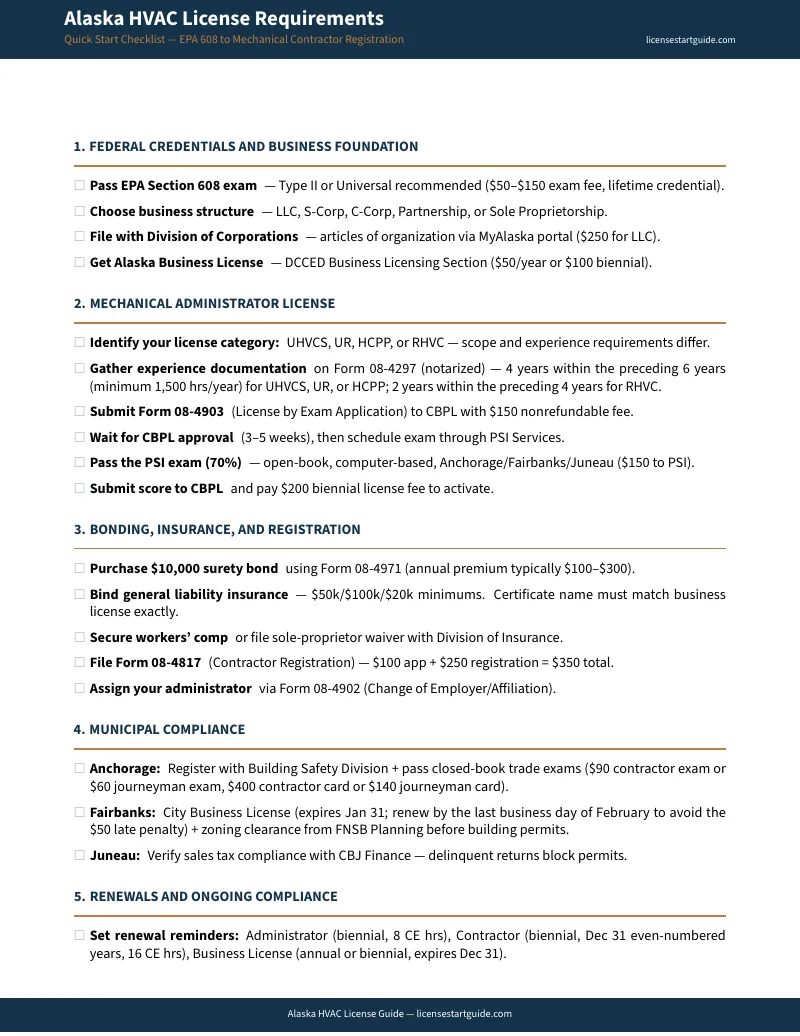
- HVAC License Requirements Checklist (2 pages) — a condensed step-by-step reference you can print and check off as you file
- Licensing Pathway Decision Worksheet — identify which Mechanical Administrator category, COFs, and municipal requirements apply to your situation
- Experience Documentation Tracker — log your field hours by employer and trade category before submitting Form 08-4297
- Business Entity Alignment Checklist — verify your LLC name, bond, insurance, and registrations match exactly across every filing
- State Fee Calculator — itemize every fee from entity formation through active registration
- Municipal Compliance Quick Reference — Anchorage, Fairbanks, and Juneau requirements side by side on one page
- Renewal Calendar and CE Tracker — map every renewal deadline and continuing education hour in one place
- Agency Communication Log — record every call, email, and submission with dates, contacts, and outcomes
The Free Checklist
Not ready for the full guide? Download the free checklist — it covers the sequence of steps without the detailed how-to. If you decide to upgrade later, the full guide picks up right where the checklist leaves off.
Your purchase is a one-time payment with instant PDF delivery — no subscription, no recurring charges. If the guide doesn't help you navigate the process, email us and we'll make it right.
The licensing process isn't going to simplify itself. But with the right roadmap, it doesn't have to slow you down.