Your Kitchen Is Ready. Wisconsin's Rules Aren't What You Think.
You have a recipe that sells out at every church bake sale and a home kitchen that's cleaner than most restaurants. But Wisconsin doesn't have a cottage food law — it has a court injunction from 2017, a canned-goods statute from 2010, and an appellate ruling from 2024 that banned half the products you were planning to sell. Figuring out which rules apply to your specific product means reading across court orders, administrative codes, and county zoning ordinances that don't reference each other.
The chocolate chip cookie you bake in your oven is legal to sell without a license. The chocolate bark you make on your stovetop is a misdemeanor. The difference comes down to a single court definition — and getting it wrong means fines, a cease-and-desist order, or paying for a commercial kitchen you don't need yet.
The Wisconsin Food Business Compliance Navigator
The Wisconsin Cottage Food & Home Food Business Guide is a step-by-step process navigator that walks you through every exemption, filing, and regulatory boundary in the order you actually need to address them. It synthesizes the Kivirist court injunction for oven-baked goods, the Pickle Bill for high-acid canned products, DATCP commercial licensing requirements, DFI business registration, DOR tax permits, and county-specific zoning rules into one chronological sequence — so you don't discover at your first farmers' market that your county bans home food operations or that your frosting recipe doesn't meet the water activity standard.
What's Inside
- Product Eligibility Decision Matrix — a structured flowchart that tells you whether your specific product falls under the oven-baked exemption (no cap, no license), the Pickle Bill (capped at $5,000, markets only), or requires a commercial DATCP license, based on preparation method, shelf stability, and sales channel
- The Oven-Baked Standard Explained — the exact legal definition of "baked" under the Kivirist ruling: dry heat above 140°F in a closed chamber, water activity of 0.85 or below, and how common products like macarons, granola, and waffle-pressed items fit within the boundary after the 2021 clarification
- Pickle Bill Compliance Checklist — the complete statutory requirements for home-canned goods: pH documentation at 4.6 or below, the $5,000 gross annual cap, approved venue types, the mandatory point-of-sale placard language, and exactly which products qualify (pickles, jams, sauerkraut) versus which are banned (pickled eggs, pesto, dressings)
- Label Templates with Allergen Formatting — ready-to-use layouts covering the mandatory home-production disclaimer, ingredient list by descending weight, net weight, producer name and address, and the "Contains" allergen statement covering all nine major allergens including sesame
- County Zoning Breakdown — specific requirements for Kenosha County (catering/food service prohibition), Brookfield (15% floor-area limit, no on-site retail, $70 permit), Green County (septic capacity verification), and Portage County (50% single-floor limit), plus a template letter for contacting your local planning department
- Commercial Transition Roadmap — step-by-step instructions for obtaining a DATCP Retail Food Establishment License when your product line requires it, including plan review fees, pre-inspection requirements, Certified Food Manager training, shared-use incubator kitchen options across Wisconsin, and a cost comparison showing when commercial rent makes financial sense versus staying home
- Business Foundation Checklist — LLC registration with the Wisconsin DFI ($130 online filing, $25 annual report), DBA certificate with the county Register of Deeds, Seller's Permit from the DOR ($20 Business Tax Registration), and the sales tax classification for your products
- Insurance Decision Guide — product liability requirements for farmers' markets, FLIP program rates, the WFMA group policy option, and the difference between general liability and product-completed operations coverage for foodborne illness claims
- 10 Printable Worksheets — fillable tools you print and use at your kitchen table: product classification, label compliance, startup cost calculator, farmers' market prep, sales tax tracking, Pickle Bill revenue tracker, pH batch log, zoning contact sheet, commercial kitchen calculator, and agency communication log
Who This Is For
- Home bakers who want to sell decorated cakes, cookies, sourdough, and pastries at farmers' markets or through online pre-orders — and need to verify that their frosting recipes meet the non-TCS shelf-stability standard
- Canned goods makers navigating the Pickle Bill's $5,000 cap, venue restrictions, and pH documentation requirements for pickles, jams, salsas, and sauerkraut
- Chocolatiers and confectioners whose unbaked products are now banned from home kitchens and need the fastest, most affordable path to a licensed commercial alternative
- First-time food entrepreneurs figuring out the difference between a DBA, an LLC, a Seller's Permit, and product liability insurance — and which ones they actually need before their first sale
Why Free Resources Leave You Guessing
The DATCP website tells you what's prohibited. It doesn't explain how to structure a recipe modification that moves your product into the legal oven-baked category. MyPorch and Cakery give you a one-page state summary, but they don't mention that Kenosha County bans home food services entirely or that Brookfield prohibits porch pickup. The Wisconsin Cottage Food Association provides excellent advocacy updates, but their information is scattered across blog posts and Facebook threads with no chronological startup sequence.
Each of these sources covers one slice of the process. None of them explains the sequence — which exemption to verify first, what business filings to complete before your first sale, and which county office to contact about zoning before you invest in packaging and market booth fees. The guide puts the sequence together.
The Free Checklist
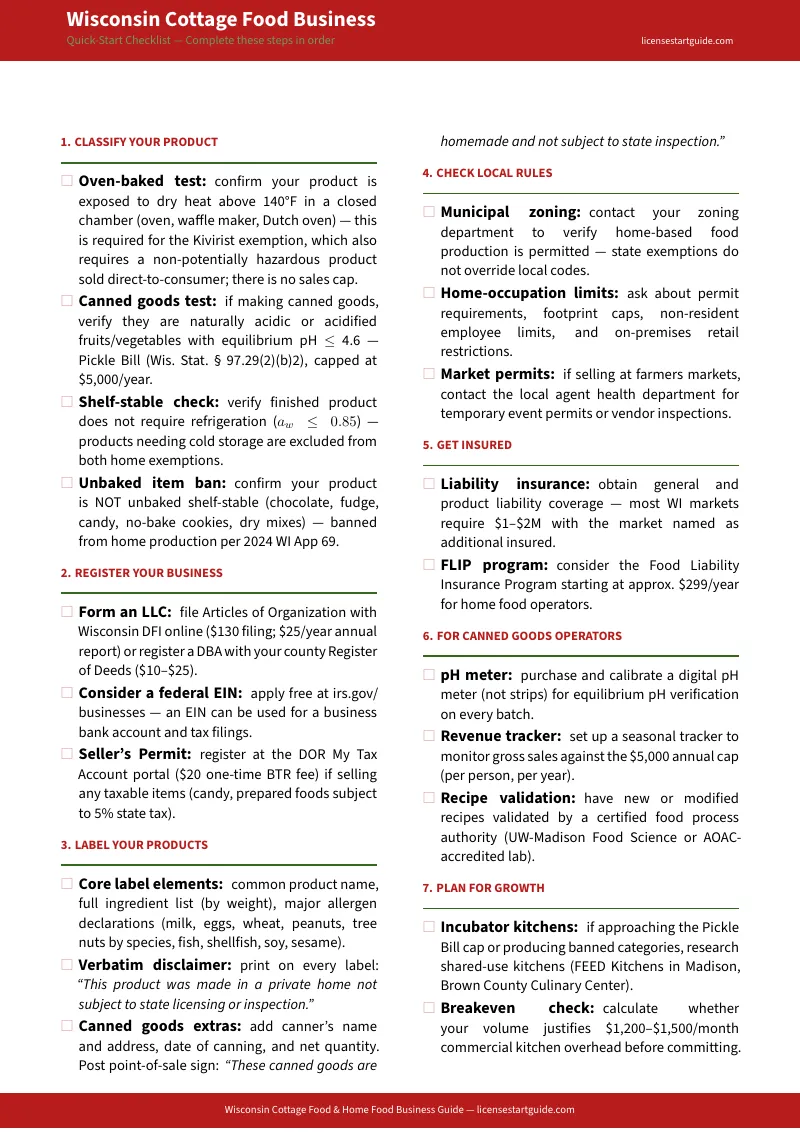
Not ready for the full guide? Download the Wisconsin — Cottage Food Business Requirements Checklist — a printable rundown of the key startup steps, from product eligibility to labeling to business registration to first-sale readiness. It covers what to do. The full guide covers how.
100% Satisfaction Guarantee
If the guide doesn't help you understand the licensing process, email [email protected] at any time for a full refund. No forms, no hoops.
Your recipes are already good enough to sell. The only question is whether you'll spend weeks deciphering court injunctions, county zoning codes, and scattered blog posts — or follow a step-by-step guide that puts it all in order for .