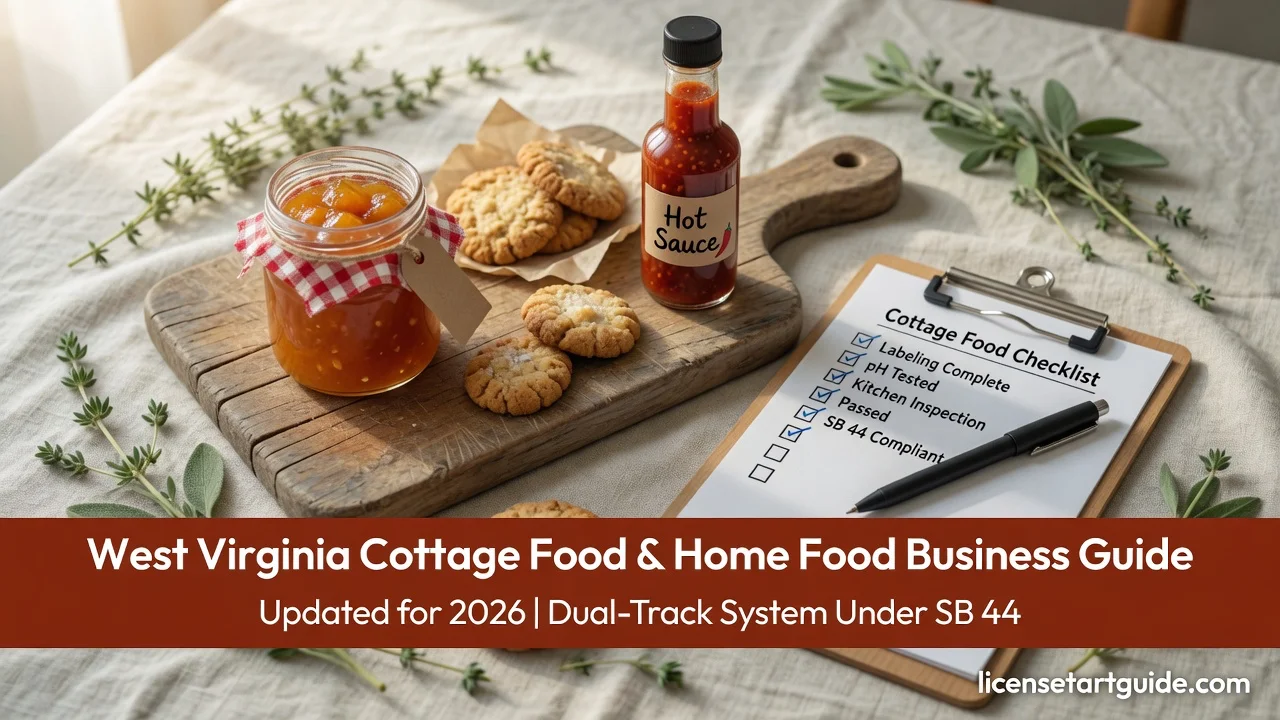
Your recipes are ready. Your compliance path isn't.
West Virginia's "food freedom" reputation makes it sound simple: bake at home, sell anywhere, skip the permits. But that story leaves out the dual-track regulatory system created by Senate Bill 44, the state business registration every seller needs regardless of product type, the municipal B&O taxes that hit your gross receipts from dollar one, and the hard in-state-only shipping boundary that turns a single out-of-state package into a federal violation.
Free blog posts and Facebook group advice give you fragments — a Track 1 product list here, a vague mention of "check your local rules" there. None of them walk you through the complete compliance sequence from recipe classification to your first legal sale. That gap is where shutdowns, tax audits, and cease-and-desist orders live.
The Dual-Track Compliance Navigator
This guide maps West Virginia's entire home food business framework — both regulatory tracks, every registration step, and the local tax obligations that most free resources skip — into one decision-driven reference. Instead of piecing together rules from the WVDA, county health departments, city finance offices, and food safety blogs, you get a single path from "I want to sell my food" to "I'm selling legally."
It starts with the Product Classification Decision Matrix: answer three questions about your recipe's ingredients, pH level, and temperature requirements, and the worksheet tells you whether you're Track 1 (exempt — no permit, no inspection, no fees), Track 2 (WVDA permit required), or commercial kitchen territory. No guessing about whether your buttercream frosting or low-sugar pepper jelly crosses the line.
What's Inside
Track 1 and Track 2 — Side by Side
A complete breakdown of both regulatory pathways under W. Va. Code § 19-35-6 and § 19-40-1 et seq., including eligible products, prohibited ingredients, allowed sales channels, and the key differences in labeling, inspection, and training requirements. Most free summaries cover one track and mention the other in a footnote. This guide covers both at the same depth.
The WVDA Permit Application Walkthrough
For Track 2 producers: the exact sequence for obtaining the Potentially Hazardous Cottage Food Vendor Permit — food safety training options and costs, how to get a Process Authority letter for acidified and fermented products, private well water testing requirements, what the pre-permit kitchen inspection covers, and how to prepare your space so you pass the first time.
State and Local Business Registration
The $30 State Business Registration Certificate on MyTaxes, LLC formation (West Virginia's $26 total filing fee — one of the lowest in the country), and the municipal Business and Occupation tax registrations that most home food guides ignore entirely. Includes filing guidance for Charleston, Huntington, Wheeling, and Morgantown.
Label Compliance Worksheet
A fill-in label layout with every mandatory element mapped to its correct position: statement of identity, ingredient list, allergen disclosures, net weight, producer contact information (full address for Track 1, city/state/ZIP for Track 2), and the required home-kitchen disclaimer. Formatted so you can hand it directly to a label printer.
Sales Channel Compliance Rules
Channel-by-channel guidance for direct sales, farmers markets, retail consignment, and online orders — including the in-store placard requirement for indirect sales, managed market application requirements, product liability insurance thresholds, and how to configure your e-commerce checkout to block interstate shipping.
Commercial Kitchen Trigger Checklist
Five specific scenarios that push a home operation into commercial licensing territory — products containing meat, poultry, seafood, or Grade A dairy; interstate shipping; event catering; volume that exceeds your residential kitchen's capacity; and wholesale of Track 2 products. Includes the state plan-review fee ($100 review + $35 permit = $135) and typical shared-kitchen rental rates ($15–$30/hour) so you can model the financial crossover before signing anything.
Who This Is For
- Home bakers and candy makers preparing to sell at a farmers market, through a local store, or online for the first time
- Pickle, salsa, and hot sauce producers navigating the Track 2 permit process and process authority requirements
- Existing cottage food sellers who started under the old rules and need to understand what SB 44 changed
- Growing home businesses evaluating whether to stay home-based or transition to a commercial kitchen
Why Not Just Use the Free Resources?
The WVDA covers food safety rules but says nothing about business registration, LLC formation, or municipal taxes. Advocacy sites like Forrager and the Institute for Justice track the law at a high level but don't walk you through the local implementation steps. Commercial kitchen incubators want you to rent space — they're not going to tell you that your product qualifies for a home permit. Food safety course providers sell you the training but don't explain which track requires it and which doesn't.
Each source covers its own piece. None of them cover the intersections — where state food exemptions meet county health authority, city business licenses, and gross receipts taxes. That's where compliance breaks down, and that's what this guide maps.
Satisfaction Guarantee, No Time Limit
If the guide doesn't give you a clear compliance path for your products and business structure, email [email protected] at any time for a full refund.
Get Started
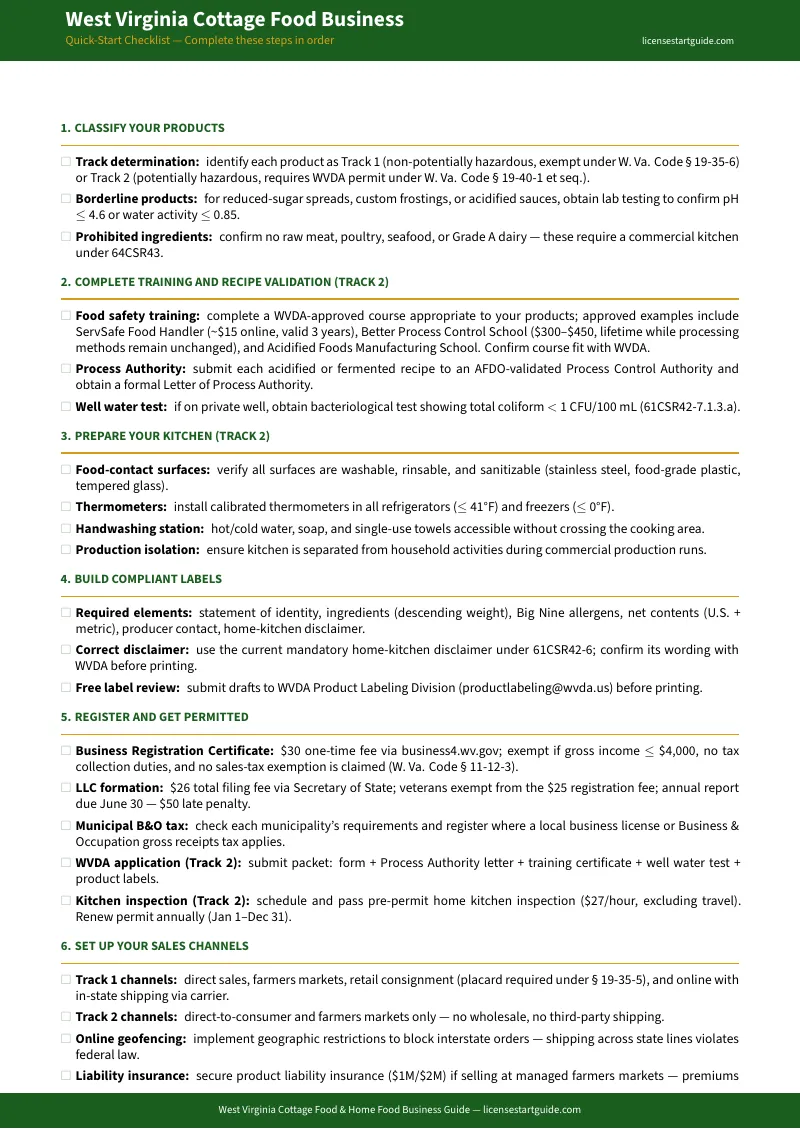
Download the free checklist for the step sequence, or get the full guide — with the Product Classification Decision Matrix, WVDA permit walkthrough, Label Compliance Worksheet, and sales channel compliance rules — for .