You Know the Trade. The Paperwork Is What Trips You Up.
You can size ductwork, pull a vacuum, and charge a system by feel. But Washington doesn't care about your field skills when it comes to credentials — it hands you three separate regulatory systems, each with its own forms, fees, and reasons to reject your application.
There's the federal EPA 608 certification that lets you handle refrigerants. There's the L&I electrical specialty certificate (06A or 06B) that lets you legally wire HVAC equipment, plus a separate contractor registration with bonding and insurance requirements. And then there are the municipal trade licenses that cities like Seattle and Spokane require before you can pull a permit — requirements that don't appear anywhere on L&I's website because L&I doesn't administer them.
File one layer out of sequence and you waste a non-refundable fee on paperwork that gets returned. Miss an entire layer and you discover the gap at the worst possible moment: a building inspector issuing a stop-work order, a general contractor pulling your name from a bid, or — under the 2026 Homeowner Recovery Program — an automatic registration suspension that lets the state come after you personally for up to $25,000.
The Three-Layer Compliance Sequence
This guide maps the exact order of steps across all three regulatory layers — federal, state, and local — so you handle the zero-cost items first, avoid the rejection triggers that waste application fees, and never show up at a government counter without the documents they actually need.
It's not exam prep. It's not legal advice. It's the administrative blueprint that tells you which office to contact, what to bring, and when in the process each step actually matters — the kind of sequencing that government websites never provide because no single agency sees the full picture.
What's Inside
A 12-chapter guide covering every step from your EPA card through your first permitted job, plus a printable quick-start checklist and 10 fill-in worksheets you can print and take to the shop, the notary, or the permit counter:
- The credential system, decoded — why there's no single "HVAC license" in Washington, how the three regulatory layers interact, and the three myths (EPA-card-is-enough, registration-covers-everything, codes-are-uniform-statewide) that cause the most compliance failures
- EPA Section 608 certification — exam structure, Universal vs. type-specific, approved testing providers, and the step-by-step process for replacing a lost card when your original provider has closed
- 06A and 06B electrical specialty licensing — the two HVAC classifications compared side-by-side (voltage limits, supervision ratios, hour requirements), trainee certificate application, supervised hour logging, classroom instruction, notarized affidavit preparation, and PSI exam logistics including the open-book policy
- Contractor registration sequence — entity formation with the Secretary of State, UBI through the Department of Revenue, the $15,000 specialty contractor surety bond, general liability insurance, electrical administrator designation, and the L&I application with its exact mailing requirements
- Seattle and Spokane trade licensing — Seattle's journeyman refrigeration mechanic program (Class A, B, and C), the online SDCI exam, Spokane's gas heating mechanic credential, and how to verify requirements in other cities before bidding work
- The permit split — when a job requires an L&I electrical permit, a local mechanical permit, or both, and the cities that require permits even for like-for-like equipment swaps
- Out-of-state credential transfers — Washington's narrow reciprocity rules, the notarized affidavit process, and which classroom hours actually transfer
- The 2026 Homeowner Recovery Program — how homeowner court judgments trigger automatic registration suspension, successor liability rules that prevent "phoenixing" a new LLC, and contract structuring to limit exposure
- Renewal calendar — biennial contractor registration, triennial electrical certificates, annual trainee cards, and Seattle's June 30 trade license deadline, all in one place
- First-project timeline — a sequenced action plan that puts every credential in calendar order relative to your target start date
- Printable worksheets — Renewal Calendar, 06A vs 06B Pathway Worksheet, Supervised Hour Log, Contractor Registration Blueprint, Out-of-State Transfer Checklist, Seattle & Spokane Municipal Licensing, Job Permit Split Worksheet, First-Project Timeline, Record Retention Tracker, and 2026 Homeowner Recovery Protection Checklist
Who This Is For
Technicians going independent. You hold an 06A or 06B certificate and have the field skills, but you've never navigated the contractor registration process. Entity formation, bonding, insurance, electrical administrator designation — the guide puts them in the exact order that prevents naming mismatches across state agencies, which is the #1 cause of registration delays.
Restricted trainees upgrading to 06A. You've been working under 100% supervision on the 06B and you're ready for the unrestricted certificate. The guide maps the hour-logging process, the affidavit requirements, and the classroom instruction rules so you don't lose documented time when switching employers.
Out-of-state movers. You're relocating to Washington with an active HVAC credential from another state and assuming it transfers. Washington's reciprocity is limited to specific Oregon licenses — everyone else goes through the notarized affidavit process. The guide shows you exactly what documentation L&I needs and which of your existing classroom hours they'll accept.
Multi-jurisdiction contractors. You hold a state L&I registration and assume that covers you statewide. It does for the state layer. But Seattle requires a separate refrigeration contractor license with a licensed Seattle journeyman on staff. Spokane requires a local gas heating mechanic credential. The guide maps which cities add what, so you don't find out at the permit counter.
Why Not Just Use the Free Resources?
L&I has forms. The Secretary of State has filing instructions. PSI has exam scheduling. The EPA has certification details. And Seattle and Spokane each have their own trade licensing portals.
What none of them provides is the sequence. L&I's contractor program doesn't mention the electrical administrator designation timing. The electrical program doesn't address bonding. Neither references municipal trade licenses. And exam prep providers — some charging $129 to $289 — focus on test passage without touching entity formation, insurance, or the registration steps that have to happen before you can even schedule the exam.
This guide connects all three layers into a single operational sequence. It costs a fraction of a single surety bond premium, a fraction of one rejected application fee, and a fraction of the administrative hours you'd spend piecing it together from eight separate government websites.
The Guarantee
If the guide doesn't save you at least one wasted trip, one rejected form, or one surprise requirement, email us and we'll refund you. No conditions.
Get Started
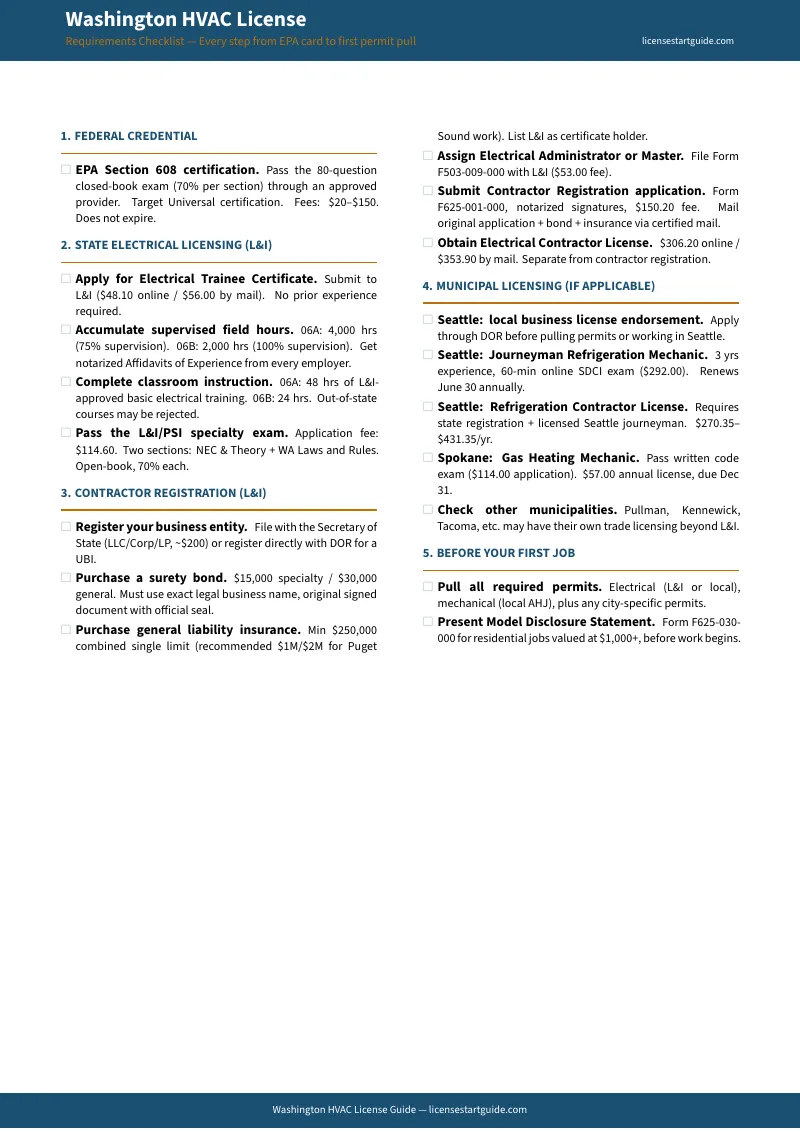
Download the free Washington HVAC License Requirements Checklist for a one-page overview of every federal, state, and local step. When you're ready for the full sequencing — including the contractor registration order, municipal licensing details, and the 2026 Homeowner Recovery Program — the complete Washington HVAC License Guide is available for .