Vermont Doesn't Issue a Contractor License. That's the Problem.
You search for "Vermont general contractor license" and get a dozen different answers. National directory sites say you don't need one. Other sites try to sell you exam prep for a test that doesn't exist. Meanwhile, the state quietly launched a mandatory registration program in April 2023 — and the Attorney General's office is already enforcing it with penalties up to $10,000 per violation.
Here's what's actually going on: Vermont runs a hybrid system. There's no statewide general contractor license or licensing board. Instead, there's the OPR Residential Contractor Registration (required for any direct homeowner contract at $10,000 or above), separate statewide licensing for specialty trades through the Department of Public Safety, and a patchwork of municipal permitting rules that change from town to town. Each layer has its own agency, its own portal, and its own sequence — and filing with the wrong one first wastes weeks.
The Vermont Contractor Compliance Roadmap
This guide maps the entire regulatory framework — from business entity formation through OPR registration to local building permits — into a single step-by-step sequence that follows the order Vermont's systems actually require. Instead of piecing together information from the OPR portal, the Secretary of State's office, the Department of Taxes, the Department of Labor, and a dozen town clerk websites, you work through one document that connects all of them in the right order.
What You Get
- The OPR Registration Walkthrough — the complete online application process for both Individual ($75 biennial) and Business ($250 biennial) pathways, including the documents to have ready before you start, the insurance certificate formatting OPR's system expects, and the common upload errors that trigger rejection
- The $10,000 Threshold Decision Tree — a clear framework for determining when you need OPR registration, when you're exempt as a subcontractor, and exactly when that exemption disappears as you transition to taking homeowner contracts directly
- Entity Formation Sequence — LLC formation ($125) versus DBA ($50) through the BizFilings portal, Federal EIN acquisition, and myVTax registration for withholding and sales tax, mapped in dependency order so each step's output feeds the next
- Insurance Assembly Guide — the exact $1,000,000/$2,000,000 general liability requirements for OPR, workers' compensation mandates under 21 V.S.A. § 687 (no employer-size exemptions), sole proprietor exclusions, and the corporate officer counting trap that catches LLC members who assume they're exempt
- Consumer Contract Compliance Kit — the written contract mandate for projects over $500, the three-day right-to-cancel disclosure that makes your contracts voidable for three years if missing, mandatory pricing provisions, and change-order documentation requirements under 9 V.S.A. § 2461c
- Municipal Permitting Directory — Burlington's zoning appeal periods and performance bonds, Rutland's DPW utility allocations, Montpelier's building energy compliance steps, South Burlington's Fire Department permits, and the general process for rural towns without full-time building departments
- Mechanics' Lien Preservation Guide — the 180-day recording deadline under 9 V.S.A. Chapter 137, correct property descriptions, and the two-part enforcement process (civil lawsuit plus Writ of Attachment) that protects your payment rights when a homeowner doesn't pay
- Nine Downloadable PDFs Including Seven Printable Planning Tools — the Business Formation Sequence Tracker, OPR Registration Pre-Submission Checklist, Insurance Coverage Assembly Worksheet, Consumer Contract Compliance Audit, Municipal Permit Lookup Directory, Mechanics' Lien Deadline Calculator, and Biennial Renewal Calendar — each a standalone fillable worksheet you print and use on the jobsite
Who This Is For
You've been framing houses, running renovation crews, or subcontracting across Vermont under someone else's name. You know the trade. What you don't know is how OPR registration, insurance mandates, consumer contract law, and local permitting rules fit together when you're the one signing homeowner contracts.
This guide is built for experienced construction professionals stepping out independently — subcontractors taking their first direct homeowner contracts, specialty tradespeople expanding into general contracting, out-of-state contractors entering Vermont's market, and existing registered contractors who want to verify their compliance is airtight. If you already know how to build, this handles the paperwork.
Why Not Just Use the Free Government Portals?
The OPR portal explains what registration requires — insurance minimums, the biennial fee, the application form. It doesn't explain how to sequence the business formation, tax setup, and insurance procurement steps that must happen before you can even submit the application. The Secretary of State's office covers entity formation but doesn't connect it to the OPR's insurance documentation requirements. The Department of Labor covers workers' comp but doesn't flag the corporate officer counting rules that catch LLC members. Each agency handles its own slice. Nobody maps the dependencies between them or tells you which town-level permits you'll need after the state registration is done.
National directory sites are worse — most haven't updated for Act 182 (April 2023) and still say Vermont doesn't require anything for general contractors. Some point you toward exam prep for specialty trade licenses that don't apply to general contracting. A few correctly mention OPR registration but skip the consumer contract disclosures that create the biggest legal exposure: a missing three-day cancellation notice lets the homeowner void your contract for up to three years.
This guide connects the agencies, sequences the steps, and covers the municipal layer that state portals ignore entirely.
The Free Checklist Covers the Steps. The Full Guide Shows You How.
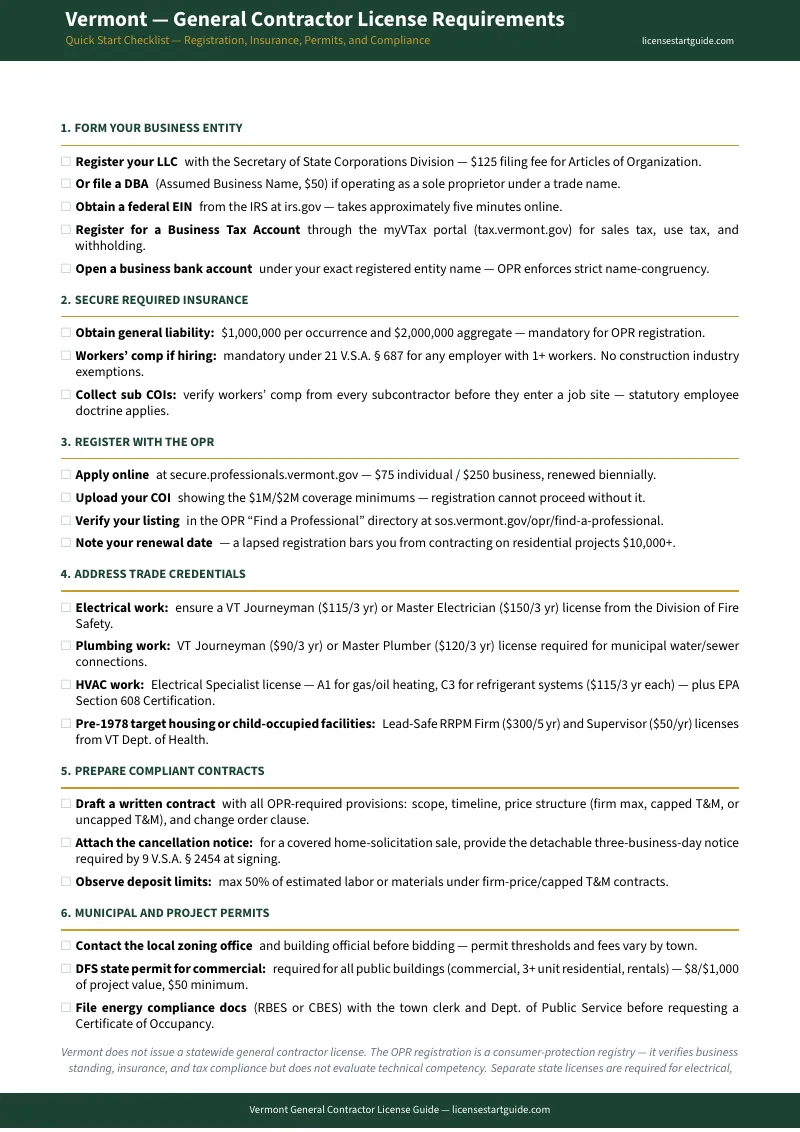
The free checklist gives you the high-level sequence — entity formation, tax registration, insurance, OPR registration, municipal permits. It's useful for seeing the full picture at a glance.
The complete guide walks through each step with the specific portal instructions, document formatting requirements, insurance certificate details, contract compliance provisions, municipal contact directories, and planning tools that turn that checklist into executed paperwork. For less than the cost of a single building permit application fee, you get the complete compliance roadmap.