You Passed the Hard Part. Don't Fail the Paperwork.
You have the degree. You have the motivation. You may even have the job offer waiting. But between you and a Utah classroom is a bureaucratic obstacle course that was designed for compliance officers, not applicants — four separate portals, rules that changed twice in the past year, and district HR pages that contradict the state's own licensing site.
The Utah Teacher Certification Guide is a Certification Route Map — a single document that translates the Utah State Board of Education's fragmented regulatory system into the step-by-step operational manual it should have been from the start.
What makes this different from just reading the USBE website
The state's information is free. The state's information is also scattered across USIMS, CACTUS (which was supposed to be retired but is still active), SM Apply, and dozens of PDFs — some current, some quietly outdated. District HR pages layer their own rules on top, and major alternative certification providers steer you toward their programs without mentioning cheaper district-led options.
This guide does three things those sources cannot: it consolidates rules from every portal into one sequence, it flags where district policy diverges from state regulation so you know which rules are non-negotiable and which are local preferences, and it was written after the June 2024 PPA elimination and the August 2026 direct-source transcript rule — so you are not following advice that was correct two years ago.
What's inside
- Three-pathway route comparison — Traditional EPP, APPEL for career changers, and License Equivalency Review for out-of-state transfers, with honest cost and timeline breakdowns so you pick the route that matches your situation, not the route that is most profitable for someone else
- Portal-by-portal walkthroughs — Exact steps for USIMS profile creation, SM Apply submissions, and CACTUS verification, including the browser compatibility issues that trip up first-time users during the paused database transition
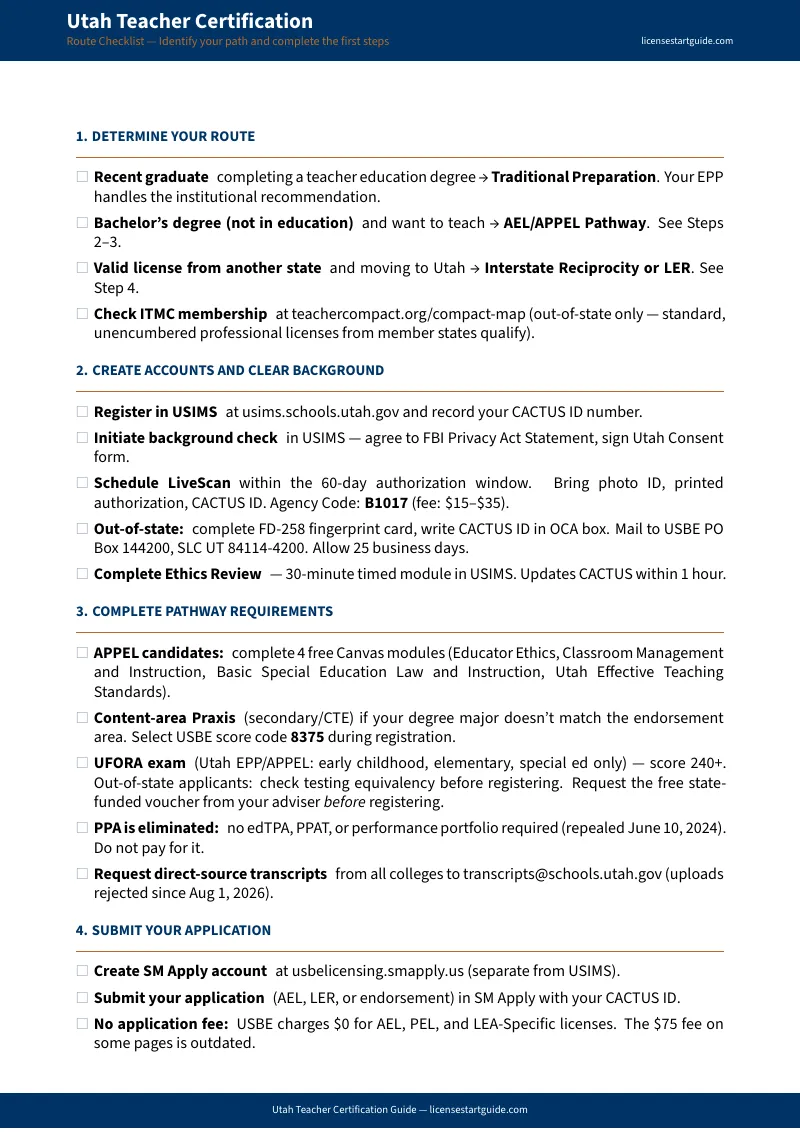
- Background check and LiveScan logistics — Which facility to use, which agency code to enter, what documents to bring, how to avoid the 60-day fingerprint authorization expiration, and a localized fee comparison because LiveScan costs range from $15 to $35 depending on where you go
- Testing requirements (current as of 2025–2026) — The Pedagogical Performance Assessment was eliminated in June 2024, but half the advice online still lists it as mandatory. This guide covers what is actually required: UFORA for elementary and special education candidates (minimum score 240), content-area Praxis for specific endorsements, and nothing else. It also explains how to claim free university testing vouchers that preparation programs rarely advertise
- Endorsement navigation — How to download and interpret USBE competency "specs" PDFs, how to submit an endorsement-only application, and the new College and Career Readiness endorsement requirement for school counselors effective August 2026
- Fee and timeline master table — The USBE charges nothing for the license application itself, which makes every third-party fee feel unexpected. This table puts LiveScan costs, BCI fees, transcript evaluation fees, testing costs, and alternative program tuition side by side so you can budget accurately before you start
- The career changer's AEL playbook — How to obtain an Associate Educator License independently through SM Apply before you have a job offer, breaking the circular lock where districts require an AEL to hire you but you assumed you needed a district to get one
- Interstate reciprocity decision guide — The Interstate Teacher Mobility Compact vs. the full License Equivalency Review: which of your credentials qualifies, what documentation you need, and how to protect your endorsements during the transfer
- Renewal and clock hours — The 100-hour, five-year Professional License renewal cycle, credit-to-clock-hour conversion rates, and the one-time two-year extension available to Associate License holders who are making documented progress
- Pre-employment action checklist — Everything you can complete before you have a job offer, sequenced so you are not scrambling during peak hiring season
- 6 printable worksheets — Route comparison, licensing application tracker, background check planner, assessment planning sheet, endorsement competency tracker, and agency communication log — print each one and fill it in as you work through the process
Who this is for
- Career changers with a bachelor's degree and no education background who want the fastest legitimate route to a classroom credential — especially if you have been rejected from district hiring portals for lacking an AEL you did not know you could obtain independently
- Recent graduates whose university recommendation is pending and who need to coordinate their background check, testing, and district hiring timeline without missing the contract window
- Out-of-state teachers relocating to Utah who need to determine whether their current credential qualifies for the Mobility Compact or requires a full License Equivalency Review
- Anyone who has spent hours on the USBE website and left more confused about the process than when they started
Why not just use free resources?
You absolutely can. The USBE publishes every rule, every form, and every administrative code. University advisors will walk you through their program's steps. District HR will explain their local hiring process.
The problem is that each of those sources shows you only its own slice. Your university advisor is incentivized to enroll you in a multi-year degree program — they will not volunteer that a district-led APPEL program could get you licensed faster and for a fraction of the cost. District HR will explain their specific requirements but will not tell you that their APPEL program only accepts candidates in high-need subject areas and that your field might require a different route entirely. And the USBE website will give you the regulations verbatim, but it will not explain which documents go to which portal or what happens when you submit a transcript through the wrong channel.
This guide is the independent view — no enrollment incentives, no district-specific bias, no outdated advice from a blog that has not been updated since the PPA was a requirement.
What this guide is not
This is not test prep. There are no exam questions, no study guides, and no practice tests. This is a process and logistics guide — the operational layer that testing vendors and certification programs assume you will figure out on your own.
Satisfaction guarantee
If the guide does not save you time navigating Utah's certification process, email us and we will refund your purchase. No forms, no hoops.
Get started now
The free checklist gives you a one-page route comparison and a high-level task list. The full guide — available for — adds the step-by-step portal walkthroughs, cost breakdowns, endorsement navigation, and operational details that turn a confusing process into a clear plan.