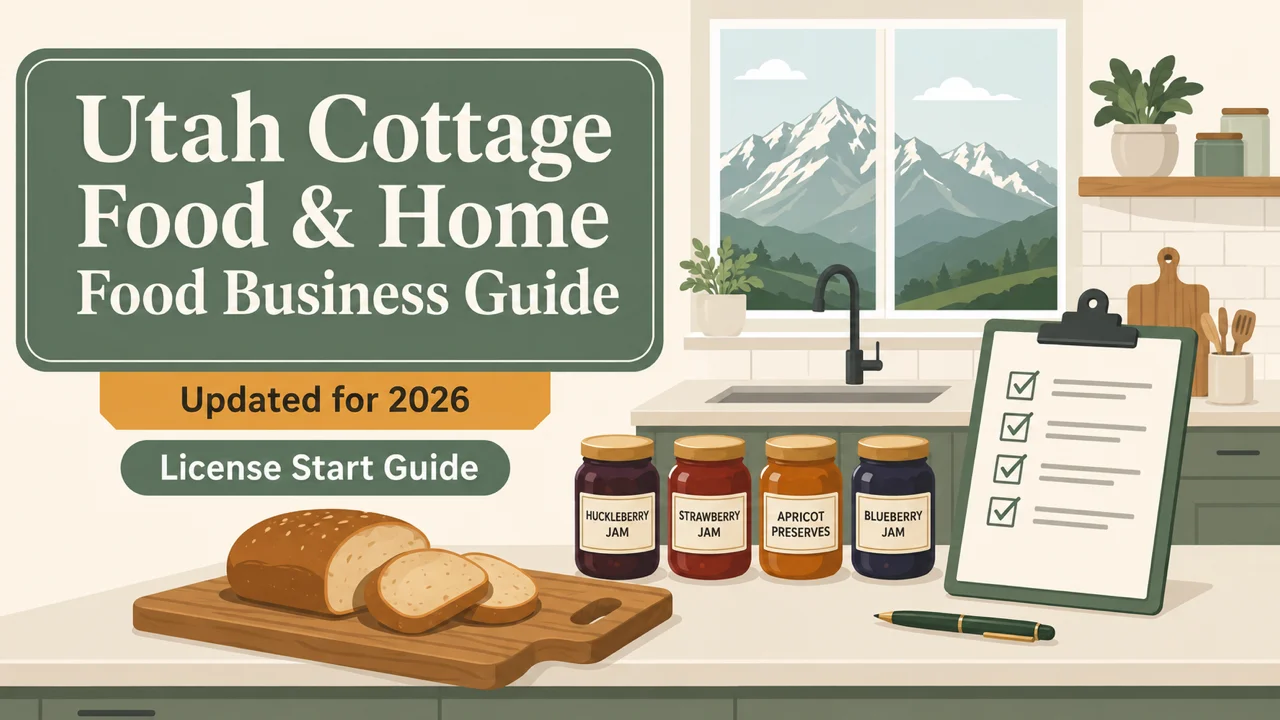
Three Agencies. Three Pathways. One Wrong Step Can Cost You Months.
You've decided to sell food from your Utah home kitchen. Maybe it's the sourdough your neighbors already line up for, or the birria tacos you've been delivering to friends. Either way, you searched "Utah cottage food law" and discovered something most first-timers don't expect: Utah doesn't have one cottage food law. It has three entirely separate legal frameworks — each governed by a different state agency, each with its own rules about what you can sell, where you can sell it, and what happens if you get it wrong.
Apply under the wrong pathway and your registration packet gets returned — with the $75 UDAF fee forfeited. Sell cream cheese cupcakes under a cottage food permit that only covers shelf-stable goods and a health inspector can seize your product at the farmers market. Skip the municipal business license step and your city can shut you down with a zoning violation, even though the state says you're legal.
The Three-Path Compliance System
This guide replaces the confusion with a single, verified sequence. It maps all three Utah home food pathways — Traditional Cottage Food (UDAF Rule R70-560), the Homemade Food Act (Utah Code § 4-5a), and the Microenterprise Home Kitchen permit (MEHKO, Rule R392-106) — into the step-by-step order that actually works: business registration first, then food-specific permits, then inspection preparation, then ongoing compliance.
You don't need to read all three paths. The Pathway Decision Worksheet included in the guide asks you five questions about your food and your sales model, then tells you exactly which chapters apply to you. The rest of the guide gives you the forms, the sequence, and the specific agency contacts for each step — so you're not calling the wrong office or filing paperwork out of order.
What's Inside the Guide
- The Pathway Decision Worksheet — five questions that determine whether you need the cottage food path, the Food Freedom exemption, or a MEHKO permit. Complete it before you contact any agency.
- Full Registration Walkthrough for All Three Paths — the exact forms, fees, and filing sequence for UDAF cottage food registration, the Homemade Food Act's no-registration exemption, and county MEHKO permits in Davis, Salt Lake, Summit, and Utah counties.
- Complete Allowed and Prohibited Foods Reference — every product category classified by pathway, including the sourdough starter pH trap, the cream cheese frosting line, and the MEHKO same-day prep rule that most new operators miss.
- FDA-Compliant Label Templates — label layouts mapped to every required element under Rule R70-560 and the Homemade Food Act, with specific guidance on the 12-point "Home Produced" statement, ingredient listing by weight, allergen declarations, and the verbal disclosure script required for Food Freedom sales.
- Kitchen Inspection Prep Checklist — a room-by-room walkthrough covering every item UDAF inspects: sanitizer concentration, dedicated refrigerator setup, pet barrier placement, storage height compliance, and the batch sample retention requirement.
- The 2026 S.B. 217 Tax Guide — what the new state sales tax exemption covers, what's still taxable, the farmers market signage change, and how to file quarterly returns correctly under the new rules.
- Startup Cost Calculator — a fill-in worksheet covering LLC filing, municipal permits, food handler training, UDAF registration, insurance, and lab testing across all three paths.
- Batch Production Log and MEHKO Daily Sales Tracker — the exact record-keeping templates for ongoing compliance, including the 14-day sample retention protocol for cottage food and the daily/weekly meal-count caps for MEHKO operators.
Who This Guide Is For
- Home bakers selling at farmers markets or wholesale to stores — if you want your cookies, breads, or preserves on shelves at local boutiques or coffee shops, you need the UDAF cottage food path, and this guide walks you through the entire registration and inspection process.
- Custom cake designers and pastry makers — if your products include cream cheese frosting, custard, or anything that needs refrigeration, the cottage food path won't work. The Homemade Food Act lets you sell these legally with no state registration — but only through specific sales channels.
- Home cooks launching a meal delivery or pickup service — selling hot meals with commercially purchased meat requires a MEHKO permit from your county health department, and only if your county has opted in. The guide covers every county that currently issues permits.
- Backyard gardeners and hobby sellers — if you just want to sell eggs, produce, or simple baked goods to neighbors without regulatory headaches, the guide confirms what you need (a municipal business license) and what you can skip.
Why Not Just Use the Free Resources?
The UDAF website tells you what the rules are. Forrager's community forum has a Utah page. FoodSafePal runs a food handler course. But none of them connect the sequence across agencies — which state filing has to happen before which city permit, which city permit has to happen before UDAF will schedule your inspection, and which inspection has to pass before you can legally list your first product for sale.
Every step in this guide is sequenced in dependency order, so you never file paperwork that a downstream agency won't accept, and you never pay a fee that turns out to be premature. The guide also covers the gaps between state and local requirements — the HOA trap that state food laws don't override, the municipal home occupation permits that most UDAF resources don't mention, and the private well water testing that applies only to homes not on municipal water.
What You Get
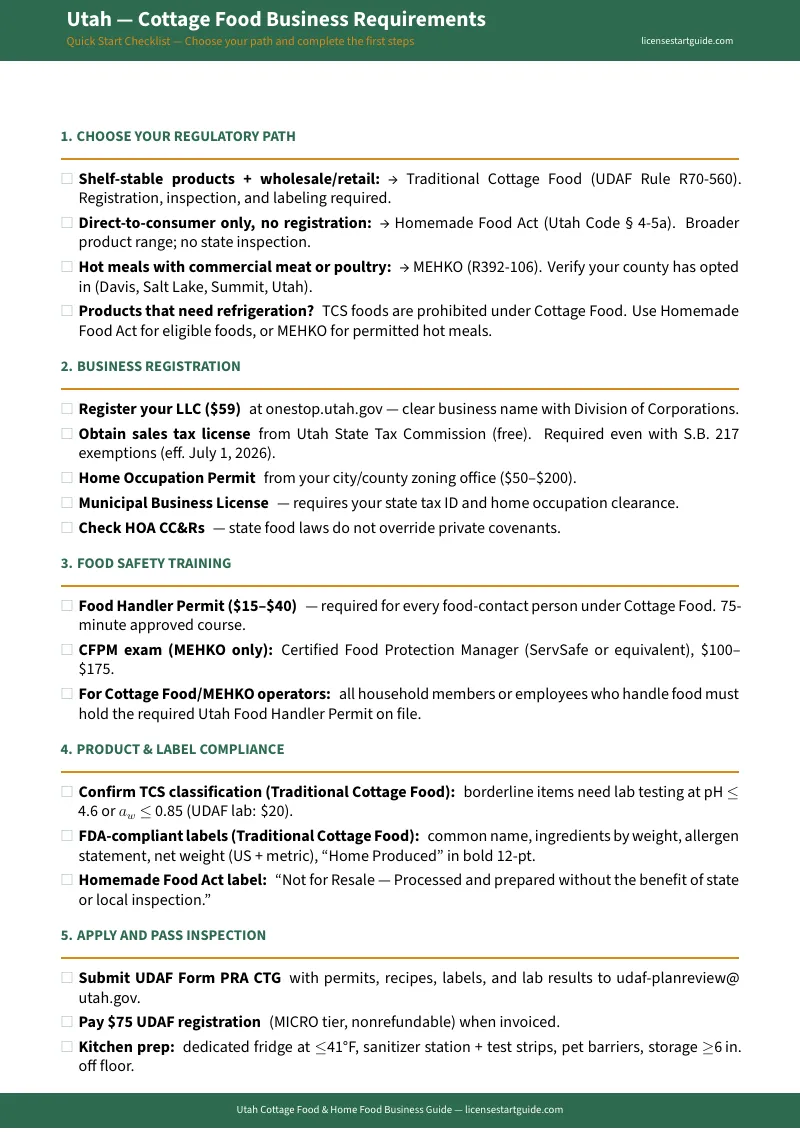
A 49-page PDF guide covering all 12 chapters, plus six standalone worksheet PDFs: the Pathway Decision Worksheet, Startup Cost Calculator, Kitchen Inspection Prep Checklist, Batch Production Log, MEHKO Daily Sales Tracker, and Label Compliance Checklist. You also get the free one-page requirements checklist — a 24-item rundown of every milestone from choosing your pathway through your first legal sale.
The guide is current through September 2026 — including the S.B. 217 sales tax exemption (effective July 1, 2026), updated UDAF Form PRA CTG (Rev. 07/2026), and county MEHKO fee schedules verified as of mid-2026.
100% Satisfaction Guarantee
If the guide doesn't save you time and prevent at least one costly mistake in your home food business launch, email us for a full refund. No forms, no questions.
Start with the free checklist to see if this is the right resource for you. If you already know you need the full guide, the complete toolkit is available for — a one-time purchase with instant download.