
Four Agencies, No Shared Timeline, and Non-Refundable Fees at Every Wrong Turn
You have been watching kids — your own, your neighbor's, a coworker's toddler after their shift ends. The arrangement works, and now more families are asking. Someone wants to pay with CCS vouchers. Someone else is asking about infants. You know you need to get legal, but "getting licensed" in Texas turns out to be four parallel processes that never acknowledge each other exists: HHSC for your state permit, your city or county for zoning and fire clearances, CBCU and IdentoGO for background checks, and TWC for subsidy enrollment.
The information is technically free. The HHSC website has the application forms. ChildCareEd has the training catalog. Your city hall has the zoning ordinance. But none of them explain the order. So you pay the $35 application fee and schedule your IdentoGO fingerprinting before you discover that your HOA prohibits home businesses — or that Plano's municipal cap limits you to 8 children even though the state would allow 12. One wrong sequence and you are out the fee with nothing to show for it.
The Cross-Agency Licensing Sequencer
This is a 13-chapter guide organized around a single principle: never pay a non-refundable fee before confirming you are clear to proceed. Every step is ordered so that zero-cost feasibility checks come first — your property title, your lease terms, your HOA restrictions, your city's zoning classification — and money only changes hands after you have confirmed your home qualifies for the permit category you are targeting.
The guide covers all three home-based permit categories (Listed Family Home, Registered Child Care Home, and Licensed Child Care Home), the 2021 Senate Bill 599 municipal preemption rules that determine what your city can and cannot require, and the practical differences that matter in Houston, Dallas, Plano, San Antonio, Austin, and Fort Worth. You will not confuse your HHSC permit with your city business license, and you will not discover a fire marshal inspection requirement three weeks before you planned to open.
What's Inside
- Permit category decision framework — Listed (1–3 unrelated children), Registered (up to 6 unrelated, 12 total), or Licensed (7–12 children with Director qualifications). The guide walks through the capacity tradeoffs, age requirements, fee differences, and inspection schedules so you choose the right category before filing anything.
- SB 599 municipal preemption analysis — what your city is legally prohibited from requiring (permit fees, inspections, or regulations beyond state minimums) versus what they can still enforce (parking, noise, fire codes). Includes the specific zoning situations in Houston (deed restrictions, no traditional zoning), Dallas (Accessory Day Home ordinance DCA #223-002), and Plano (8-child cap under Ordinance ZC 2012-21).
- Property and lease viability assessment — how to check your title for deed restrictions, what to verify with your landlord before applying, and why Texas's 2026 eviction law updates make an unauthorized home business a fast-track to losing both your home and your permit under SB 225's permanent name-association database.
- Background check filing guide — every person in your household age 18+ must be screened through the CBCU. The guide breaks down the name-based state search, the DPS fingerprint search, the FBI national search, and the IdentoGO vendor processing — with the exact fee per component and a household member tracker so nobody gets missed.
- Training milestone roadmap — the 24-hour pre-service requirement (8 hours before you count in ratio, 16 more within 90 days), annual clock-hour obligations (24 for Registered, 30 for Licensed), CPR and First Aid certification, the pre-licensure computer-based training, and where to find free or low-cost approved courses through Texas A&M AgriLife Extension.
- Room-by-room inspection prep checklist — modeled after Chapter 747 minimum standards and HHSC CLASS Form 2936. Covers indoor space (30 sq ft per child), outdoor fencing (4-foot minimum, self-closing self-latching gates), water hazard barriers, sleeping equipment, medication storage, and every other item the inspector will check during your unannounced visit.
- Mixed-age capacity calculator — the "youngest child rule" means a single infant can cut your total capacity from 11 to 4. The worksheet helps you model different enrollment scenarios with your own children included in every count, so you can project realistic revenue before committing to a permit category.
- Application forms and portal walkthrough — Forms 2910, 2948, 2911, and 2760 in the correct filing sequence, with instructions for creating your HHSC online provider account and avoiding the common errors that trigger application returns.
- Insurance requirements — the $300,000 mandatory minimum liability coverage, the waiver option, what your policy should cover, and how to keep business and personal assets separated.
- SB 225 compliance tracking — how the permanent name-association database and five-year lookback window changed ongoing compliance, what the 2026 proposed rule changes to Chapters 742 and 747 require for revocation disclosure and parent notification, and the renewal cycles for each permit type.
- TWC subsidy enrollment pathway — how to become a CCS-authorized provider, the mandatory Texas Rising Star certification, Entry-Level Designation milestones, the 24-month certification clock, reimbursement rate calculations, and KinderConnect digital attendance tracking. If you are building a business around subsidized families, this chapter is your revenue plan.
Who This Is For
ECE professionals going independent. You have worked in center-based care for years. You know child development, ratios, and safety protocols. But you have never registered a business, navigated city zoning, or coordinated background checks for your household. This guide handles the regulatory and municipal infrastructure so you can focus on the childcare you already know how to deliver.
Parents building a home-based income. You want to earn while staying home with your own children — but you need to understand how your kids under 13 affect your licensed capacity, whether your rental lease or HOA allows commercial use, and what physical modifications your home might need before the inspector arrives. The feasibility-first sequencing answers all of that before you spend a dollar.
Informal caregivers going legal. You are already watching neighborhood children, and a parent just asked about CCS vouchers — or you have hit the threshold where Texas law requires formal registration. This guide transitions you from informal to compliant without guesswork about which permit type fits, which fees are required, or what the background check process covers.
Why Not Just Use the Free State Resources?
The HHSC website has the application forms, the administrative code references, and a general overview of requirements. It does not tell you which steps to complete first, how to coordinate your state application with your city's fire marshal inspection, or how to avoid paying non-refundable fees before you have confirmed your zoning. The portal is a reference library organized by regulation chapter, not a sequenced plan organized by what you need to do next.
ChildCareEd offers approved training courses — including a $192 pre-service bundle — but no guidance on municipal navigation, background check logistics, or business formation. Wonderschool provides structured coaching that leads into ongoing platform fees tied to your enrollment revenue. Etsy sellers offer printable daycare binders for $4–$27 that rarely reflect Texas-specific updates like SB 225 or the 2026 proposed Chapter 747 revisions.
This guide fills the gap: a one-time purchase that sequences every step from property feasibility through your first year of compliance, covers the municipal layer that platform tools skip entirely, and stays out of your way once you are operational.
What You Get
Your download includes 8 printable PDFs:
- The full guide (49 pages) — 13 chapters covering permit categories, SB 599 municipal preemption, property viability, training milestones, background checks, the application sequence, Chapter 747 inspection prep, capacity and ratios, insurance, SB 225 compliance, TWC subsidy enrollment, planning worksheets, and key contacts.
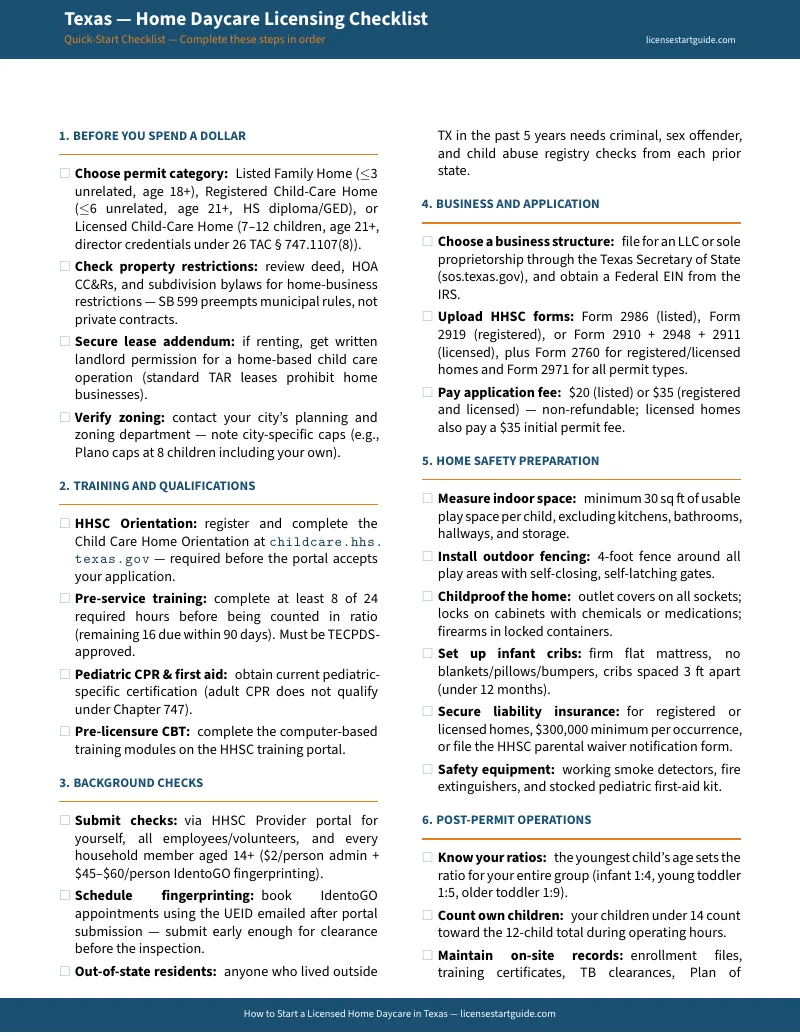
- Quick-start checklist — 25 items organized by phase, from eligibility verification through your first week of licensed operation. Print it, work through it in order, check off each step as you go.
- Property & zoning viability checklist — fill-in worksheet covering ownership, HOA, lease, municipal zoning, and physical space checks. Complete every item before paying any application fee.
- Background check tracker — one row per household member to track CBCU submissions, IdentoGO appointments, UEIDs, and clearance dates so nobody gets missed.
- Pre-inspection home safety audit — room-by-room walkthrough modeled on Chapter 747 minimum standards. Run it before the HHSC analyst arrives.
- Capacity & revenue planning worksheet — model enrollment scenarios with the youngest-child ratio rule and your own children counted, then project weekly and monthly revenue.
- Application timeline planner — week-by-week schedule from property verification through permit issuance, with a training-hours tracker for your 90-day deadline.
- Ongoing compliance tracker — track permit renewals, annual training hours, certification expirations, and inspection results after your permit is issued.
Satisfaction Guarantee
If the guide does not help you move forward, email us and we will refund you. No time limit, no hoops.
Download the free checklist to see the structure. When you are ready for the full sequenced guide with city-specific zoning guidance, background check breakdowns, and inspection prep tools, the complete toolkit is here.