You Know the Work. The Paperwork Is the Problem.
You've spent years framing houses, pouring foundations, running crews, and building a reputation that precedes you on every job site. Clients trust your work. General contractors want you on their bids. And now a property owner is handing you a direct contract — or a GC is asking you to bid independently — and the only thing between you and that project is a state contractor license.
The problem isn't whether you're qualified. The problem is that Tennessee's licensing process is scattered across four agencies, two exam systems, and a financial verification requirement that has sent more starting contractors to a $2,000 CPA engagement than to an actual job site. And as of July 2026, the rules have changed again — new testing administrator, new bond alternative, new financial options — and most of the guides online haven't caught up.
The Licensing Roadmap System
The Tennessee General Contractor License Guide maps the entire licensing process — from entity formation through your first pulled local permit — into a single, step-by-step sequence. No exam prep. No study questions. Just the administrative roadmap that connects the Secretary of State, the Board for Licensing Contractors, the CORE portal, and the local permit offices in Nashville, Memphis, and every other municipality where you'll actually pull permits.
Every step is in the order you need to do it, with the forms, fees, and deadlines that apply at each stage. The guide is built around the current 2026 regulatory landscape, including the new surety bond option under Public Chapter 1039 that lets you bypass expensive CPA-prepared financial statements entirely.
What's Inside
- The $25,000 Threshold, Decoded — what counts toward the project value, how the Board treats contract-splitting, and the separate Home Improvement license in the nine adopting counties. Most contractors know the number; this section explains the enforcement mechanics that catch people off guard.
- Classification Selection Guide — BC-A, BC-A/r (restricted residential), BC-B, and specialty classifications mapped against the work you actually do. Includes the monetary limit formula (10× the lesser of working capital or net worth) and why the restricted residential license has zero tolerance for overages.
- The 2026 Surety Bond Path — the new alternative to CPA-prepared financial statements, effective July 1, 2026. How the bond amount is calculated, when it makes financial sense over a Reviewed or Audited statement, and how to set it up with your surety company. This single change saves most new applicants between $1,000 and $3,000 in accounting fees.
- Exam Registration with Prov — Tennessee's new testing administrator replaced the previous system in mid-2026. How to register, what the Business and Law exam covers, what reference materials are allowed for the open-book sections, and the trade exam requirements for each classification.
- Insurance and Workers' Comp Mapped to Your Limit — general liability minimums tied to your requested monetary limit, plus the Workers' Compensation Exemption Registry process for qualifying owner-operators. Includes exact fee breakdowns so nothing is a surprise at application time.
- Out-of-State Reciprocity — the eight states with active agreements, what gets waived (trade exam) and what doesn't (Business and Law exam), plus the complete foreign entity registration sequence with the Secretary of State.
- Nashville and Memphis Local Permits — Metro Codes registration with the $40,000 Metropolitan Permit Bond in Davidson County, the Develop 901 Citizen Portal in Shelby County, and the local business tax registrations that trip up contractors who assume the state license is enough.
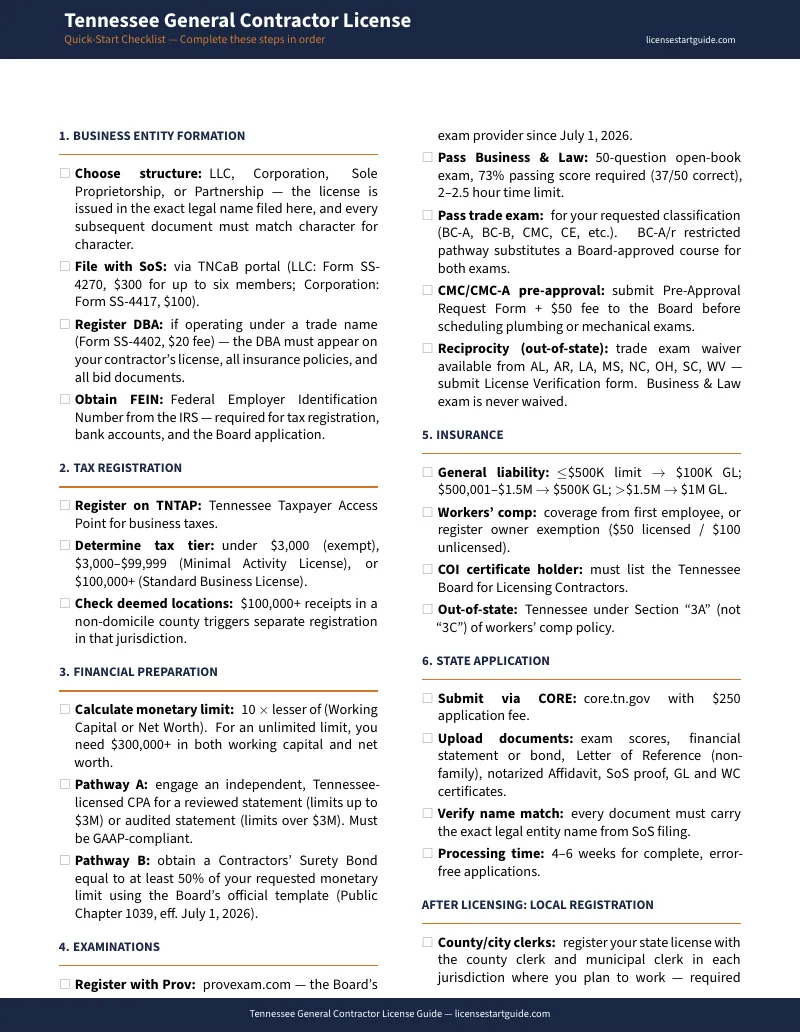
- Printable Planning Tools — a 26-item application checklist, financial pathway comparison worksheet, exam preparation timeline, insurance requirements tracker, and agency communication log — six separate PDFs you can print and work through alongside the guide.
Who This Is For
This guide is built for experienced construction professionals who know the trade but haven't navigated the state's administrative system before:
- Subcontractors stepping up — you've been working under someone else's license and you're ready to bid projects in your own name
- Remodelers crossing the threshold — your projects are pushing past $25,000 and you need to move from Home Improvement credentials to a full BC-A license
- Out-of-state operators — you're entering Tennessee's market and need to understand the reciprocity process, foreign entity registration, and local permit requirements
- Commercial bidders on deadline — you have an RFP due and need your license number, classification, and monetary limit sorted before the bid envelope goes out
Why Not Just Use the Free State Website?
Every form the Board uses is free to download from the TDCI website. But the state's information is scattered across four separate portals — the Board's own pages, the CORE application system, the Secretary of State's business registration, and the Department of Revenue's business tax system. None of them tell you which agency to hit first, what triggers a Board interview versus a routine approval, or how the new surety bond option interacts with the monetary limit formula.
A single mistake on the application — a name mismatch between your entity registration and your insurance certificate, a financial statement that doesn't meet the GAAP threshold for your requested limit, a missing workers' comp exemption registration — delays your approval for weeks or months. During that time, you can't legally bid, negotiate, or take projects above the threshold. The guide puts every step in the right sequence so you submit a clean application the first time.
What This Guide Is Not
This is not an exam-prep course. It does not contain trade exam questions, study answers, or tutoring materials. Those services cost hundreds to thousands of dollars because they're teaching you construction codes and standards. This guide assumes you already know your trade — it handles the administrative side so you arrive at exam day with your entity, finances, insurance, and references already organized and ready.
Get Started Today
Download the free checklist for a quick-reference list of every requirement and filing in the licensing process. When you're ready for the full step-by-step guide with classification selection, the surety bond walkthrough, local permit breakdowns, and six printable planning tools, get the complete Tennessee General Contractor License Guide for — less than the cost of one hour with a licensing consultant, and a fraction of the CPA engagement you may no longer need.