You Know the Trade. You Don't Know the Paperwork.
You can charge a system, size ductwork, and troubleshoot a compressor with your eyes closed. But the moment you decide to go independent in South Dakota, you're facing a completely different kind of problem: a regulatory maze with no centralized map.
South Dakota doesn't issue a statewide HVAC license. There's no single application, no universal exam, no one agency that says "you're good to go." Instead, the state splits authority across three levels — federal environmental compliance, state tax registration, and a patchwork of municipal licensing rules that change from one city line to the next.
Sioux Falls wants a Master Mechanic exam, a $10,000 compliance bond, and biennial renewal. Cross into Rapid City and you need six years of documented experience, a separate exam, and a $1,000,000 liability policy. Spearfish waives the exam if you hold an out-of-jurisdiction license but demands a $1,000,000/$2,000,000 aggregate policy. Brookings folds HVAC into its residential building contractor registration. And every one of these cities enforces differently.
Miss any piece and you're looking at stop-work orders, double-fee penalties, or worse — operating without a registered Contractor's Excise Tax number is a Class 1 misdemeanor in South Dakota.
The Compliance Stack Navigator
This guide organizes South Dakota's fragmented HVAC credentialing system into a single, sequential process you can follow from top to bottom. We call it the Compliance Stack because that's what it is — a stack of independent credentials from different levels of government that you need to assemble in the right order.
The guide maps every layer:
- EPA Section 608 certification — the federal baseline that everyone needs, plus the 2026 A2L refrigerant transition rules that affect your tools, your inventory, and your installation procedures
- State business formation — LLC filing with the Secretary of State, EIN, and bank account setup in the sequence that avoids backtracking
- Contractor's Excise Tax registration — the free CET license through the DOR's EPath portal, the 2.041% bid factor formula that most contractors get wrong, and the Form 1346 process for subcontractor projects
- Municipal mechanical licensing — side-by-side requirements for Sioux Falls, Rapid City, Spearfish, Brookings, Aberdeen, and surrounding markets, covering exams, fees, bonds, insurance thresholds, and renewal cycles
- Insurance and bonding — which policies you need, what coverage levels each city demands, and how to format bonds so they're not rejected at the counter
- Trade coordination — exactly where your mechanical scope ends and where a licensed electrician or plumber must step in, so you don't accidentally cross a jurisdictional line
- Permitting and inspections — when you need a permit, what to submit, inspection scheduling, and what happens when you skip the process
Who This Is For
- The W-2 technician going independent — you've got the field skills and now you need the credentials to take your own jobs. The guide gives you the exact administrative sequence so you can launch during peak season instead of losing weeks to paperwork confusion.
- The contractor expanding across city lines — bidding in a new municipality means new licenses, new bonds, new insurance minimums. The guide's city-by-city comparison prevents you from under-bidding a project because you didn't account for local compliance costs.
- The out-of-state operator entering South Dakota — no state income tax sounds great until you trigger an excise tax audit because you treated your South Dakota projects like your home state. The guide explains the dual tax structure and nexus rules before they become a problem.
Why Not Just Google It?
You could. The Department of Revenue publishes its tax forms. Sioux Falls posts its mechanical contractor application. Rapid City has its fee schedule online. The EPA has its 608 certification page.
The problem isn't access — it's assembly. Each agency covers its own piece in isolation. None of them tells you how the pieces fit together, what order to complete them in, or what happens when you miss a step. The DOR doesn't mention municipal bonding. Sioux Falls doesn't explain the excise tax bid factor. The EPA doesn't tell you that its card doesn't authorize you to pull a permit.
What costs you isn't the information gap — it's the sequencing gap. Filing for a municipal license before you have your CET number means restarting the application. Buying a $10,000 bond before confirming the obligee format means paying for it twice. Starting work before pulling a permit means an investigation fee that's double the permit fee.
The guide eliminates sequencing mistakes by putting every step in order, with the dependencies mapped out, so you complete the stack once — correctly — instead of looping back to fix what you missed.
Satisfaction Guarantee
If the guide doesn't deliver what you expected, email us at any time and we'll refund you, no questions asked.
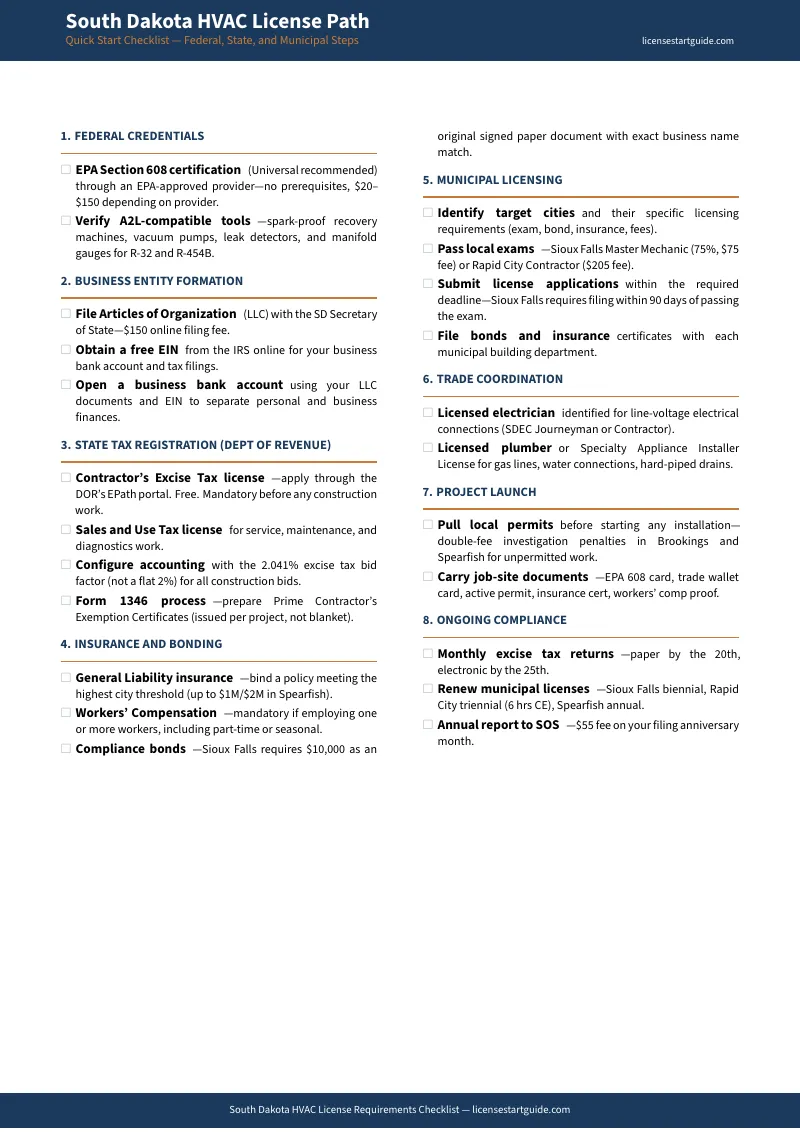
Start With the Free Checklist
Not sure if you need the full guide? Download the free requirements checklist first. It gives you every federal, state, and local credentialing step on one page so you can see exactly where you stand. If the checklist reveals gaps you need help filling, the full guide is waiting.