You Know HVAC. You Don't Know South Carolina's Two-Board System.
You can braze copper, charge a system, and diagnose a compressor failure faster than most people can find the thermostat. But when you decide to go independent in South Carolina, you're not dealing with one licensing agency — you're dealing with two boards, under two different chapters of state law, with different thresholds, different financial requirements, and different renewal calendars.
The Contractor's Licensing Board handles commercial work over $10,000. The Residential Builders Commission handles residential work over $500. They use different application forms, different exams, different bond structures, and different experience standards. File with the wrong board and your application goes nowhere. File with the right board in the wrong order — say, applying before you've formed your LLC or scheduling the wrong PSI exam — and you lose non-refundable fees and weeks of processing time.
On top of the state boards, every county and city runs its own mechanical permitting process, each requiring your state license number before they'll hand you a permit. And none of these agencies tells you how the pieces connect.
The Dual-Board Filing Blueprint
This guide untangles South Carolina's split-authority licensing system into a single process you can follow from start to finish. We call it the Dual-Board Filing Blueprint because that's the core challenge: understanding which board governs your work, what each one requires, and assembling the full package in the sequence that prevents rejections.
The guide maps every layer:
- EPA Section 608 certification — the federal baseline everyone needs, what the four certification types cover, and the critical distinction between an EPA card and a state license (hint: your EPA card doesn't let you pull permits or advertise contracting services)
- Commercial mechanical licensing (CLB) — trade subclassifications (AC, HT, PK, RG), the Primary Qualifying Party designation, financial groups 1–5, net worth vs. working capital vs. the 1:1 surety bond option, and the exact CPA reporting tier for each group
- Residential specialty licensing (RBC) — the RBH license pathway, the $500 project trigger, credit report requirements (they're checking for construction judgments, not your score), and the flat $10,000 bond
- PSI exam logistics — commercial vs. residential exam formats, passing scores, reference book requirements, the critical scheduling difference (commercial candidates can book PSI directly; residential candidates need RBC eligibility first), and open-book navigation strategy
- Alternative experience verification — when a former employer won't sign the affidavit, how to build a compliant package using W-2s, 1099-MISC records, tax returns, and notarized reference letters that satisfy the board's review
- The 1:1 surety bond shortcut — how to qualify for an unlimited Group 5 commercial license with a $300,000 bond instead of paying for a CPA-audited financial statement, saving thousands in accounting fees
- CAGC trades certification — how the HARV (Master Mechanical) credential from the newly restructured program serves as a technical exam waiver pathway for state licensing
- Reciprocity and exam waivers — which states qualify for commercial and residential technical exam waivers, and why the SC Business Management and Law exam is always required regardless
- Business formation sequence — LLC/Corporation filing with the Secretary of State, EIN, and the exact order that prevents your LLR application from being rejected
- Insurance requirements — general liability benchmarks, workers' comp triggers, and what commercial GCs actually demand before they'll let you on site
- Local permitting — mechanical permit processes for Greenville County, Charleston County, Columbia, North Charleston, and Myrtle Beach, including online portals, fee schedules, and the license-matching rules that building departments enforce
Who This Is For
- The residential technician going independent — you've got years of field experience under a licensed contractor and now you're taking your own jobs. The guide gives you the exact RBC application sequence, credit report prep, and bond requirements so you launch correctly the first time instead of having your application kicked back.
- The residential contractor stepping up to commercial — a strip mall project just landed in your lap, but your RBH license is legally capped at residential properties under three stories. The guide walks you through adding a CLB commercial license without disrupting your residential cash flow.
- The new Primary Qualifying Party — the previous PQP left the firm and you've got 90 days before the commercial license is suspended. The guide covers exactly how to compile the experience affidavit, schedule the exams, and file the PQP designation change before the deadline.
- The out-of-state contractor — you're licensed in North Carolina or Georgia and assumed South Carolina would be a quick transfer. The guide shows you what actually transfers (the technical exam, maybe) and what doesn't (everything else), plus the fastest path to a compliant SC license.
Why Not Just Use the LLR Website?
You could. The Contractor's Licensing Board posts its application forms. The Residential Builders Commission publishes its fee schedule. PSI has its candidate bulletins online. The EPA has its Section 608 certification page.
The problem isn't access to information — it's that each agency covers its own piece in isolation. The CLB doesn't explain the RBC pathway. The RBC doesn't mention the CAGC exam waiver. PSI doesn't tell you that commercial candidates can schedule directly but residential candidates need board eligibility first. No one explains how the financial groups interact with the bond option, or that filing your LLC after applying to the board means your application gets rejected and your fee isn't refunded.
What costs you isn't the information gap — it's the sequencing gap. The guide eliminates that gap by mapping every dependency and putting every step in the order that prevents expensive mistakes.
Satisfaction Guarantee
If the guide doesn't deliver what you expected, email us at any time and we'll refund you, no questions asked.
Start With the Free Checklist
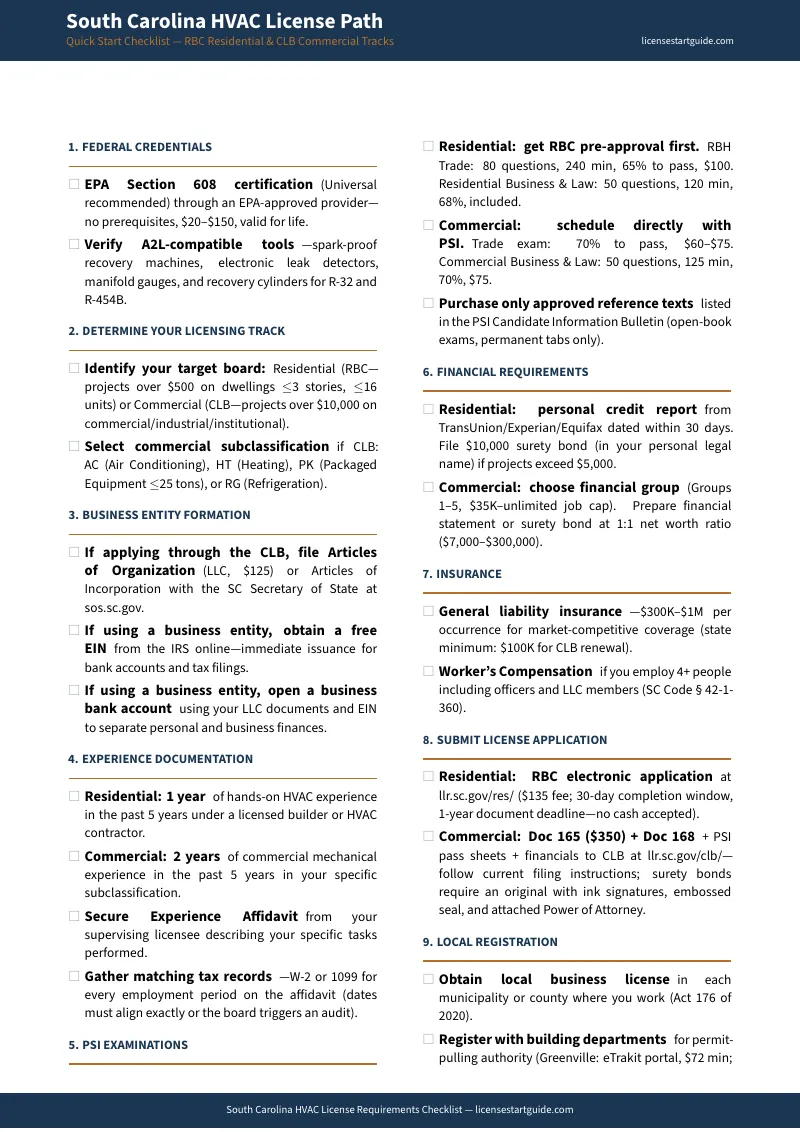
Not sure if you need the full guide? Download the free requirements checklist first. It gives you every federal, state, and local credentialing step on two pages, organized by licensing track — commercial CLB and residential RBC side by side. If the checklist reveals gaps you need help filling, the full guide is waiting.