
Your $80 Is Non-Refundable. The State Doesn't Care Why Your Application Was Rejected.
Rhode Island's notary application looks simple — two pages, a few signatures, mail it to Providence. But the Department of State's Business Services Division has a zero-tolerance policy for errors. Photocopied forms are rejected. Digital signatures are rejected. Electronic submissions are rejected. Every line must be completed by hand with original ink, and the application requires a voter registration endorsement from a registered Rhode Island voter — not just any state resident, but someone specifically registered to vote — who vouches for your character directly on the form.
Get any of that wrong, and you're out $80 with no recourse. The fee is non-refundable regardless of the reason for rejection. And because the state processes paper applications by physical mail, you won't find out about the error for weeks — after your employer has already planned around you having the commission, or after the closing you were supposed to notarize has moved forward without you.
Meanwhile, supply vendors package their Rhode Island checkout pages as if surety bonds, premium journals, and embosser kits are state requirements. Rhode Island doesn't require a surety bond. The state recommends a journal but doesn't mandate one. And the only stamp requirement is an inked stamp with a specific border format — not the $150 deluxe package vendors push at checkout. A single trip through the wrong vendor's funnel can triple your actual startup cost.
The Paper-First Compliance System — Every Step Verified Before You Spend
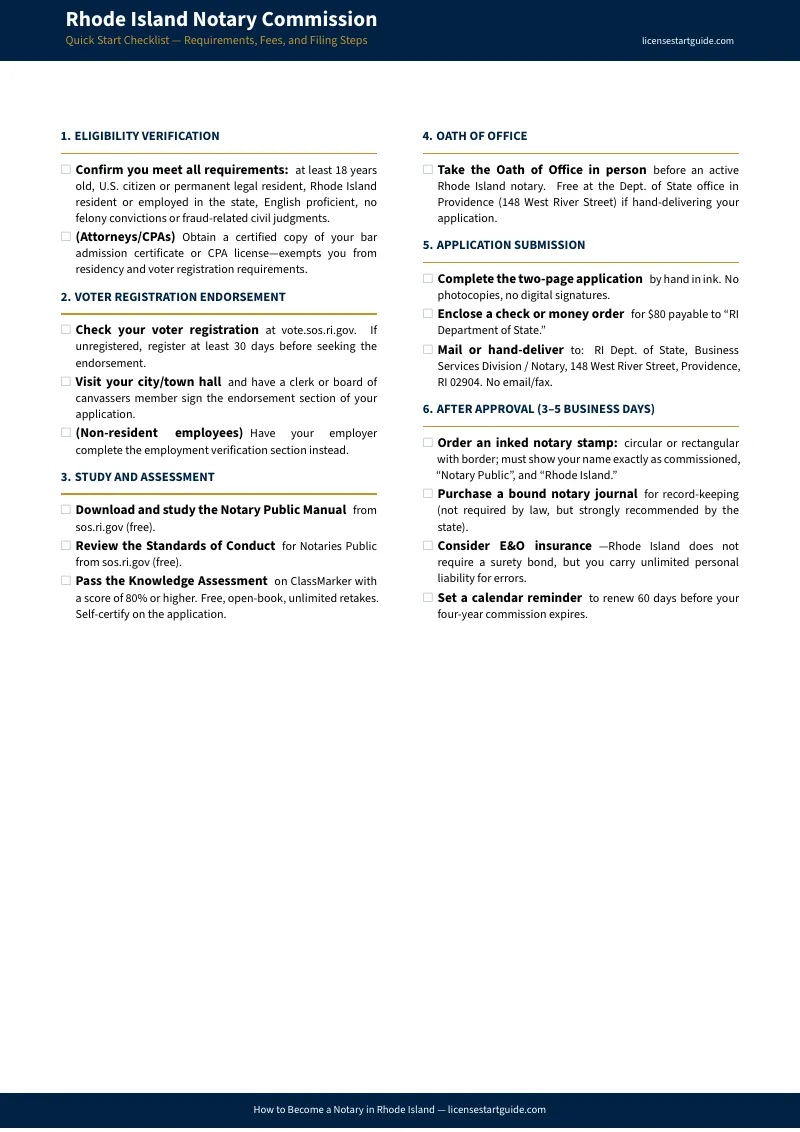
This guide is built around the reality that Rhode Island's commissioning process is almost entirely paper-based and that every dollar you spend on it is at risk until the commission certificate arrives. Instead of listing requirements and leaving you to guess the sequence, the Paper-First Compliance System walks you through each step in the exact order the state expects it — so you confirm eligibility, secure the voter endorsement, pass the knowledge assessment, and verify your application packet before mailing it with the $80 fee.
The system extends past the initial application. The 2026 deed fraud protections under Senate Bill 2715 now let municipal recorders cross-reference your notary commission details on every real estate filing — and flag the document if your information doesn't match state records. The guide covers how to keep your commission data accurate and how to exercise your new statutory right to refuse service when identity proofing falls short.
What's Inside
- Eligibility Self-Assessment — age, citizenship, residency rules, and the professional exemptions for attorneys and CPAs who bypass the standard residency requirement. Check every box before you touch the application form.
- Voter Registration Endorsement Walkthrough — the endorsement is not a reference letter. It's an on-form signature from a registered Rhode Island voter. The guide explains who qualifies, how to verify their registration status, and the separate rules for non-resident employees.
- Knowledge Assessment Study Plan — the exam is free, online, and open-book with an 80% passing threshold. The guide identifies the key sections of the Notary Public Manual and Standards of Conduct that the assessment draws from, so you study what matters instead of reading 40 pages of procedural language.
- Application Checklist — a verification pass through every field, signature, and enclosure before you seal the envelope. The state rejects incomplete applications without refunding the $80 fee, so the checklist catches missing endorsements, unsigned pages, and photocopied sections that should be originals.
- Supply Cost Separator — a clear breakdown of what Rhode Island law requires (inked stamp with border, round or rectangular) versus what vendors sell as mandatory. No bond. No required journal. No paid training. The guide isolates your true startup cost so you can compare it against vendor bundles.
- 2026 Deed Fraud Compliance Guide — Senate Bill 2715 gave municipal recorders the authority to flag notarized real estate documents where commission details don't match state records. The guide covers how to respond to recorder inquiries, when to exercise the new right to refuse service, and how House Bill 8060's anti-impersonation provisions affect your liability.
- Fee Cap and Travel Fee Reference — Rhode Island caps notarial fees at $25 per act under RIGL § 42-30.1-20.1. Travel fees are permitted by mutual agreement, but the rules are scrutinized. The guide explains what you can charge, how to disclose it, and where the statutory boundaries are.
- RON Endorsement Roadmap — Remote Online Notarization is not a separate commission; it's an endorsement on your active traditional commission. The guide covers approved platform selection, digital seal requirements, the Information Update Form filing, and why consumer video tools are prohibited.
- Renewal Timeline and Grace Period — the four-year commission term, the 60-day advance application window, the same $80 renewal fee, and the 30-day grace period that lets you keep notarizing while your renewal processes. Miss the window and there's a gap in your authority.
- Common Mistakes Reference — the application-stage errors that trigger rejection (photocopies, missing endorsements, unsigned pages) and the operational mistakes that create liability (notarizing for family members, exceeding authority, failing to verify identity). Each mistake is paired with the specific statute or rule it violates.
Who It's For
- Administrative professionals whose employers need in-house notarization and can't afford to waste the company's $80 on a rejected application. The guide gets you commissioned correctly on the first attempt, with no vendor upsells and no missed steps.
- Real estate and title workers who need a commission for closings and need to understand how the 2026 deed fraud protections affect notarized real estate filings — without learning it the hard way when a municipal recorder flags your work.
- Legal-support professionals who notarize affidavits, depositions, and powers of attorney and need to understand Rhode Island's personal interest restrictions, the unauthorized practice of law boundaries, and the fee disclosure requirements that apply to every notarial act.
- Side-business starters building a mobile notary or loan signing practice who need to separate the real $80 state path from vendor bundles that add $100+ in products the state never required — and who need to understand that Rhode Island's $25-per-act fee cap means the income math works differently than the influencer videos suggest.
Why Not Just Use the State Website?
The Department of State's website publishes the forms, the Notary Public Manual, the Standards of Conduct, and the RON registration information. It does not sequence them. The application form doesn't explain that your voter endorser must be a registered Rhode Island voter specifically — not just a state resident. The training page doesn't tell you which sections of the manual the knowledge assessment actually draws from. The RON page doesn't warn you that buying digital tools from a non-approved vendor means you'll need to re-purchase from an approved one.
Competitor sites are worse. One national training school incorrectly lists the Rhode Island commission term as five years (it's four). Another lists voter registration as an eligibility requirement (it isn't — the voter registration endorsement is a character reference from someone else, not a requirement that the applicant be registered). These errors don't just confuse applicants — they lead to applications built on wrong assumptions, submitted with wrong information, and rejected with no refund.
This guide fills the gap between the information the state publishes and the chronological order you need to follow to get commissioned without wasting fees, time, or professional credibility.
What's Included
Your purchase includes 10 PDFs, available for immediate download:
- guide.pdf — The complete 13-chapter guide with 3 appendices covering eligibility, voter endorsement, knowledge assessment, oath, application, supplies, performing notarial acts, fee caps, commission ownership, renewal, electronic and remote notarization, mobile notary business considerations, and common mistakes.
- checklist.pdf — A printable 21-item checklist that sequences every step from initial eligibility through your first notarial act.
- eligibility-self-assessment.pdf — A fillable worksheet to confirm every eligibility requirement before you start the application, including professional exemptions and fee exemptions.
- application-pre-flight-checklist.pdf — A verification pass through every field, signature, and enclosure before you seal the envelope and risk the non-refundable $80 fee.
- commission-timeline-tracker.pdf — A fill-in tracker for every milestone from eligibility confirmation through your first notarization, with target dates and key commission dates.
- notarization-log.pdf — A structured journal template for recording each notarial act, signer identity, fees charged, and location — print as many copies as you need.
- supply-cost-worksheet.pdf — A vendor comparison worksheet that separates required supplies from vendor upsells, with space to track quotes and calculate your actual startup cost.
- ron-registration-checklist.pdf — Step-by-step checklist for registering as a Remote Online Notarization provider, including vendor details and operating requirements.
- renewal-checklist.pdf — A complete renewal workflow with key dates, all renewal steps, and post-renewal verification items to avoid gaps in your authority.
- signer-verification-form.pdf — A per-appointment form covering identity verification, willingness and competency checks, and conflict-of-interest screening — print multiple copies.
Satisfaction Guarantee
If the guide doesn't help you navigate the Rhode Island commissioning process more confidently, email [email protected] and we'll make it right.
Get Started
Download the free checklist to see how the Paper-First Compliance System works. When you're ready for the full guide — with the application walkthrough, voter endorsement instructions, supply cost separator, deed fraud compliance guide, and the complete 13-chapter reference — get the complete toolkit for .