Oregon's electrical licensing system has a rejection problem — and it's not the exam
Most Oregon electricians who get delayed aren't stuck because they can't pass a test. They're stuck because they mailed in a paper application packet that the Building Codes Division sent back.
The BCD doesn't accept email submissions. They don't accept digital uploads. You print out Form 440-2570 and 440-2570A, get your former employers to fill in handwritten hour breakdowns by category, and physically mail the whole stack to Salem. If one date range doesn't match, one signature line is blank, or one work category exceeds the 300 Percent Rule cap you didn't know existed — the BCD returns the packet and your 2–3 week evaluation clock resets to zero. Your application fee isn't refunded.
That's before you even reach the exam. And the exam has its own administrative trap: a 60-day authorization window that starts counting down the day the BCD mails your letter, not the day you open it.
The Oregon Dual-Agency Licensing Navigator
This guide maps the full licensing path across both state agencies — from your first BOLI apprenticeship enrollment through your first permitted project as an independent contractor. The reason it works where pieced-together government website instructions don't: Oregon's electrical licensing involves two separate state agencies (BCD for individual credentials, CCB for business licenses), each with different forms, different portals, and different timelines — and neither agency's website tells you how their process connects to the other's.
The Dual-Agency Licensing Navigator puts the steps from both agencies into one chronological sequence, with the exact form numbers, the documentation each form requires, and the rejection triggers that cause the most common delays. You handle the zero-cost steps first, avoid submitting paperwork that isn't ready, and never pay a non-refundable fee before you've confirmed eligibility.
What's inside the guide
- The BCD-to-CCB process map — Oregon's dual-agency system explained from the perspective of someone actually navigating it. Why you need credentials from both agencies, how the Responsible Managing Individual model links them, and the three conflations that lead to rejected paperwork or illegal contracting.
- License class comparison — General Journeyman, General Supervising, Limited Residential, Limited Maintenance, Class A/B Limited Energy, and Plant Journeyman compared side-by-side. Work scope boundaries, hour requirements, and which class matches your actual career plan — because picking the wrong one means accumulating hours the BCD won't credit toward the license you actually need.
- BOLI apprenticeship enrollment guide — approved program types (union JATC and non-union IEC/ABC), the algebra or Integrated Math 2 prerequisite that catches career changers off guard, and why hours logged before formal BOLI registration don't count toward your license — even if they were legitimate electrical work under a licensed supervisor.
- The 300 Percent Rule hour-tracking system — at least 1,000 hours each in residential, commercial, and industrial, the cap that limits credit from any single category to three times its minimum (3,000 hours), and a printable tracker that organizes your verification forms so you catch disqualified hours before the BCD does. This single rule is responsible for more delayed applications than any exam failure.
- Application packet assembly guide — Form 440-2570 and 440-2570A walkthroughs, the physical mailing requirement, the employer verification process, and the specific clerical errors (mismatched date ranges, missing signatures, incomplete duty descriptions) that trigger the most application returns.
- Exam logistics sequence — the 60-day Letter of Authorization window, PSI scheduling at community college testing sites across the state (Chemeketa in Salem, Rogue in White City, Portland CC), the open-book OESC 2023 format, retake rules under OAR 918-030-0060, and the four-attempt cap that requires board permission to exceed.
- Out-of-state reciprocity assessment — the seven states with active General Journeyman agreements (Washington, Idaho, Montana, Wyoming, Utah, Maine, Arkansas), the specific conditions that qualify or disqualify Washington applicants, and the 16,000-hour documentation pathway for non-reciprocal credentials. Includes a self-audit so you can evaluate your eligibility before paying non-refundable application fees.
- Supervising electrician advancement — the additional 8,000 journeyman-level hours required for the General Supervising (S) credential, the signing supervisor legal responsibilities, the five-day termination notification rule, and why you need this specific credential before any business you're associated with can pull permits.
- CCB contractor business launch sequence — the 16-hour pre-licensure course, business and law exam, Secretary of State entity filing, the $20,000 surety bond minimum under HB 2922, liability insurance, and the BCD Electrical Contractor (C) license that links your business to its signing supervisor — all in the order that avoids paying fees before you're eligible for the next step.
- Permit and inspection jurisdiction map — how statewide licensing and localized permitting authority work together, the ePermitting portal, how to identify whether your project site falls under a state-administered or municipally-administered jurisdiction, and the homeowner self-installation exemption.
- Triennial renewal and CE tracker — renewal cycles for each license class, the breakdown between Oregon Rule & Law (ORL), Code Change (CC), and Code-Related (CR) continuing education hours, late fees, the address-update requirement, and the grace period rules for lapsed licenses.
- Penalty reference — civil penalties for unlicensed work of up to $4,000 for a first offense and up to $5,000 for later violations or property damage, the distinction between working without an individual credential and unlicensed contracting, how BCD complaint investigations work, and when the situation calls for a lawyer rather than a self-correction.
What's included
Your purchase includes 11 PDFs, available for immediate download:
- guide.pdf — The 13-chapter Dual-Agency Licensing Navigator from BOLI enrollment through your first permitted project.
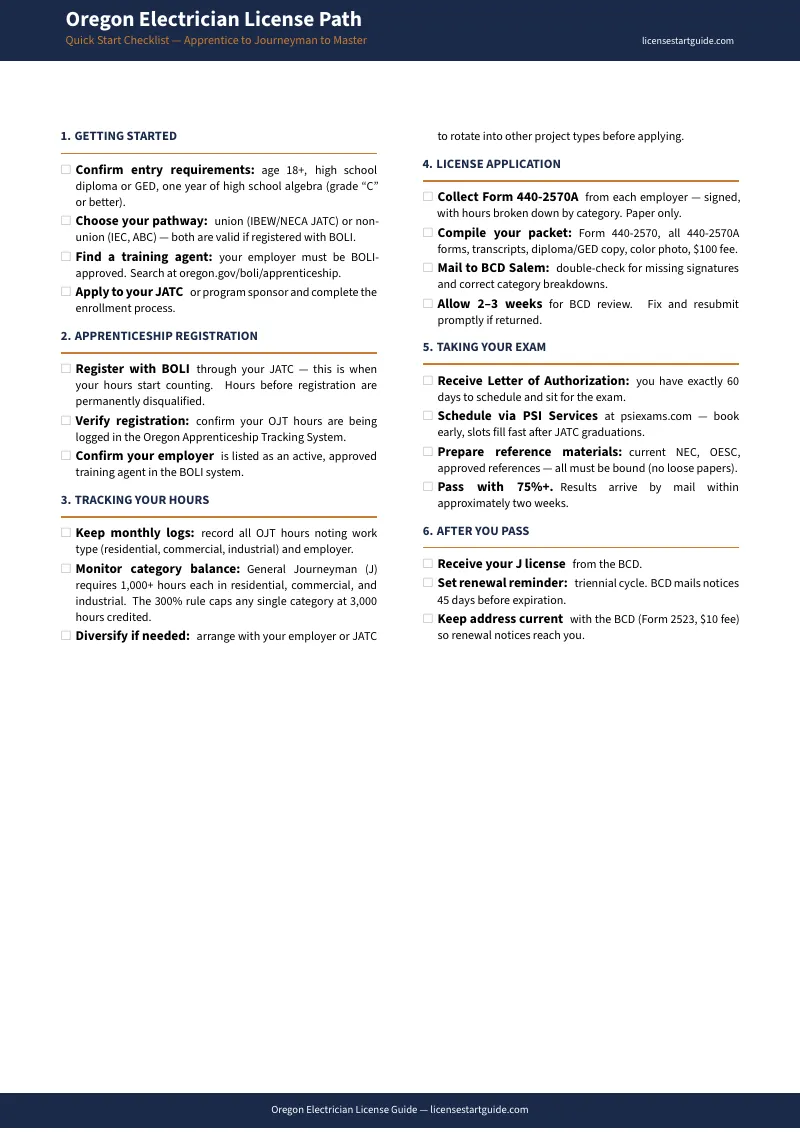
- checklist.pdf — Printable quick-start checklist of key steps, forms, and documentation.
- 300-percent-rule-hour-tracker.pdf — Monthly OJT log by category with the 300% credit check before you mail Form 440-2570A.
- application-packet-walkthrough.pdf — Form 440-2570 / 440-2570A packet assembler with the clerical errors that trigger returns.
- reciprocity-self-audit.pdf — Direct reciprocity vs. 8,000-hour or 16,000-hour equivalency, before you pay the non-refundable fee.
- dual-agency-process-map.pdf — BCD + CCB sequence so you never file a business registration you cannot permit under.
- exam-logistics-timeline.pdf — 60-day Letter of Authorization window, PSI booking, 30-day retake wait, four-attempt board-permission rule.
- contractor-business-launch-sequence.pdf — SOS, C license, 16-hour course, bond, insurance, and CCB registration in order.
- triennial-renewal-ce-tracker.pdf — ORL / Code Change / Code-Related log, 45-day notice window, one-year expired/renewable grace.
- permit-jurisdiction-worksheet.pdf — One sheet per job: ePermitting vs. DevHub vs. municipal, 180-day start clock.
- supervising-electrician-advancement.pdf — Extra 8,000 journeyman-level hours, S-exam packet, five-day termination notice.
Who this is for
- Apprentices preparing for journeyman — you're approaching 8,000 hours and need to compile your verification forms, understand the 300 Percent Rule before it disqualifies documented hours, and submit a paper application packet that won't get returned.
- Journeymen advancing to supervising — you want the General Supervising (S) credential for career advancement or to serve as the signing supervisor for a contracting business. The guide covers the additional qualification requirements and the legal responsibilities the designation carries.
- Out-of-state electricians relocating to Oregon — you have an active license from another state and need to know whether you qualify for reciprocity or must go through the equivalency pathway. The self-audit framework saves you from paying non-refundable application fees before you know if your credentials meet Oregon's requirements.
- Licensed electricians starting a business — you hold your individual BCD credential and want your own contracting operation. The guide sequences credentials from both agencies in the order that avoids wasted fees, so you're not paying for a CCB registration before your BCD Electrical Contractor license is ready.
- Career changers entering the trade — you're exploring electrical work as a career and need an objective map of the pathway before committing to a program. The guide distinguishes between registered apprenticeships that lead to licensure and private trade schools that charge $15,000–$25,000 but may not meet BOLI requirements.
Why not piece it together from government websites?
You can assemble most of this information yourself. The BCD website has the forms. The CCB website has the business registration requirements. BOLI's apprenticeship division has the program directory.
The problem is that each agency's site describes its own process in isolation. The BCD doesn't explain what you need from the CCB before your business can operate. The CCB doesn't tell you that your contractor registration is useless without a BCD Electrical Contractor license linked to a signing supervisor. Neither site explains the sequence — which forms to submit first, which fees are non-refundable, which steps have to happen before others.
Exam-prep companies (RocketCert, Jade Learning) sell study materials starting at $39–$349, but they focus on the technical exam content, not the administrative process of qualifying for the exam in the first place. If your application packet is incomplete, you're not eligible to schedule the test — no amount of exam prep fixes that.
The guide fills the gap between what the agencies publish and what you actually need to know to navigate the process without delays, rejected applications, or wasted fees.
100% satisfaction guarantee
If the guide doesn't save you time and confusion navigating Oregon's licensing process, email [email protected] for a full refund. No forms, no hoops.
Start with the free checklist — or get the full guide
The free Oregon Electrician License Path Checklist covers the key steps and documentation requirements in a printable one-page format. It's a solid starting point if you want to audit where you stand before committing.
The full Oregon Electrician License Guide goes deeper — 13 chapters covering every step from apprenticeship enrollment through business launch, with form walkthroughs, the 300 Percent Rule hour tracker, reciprocity self-audit, and the dual-agency sequencing that keeps your paperwork moving instead of getting returned. For less than the cost of a single non-refundable application fee, you get the process mapped out before you start spending.