Three Agencies, Zero Coordination, and a 180-Day Clock You Can't Pause
You've been watching neighborhood kids for a while. Maybe it's your neighbor's toddler, a coworker's preschooler, a relative's infant on weekdays. And now someone is asking about subsidy vouchers — or a fifth family wants in. You know that means a license. What you don't know is that Ohio's licensing pipeline splits across three separate authorities that never talk to each other: the state DCY for your license, your county JFS for inspections and subsidies, and your municipal government for zoning, fire, and business permits.
The information is technically available. The DCY website has the application forms. OCCRRA has the training catalog. Your city hall has the zoning ordinance. But none of them tell you what order to do things in. So you end up paying $99 for your LLC and $60 for fingerprinting before you find out your HOA prohibits commercial activity. Or you pass every check except the one where your outdoor play area doesn't meet the 60-square-foot-per-child fencing requirement you didn't know existed.
The Licensing Sequencer
This is a 12-chapter guide built around one principle: never spend money before you're cleared to proceed. Every step is ordered so that zero-cost feasibility checks come first — your zoning status, your landlord approval, your indoor space measurement — and non-refundable fees only come after you've confirmed your home qualifies.
The guide covers Ohio's three-layer regulatory system — state DCY rules, county JFS inspection protocols, and the municipal requirements that are genuinely different in Columbus, Cleveland, Cincinnati, and every other jurisdiction. You won't confuse your state childcare license with your city business license, and you won't discover a Council Variance hearing three weeks before you planned to open.
What's Inside
- License type decision framework — Type B (1–7 children, zoning-protected under ORC 5104.054) versus Type A (8–14 children, subject to commercial building codes and municipal zoning hearings). The guide walks through the tradeoffs so you pick the right category before filing anything.
- Feasibility-first sequencing — the first steps cost you nothing. You verify zoning, landlord consent, HOA restrictions, and physical space requirements before paying a single licensing fee. If your home can't pass, you find out before you've invested.
- Background check filing guide — BCI and FBI fingerprinting through WebCheck is required for you, every staff member, and every household member age 18+. The guide gives you the exact reason codes (BCI 5104.013, FBI CCDBGA), the routing instructions to hand the WebCheck operator, and a household member tracker so nobody gets missed.
- Pre-licensing training roadmap — the mandatory Family Child Care Pre-Licensing Training modules on the Ohio Professional Registry, plus Pediatric CPR and First Aid certifications. Includes the validity windows, approved providers, and how to log everything on your OPR profile.
- Room-by-room inspection checklist — county JFS specialists check 35 sq ft of indoor play space per child, outdoor fencing, water temperature under 120°F, firearms storage, smoke detectors on every level, carbon monoxide detectors, and safe sleep surfaces. The guide includes an item-by-item pre-audit so you can self-inspect before the specialist arrives.
- Capacity and ratio tables — the 1:7 staff-to-child ratio, the three-under-two cap, how your own children under six count toward every limit, and when a second staff member must be present. Includes a worksheet to calculate your actual available slots.
- Municipal requirements by city — Columbus Council Variances and BZS inspections, Cleveland's annual Daycare Permit and Board of Zoning Appeals process, Cincinnati's zoning district restrictions, and the specific contacts for each office. Because what's required in Columbus doesn't apply in Cleveland, and neither applies in a rural township.
- Landlord and HOA navigation — how ORC 5104.054 protects Type B homes from municipal zoning blocks but does not override private lease agreements or HOA covenants. Includes a landlord consent approach and the specific questions to ask your HOA board.
- SUTQ and subsidy enrollment — the Step Up To Quality rating process (Bronze 10%, Silver 15%, Gold 25% payment enhancements), PFCC provider enrollment, and how county JFS offices process weekly payments. If you're building a business around subsidized families, this is the revenue chapter.
- Insurance, taxes, and ongoing compliance — liability coverage requirements, the Tom Copeland method for in-home business tax deductions, what your individual child files must contain, and what happens during unannounced annual inspections after you're licensed.
Who This Is For
ECE professionals going independent. You've worked in center-based care for years. You know child development ratios and safety protocols cold. But you've never registered a business, filed fingerprint cards through WebCheck, or negotiated with a municipal zoning office. This guide handles the regulatory infrastructure so you can focus on the childcare.
Parents building a home-based income. You want to earn while staying home with your own kids — but you need to know how your children under six affect your licensed capacity, whether your rental lease allows commercial use, and what physical modifications your home might need. The feasibility steps answer all of that before you spend anything.
Informal caregivers going legal. You're already watching neighborhood children for pay, and the arrangement works. But a parent just asked about subsidy vouchers, or you've hit the limit of what unlicensed care allows, or you simply want the protections and reimbursement rates that come with a license. This guide gets you through the transition without guesswork.
Why Not Just Use the Free State Resources?
The DCY website has the application forms, the administrative code references, and a general overview of requirements. It does not tell you which requirements to complete first, how to coordinate the state application with your local city business license, or how to avoid paying for background checks before you've confirmed your zoning. It's a reference library, not a sequenced plan.
Regional CCR&R agencies — Starting Point in northeast Ohio, Action for Children in central Ohio, 4C for Children in southwest Ohio — offer free cohorts, consultations, and even startup safety kits. Their support is valuable but geographically limited, delivered over multi-week sessions, and focused on child development quality rather than the business formation and municipal navigation that trip up most applicants.
Wonderschool provides structured licensing coaching and management software. Their free tier leads into ongoing platform fees tied to your enrollment revenue — built for ongoing operations, not the one-time startup sprint.
This guide fills the gap between those resources: a one-time purchase that sequences every step from feasibility through your first year of compliance, then gets out of your way.
What You Get
Your download includes five printable PDFs:
- The full guide — 12 chapters covering license types, the licensing timeline, background checks, training, ratios, home inspection prep, zoning and HOA navigation, insurance and taxes, SUTQ and subsidies, records and compliance, transport rules, and common mistakes that delay applications.
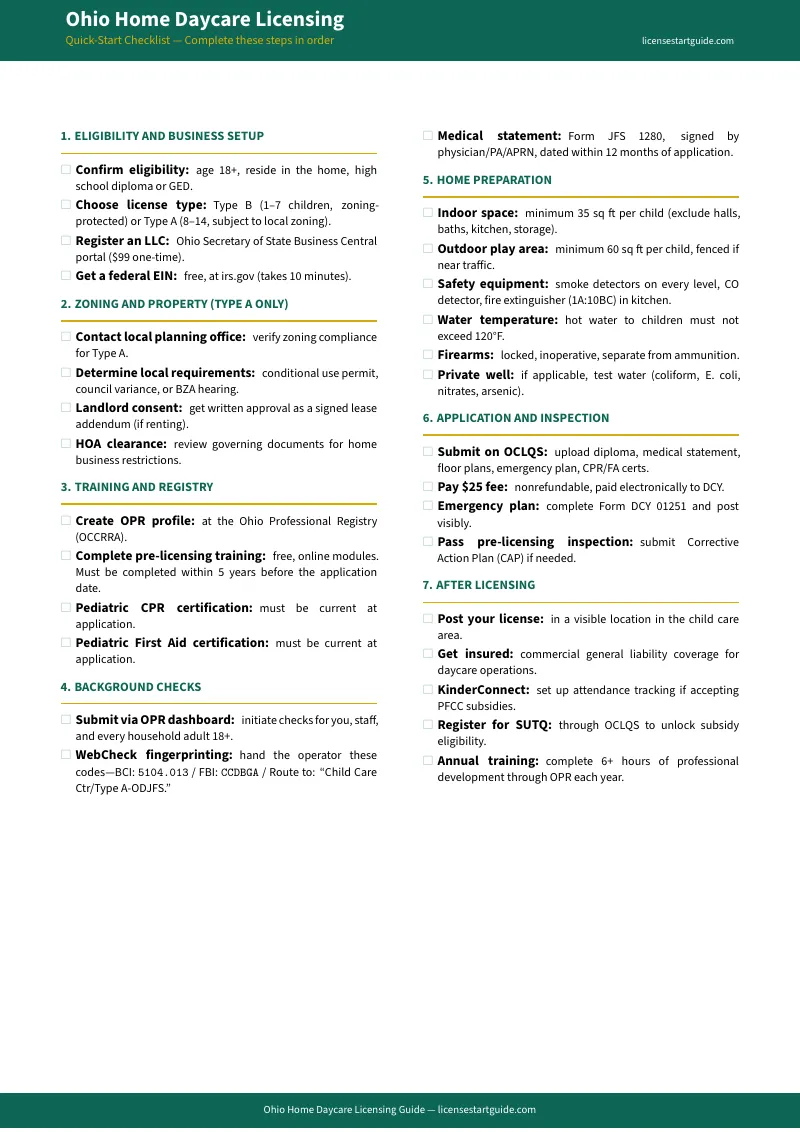
- Quick-start checklist — 28 items organized by phase, from eligibility verification through your first week of operation. Print it, work through it in order, check off each step as you go.
- Background check filing guide — the exact WebCheck reason codes (BCI 5104.013, FBI CCDBGA), routing instructions, and a household member tracker. Print it and bring it to the WebCheck location.
- Inspection prep checklist — a room-by-room pre-audit against OAC Chapter 5180 standards with checkboxes for every item the county specialist will check.
- Capacity worksheet — calculate your actual available enrollment slots after accounting for your own children under six, the under-two cap, and your indoor/outdoor space.
Satisfaction Guarantee
If the guide doesn't help you move forward, email us and we'll refund you. No time limit, no hoops.
Download the free checklist to see the structure. When you're ready for the full sequenced guide with municipal breakdowns, background check scripts, and inspection prep checklists, the complete toolkit is waiting.