You Can Run Pipe. The Licensing System Is the Problem.
You can solder copper in a crawl space, rough-in a new-construction riser, and troubleshoot a backflow assembly by sound alone. None of that matters to the State Board of Examiners of Plumbing, Heating and Fire Sprinkler Contractors until you prove your experience on paper, in hours that were earned as a W-2 employee, verified by employers who may no longer be in business — and you submit everything in exactly the order the Board expects.
North Carolina's plumbing licensing system has traps that working plumbers walk straight into. The state does not issue journeyman or master licenses — despite what ServiceTitan, HouseCall Pro, and half the plumbing forums on the internet say. The real classifications are Plumbing Technician (Class I and Class II) and Plumbing Contractor (Class I and Class II), and mixing up the terminology means applying for the wrong license. If your hours were accumulated under a 1099 arrangement instead of as a W-2 employee, the Board will reject your entire experience record — even if you worked for the same contractor for ten years. The non-refundable $150 application fee is gone regardless.
And passing the exam is not the finish line. North Carolina runs a dual-authority system: the state Board licenses you, but every city and county enforces its own building codes, permits, and inspections independently. Charlotte requires a $2,000 surety bond before you touch a permit application. Raleigh has separate permitting rules for water-heater replacements. Wilmington's New Hanover County enforces the state code through County Citizen Self Service — local journeyman cards are gone as of April 20, 2026.
The NC Plumber Licensing Navigator maps the complete administrative path from unlicensed helper to independently operating contractor. It covers the four licensing pathways (Technician Class I, Technician Class II, Contractor Class I, Contractor Class II), the experience verification process, the out-of-state transfer options, business entity setup, and the metro permitting systems in Charlotte, Raleigh, and Wilmington. This is not exam prep. It does not sell code books or study courses. It shows you how to get through the paperwork, protect your application fee, and avoid the compliance gaps that shut down projects.
What's Inside the Guide
You get the 14-chapter process guide, the 24-item licensing checklist, and ten fillable worksheets — everything you need to navigate from first application through your first local permit:
- License Classification Decision Sheet — One-page write-in: check Technician Class I or II, Contractor Class I or II, RLP, or LPWHR against hour thresholds (2,500 to 4,000) and academic-credit rules (up to 50% of Contractor hours).
- W-2 Employment Audit — Per-employer tax-record table (W-2 vs 1099) so you catch misclassified hours before you pay the non-refundable $150 application fee.
- Experience Hours Tracker — Landscape log for employer, date range, W-2 status, hours, residential vs commercial work, and running total.
- Employer Verification Checklist — One sheet per supervising licensee for the Board's Current / Past NC Licensed Employer Statement: notary date, two-week mailing of originals, and refusal/closed-shop fallbacks.
- Application Package Checklist — Packet checklist for the $150 exam application, CastleBranch background check, transcripts, and Notice of Eligibility / 90-day window dates.
- Out-of-State Transfer Maps — Fillable filing sequences for the South Carolina Technical Exam Waiver ($30, Business and Law exam still required) and the Neighbor State License Recognition Act (NC residency + GA/SC/TN/VA/WV license + four-hour Raleigh class).
- Exam Preparation Timeline — 90-day countdown from Notice of Eligibility: seven PSI centers (Asheville through Wilmington), book/tab rules, 70% passing score, and retake log (90-day wait + paper Re-Examination Application + $150).
- Qualifying Party Setup — 45-day activation, Secretary of State entity, one-location-per-licensee rule, active-duty supervision, insurance, and what happens if the qualifying party leaves.
- Municipal Registration Tracker — Landscape log for Charlotte/Mecklenburg (Accela ePermits, $2,000 city / $1,000 county bond), Raleigh/Wake (Permit and Development Portal, water-heater permit even like-for-like), and Wilmington/New Hanover (County Citizen Self Service).
- Annual Renewal Reminder — October 1 through December 31 checklist: $75 technician / $150 contractor fee, Public Notice Statement, $25 late fee after January 31, and the three-year retirement rule. SP-PH CE lives here if you hold that separate electrical credential; the discipline pipeline stays in the guide.
Who This Is For
- Apprentices and helpers preparing their first application who need to verify that their hours are properly documented as W-2 employment, understand the difference between Technician and Contractor tracks, and submit a complete application that does not get rejected on paperwork alone
- Licensed Technicians pursuing Contractor status who need the additional 1,000 hours of qualifying experience, the Contractor exam sequence, and the business entity requirements that separate personal licensure from the authority to contract independently
- Out-of-state plumbers relocating to North Carolina who assume reciprocity exists and need to understand the two narrow transfer options, both of which still require passing a North Carolina exam or attending a mandatory Board class
- Newly licensed contractors pulling their first permit who discovered that a state license does not authorize them to start work — and need to navigate Charlotte's bond requirement, Raleigh's portal system, or Wilmington's permit expiration rules before the project can begin
Why Not Just Use the Free Information?
The Board's website publishes the statutes, the application forms, and the fee schedule. PSI lists the exam centers. Charlotte, Raleigh, and Wilmington each have permitting portals. The information is technically available.
But it is scattered across a state Board site that acts as a regulator — not a process guide — and dozens of municipal building department pages that do not link to each other and do not tell you what order to file things in. The most common Google results for "North Carolina plumber license" still describe a journeyman-to-master progression that does not exist in this state. Commercial blogs from ServiceTitan and HouseCall Pro publish license class descriptions that mix up state-level classifications with employer-given titles, leaving readers applying for credentials the Board has never issued.
Exam prep companies charge $300 to $500 for code study courses. Those cover the technical exam. They say nothing about the W-2 employment mandate, the employer statement filing process, the out-of-state transfer options, or the metro permitting layer — the administrative pipeline that determines whether you can legally operate after you pass.
This guide costs less than a single application fee and covers everything the exam prep providers and free blogs leave out.
Satisfaction Guarantee
If the guide does not help you navigate the North Carolina plumber licensing process more clearly, email us and we will refund your purchase. No forms, no questions.
Start Your Licensing Path
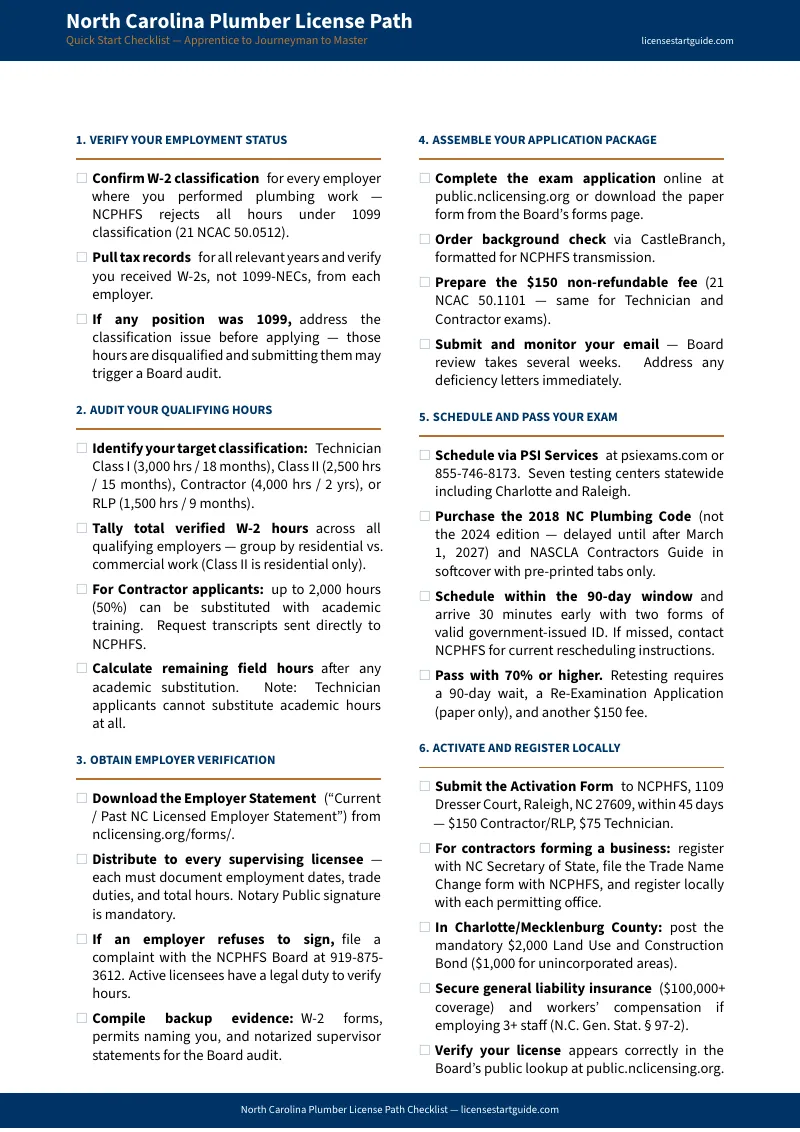
Download the free checklist to see the full apprentice-to-contractor timeline at a glance, or get the complete guide to navigate every step from experience verification through your first local permit.
The Board's exam authorization windows, PSI's scheduling calendar, and your municipality's permit cycle all run on their own clocks. The W-2 verification rules, the employer statement deadline, and the three-year license retirement rule do not wait for you to figure out the system. Getting organized before you start filing is the single highest-value move you can make.
Get the full North Carolina Plumber License Guide for and stop guessing your way through the licensing maze.